
Mintlify: A Documentation System Rebuilt with AI as Its God
Mintlify, the AI documentation platform valued at $500 million, makes documentation serve humans and AI at once, with structured Markdown content, an llms.txt machine directory, and real-time MCP queries. Anthropic, X, and PayPal all use it.

Mintlify: A Documentation System Rebuilt with AI as Its God
Mintlify, the AI documentation platform valued at $500 million, makes documentation serve humans and AI at once, with structured Markdown content, an llms.txt machine directory, and real-time MCP queries. Anthropic, X, and PayPal all use it.
If you are building a developer-facing product, whether AI can understand your technical documentation is fast becoming more important than how beautiful the layout looks. Mintlify is a startup that builds its product around technical documentation, and its core idea is: redesign the documentation system with AI as the user, so that docs can be consulted by humans and also read and called by AI directly.
Anthropic, X, PayPal, and others are all using Mintlify today; its ARR (annual recurring revenue) has reached $10 million, and it is valued at $500 million.
Why Documentation Needs an AI-First Rebuild
Developers increasingly ask their questions directly inside Cursor, Claude Code, or GitHub Copilot and let the AI consult the documentation before answering. Mintlify's data makes this vivid: documentation sites hosted on the platform have received about 790 million requests, of which requests from AI coding agents account for 45.3% -- nearly on par with traditional browser traffic. Claude Code alone has generated about 199 million requests.
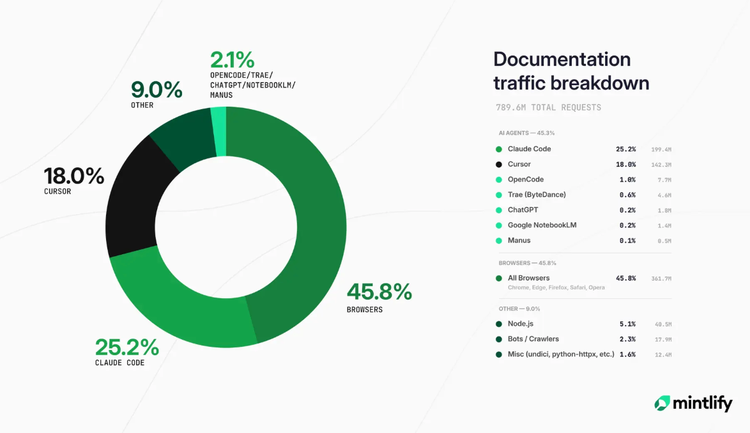
AI agent requests now account for 45.3%
The problem is that traditional documentation is designed for humans, so AI reads it inefficiently and error-prone. When information is outdated, the AI takes it at face value; when the structure is messy, the AI's understanding skews. Mintlify offers a complete solution to exactly this problem.
Core Features
Layer 1: Structured Markdown content
Every documentation page has a corresponding Markdown version that strips away visual structure and keeps only the content, letting AI process it faster while consuming fewer tokens.
Layer 2: llms.txt, a machine-readable directory
It automatically generates an llms.txt file -- a table of contents made specifically for AI, listing the most important pages of the documentation with concise text descriptions. It also provides llms-full.txt, which consolidates the entire documentation site into a single file so AI tools can grab the complete context in one go.
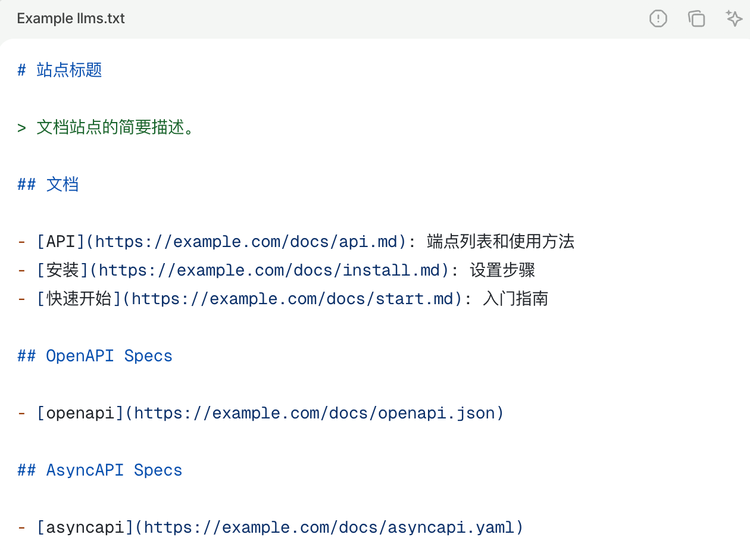
Mintlify's AI documentation architecture
Layer 3: MCP server for real-time queries
An MCP server lets AI query the latest documentation when answering a question, instead of relying on memories from its training data that may already be outdated.
Layer 4: skill.md capability descriptions
It describes the product's capability boundaries to AI -- what operations the product can perform, what inputs it needs, and what restrictions apply. If AI is going to call tools to carry out tasks, it needs to know this information.
Built-in AI assistant
The documentation comes with a built-in AI assistant, but it does not do a naive search across the entire knowledge base. It works only around the current document's content: it first searches the documentation for relevant material, then generates an answer grounded in that content, with citations to the specific pages.
Automatic documentation maintenance
When an engineer commits a change to the code repository, the system reads the code diff, determines which features have changed, and generates a documentation update draft accordingly, submitted as a Pull Request for review.
Pricing
Mintlify offers a free plan and paid plans, with exact pricing tailored to team size and feature requirements. The enterprise tier supports custom domains, SSO single sign-on, advanced analytics, and more.
Who It's For
- Developer tools / SaaS products: if your product needs API documentation, Mintlify can serve human developers and AI coding tools at the same time
- Enterprise internal knowledge bases: structure scattered internal documents so enterprise AI Agents can retrieve information accurately
- Open-source projects: help AI tools understand and recommend your project better
- Technical blogs / tutorial sites: improve your content's discoverability in the AI era
Official Website
Toolin Editorial Team
Categories
Related articles
Hands-On Methods for Running 4 High-Frequency Office Scenarios with an Agent
From viral-article breakdowns to business-trip itineraries, from knowledge management to short-video production — build zero-code automation workflows with bit-Agent's "explore-then-solidify" pattern.

OpenAI Codex Advanced Guide: 7 Tips from the Official Team
A member of the official Codex team shares how to push Codex to its limits, combining durable threads, voice input, steering, automations, and goal setting.

SenseNova-Skills: Hands-On with an Open-Source Office Agent Skill Pack
SenseTime open-sources SenseNova-Skills, an MIT-licensed agent skill pack covering four office scenarios — data analysis, deep research, PPT generation, and search — that runs in both Claude Code and ChatGPT.