
Claude Code vs Codex: A Panoramic Timeline of 24 Features
A timeline breakdown of the 24 features both AI coding agents share — Claude Code shipped 18 of them first, but the gap is now closing in days, not months.

Claude Code vs Codex: A Panoramic Timeline of 24 Features
A timeline breakdown of the 24 features both AI coding agents share — Claude Code shipped 18 of them first, but the gap is now closing in days, not months.
If you're torn between Claude Code and OpenAI Codex, a feature timeline compiled by developer Elie Bakouch is worth a look. He lined up, in chronological order, the 24 features both AI coding agents have shipped since launch. The verdict: Claude Code got to 18 of them first, Codex got to only 4 first — but the gap between them is evaporating on a scale of days.
The Headline Numbers
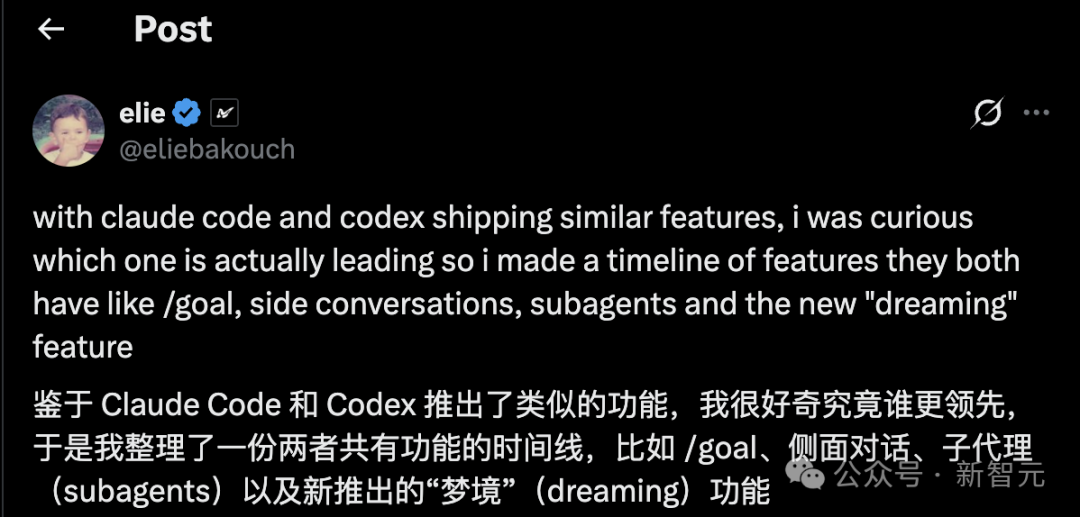
The timeline spans February 2025 to June 2026, with orange marking Claude Code and blue marking Codex. Each row is a feature both sides now have, or a close equivalent.
| Metric | Claude Code | Codex |
|---|---|---|
| Features shipped first | 18 | 4 |
| Contested items | 2 | 2 |
| Launch date | February 2025 | May 2025 |
| npm monthly downloads (last 30 days) | ~46.3 million | ~14 million |
| Weekly active users | ~2 million (third-party estimate) | 5 million+ (official figure) |
Feature-by-Feature Alignment
The 18 features Claude Code shipped first cover the core capability stack of the modern coding agent:
Key features Claude Code shipped first:
- Headless scripting
- Model Context Protocol (MCP)
- Custom slash commands
- Context compaction
- Subagents
- Lifecycle hooks
- Skills system
The 4 features Codex shipped first:
- Built-in sandboxing
- Cloud async agents
- Multi-agent parallel teams
- Goal mode
The 11-Day Catch-Up Cases
The most interesting data point is the speed of the chase. Of the 4 features Codex shipped first, 2 were matched by Claude Code within 11 days:
- Goal mode: Codex got there first; 11 days later Claude Code shipped
/goal - Multi-agent parallelism: Codex shipped first; Claude Code caught up in the same 11 days
First-mover advantage in AI coding tools is being eroded on a timescale of weeks.
Feature Convergence: Not Copying, Converging
The phenomenon most worth watching isn't who shipped what first — it's that the two tools are growing the same face.
The /goal command: Claude Code's /goal keeps executing across turns once a completion condition is set, with a small model judging each turn whether the condition has been met. Codex's Goal mode does exactly the same thing — given a persistent objective, it grinds through turn after turn for hours or even days without human supervision.
Subagents: Claude Code's subagents run in separate context windows, used to isolate context, constrain tools, and control costs. Codex runs subagent workflows through parallel specialized agents, then aggregates the results.
Skills format: both have adopted the SKILL.md format initiated by Anthropic — down to identical file names.
Dreaming mechanism: Anthropic built a self-improvement mechanism called dreaming for Claude Managed Agents, and OpenAI subsequently shipped a same-named dreaming memory system for ChatGPT.
This isn't one copying the other — it's the AI coding agent category itself converging on a fixed shape: long-running tasks, subagents, context compaction, permission sandboxing, workspace isolation, and a skills ecosystem.
Which One to Pick
Reasons to Pick Claude Code
- Terminal-first design philosophy, built for heavy developers
- 3x Codex's npm downloads, with a more mature community ecosystem
- Feature depth accumulated from an 80-day head start
Reasons to Pick Codex
- Multi-surface workbench (CLI + IDE + desktop app + mobile + cloud)
- 5 million+ weekly active users and fast growth (6x growth since February)
- First to ship key features like sandboxing and multi-agent parallelism
What Actually Decides It
The feature checklist is no longer a moat. The competition has escalated from "does it have this feature" to "how well is this feature actually built": who responds faster, completes long tasks at a higher rate, compacts context more cleanly, secures permissions better, and costs less.
If you're a developer, both are worth trying. Claude Code is more solid in the terminal; Codex has the edge in multi-surface collaboration. The final choice depends on your workflow.
Related articles
OpenFPM's Experimental Metal Backend: Running CUDA Programs on Apple Silicon
An experimental Metal backend PR for the open-source scientific computing framework OpenFPM runs original CUDA kernels nearly unchanged on an M3 Pro via Clang/HIP-SPIR-V-Vulkan-MoltenVK, with a measured ~10x speedup on a 3D SPH benchmark.

ChatCut: The Video Execution Layer Behind General Agents — Cut Video Through Conversation
From PaperCut to Codex/ChatGPT plugins, ChatCut is building the reliable, editable video execution layer behind general agents.

Claude's "Record a Skill": Screen Recording Plus Voice, One Click to a Reusable Skill
Hands-on with Anthropic's new feature: record your screen and narrate inside Cowork to auto-generate a reusable Skill, skipping the hand-written SKILL.md.

Qoder Security: Three Layers of Code Protection Inside the Session — a First in China with Same-Session Fixes
Alibaba's Qoder ships China's first three-layer in-session code security guard — vulnerability detection up 60%, false positives down 80%, enabled in 3 steps.

Tencent Miora: A Design Agent That Handles Images, Video, and Web Pages on One Canvas
Tencent's first design agent is now fully open — the whole pipeline from brief to delivery, everything built on Skills, with built-in memory and an inspiration library.

Hyra-1.0: Tencent Hunyuan's Scientific Discovery Agent
A research agent capable of recursive self-improvement, covering AI training optimization, open math problems, quantum computing, and drug design, with multiple records broken.