
GLM-5.2's Million-Token Context, Tested: An 85-Page World Cup Preview in One Click
Zhipu's GLM-5.2 supports a 1 million token context window and will be open-sourced under MIT next week; in testing it produced an 85-page World Cup preview deck, with multi-agent parallelism that beat expectations

GLM-5.2's Million-Token Context, Tested: An 85-Page World Cup Preview in One Click
Zhipu's GLM-5.2 supports a 1 million token context window and will be open-sourced under MIT next week; in testing it produced an 85-page World Cup preview deck, with multi-agent parallelism that beat expectations
GLM-5.2 is Zhipu's newly released large language model, supporting a 1 million token context window and being open-sourced under the MIT license. Inside the Claude Code framework it shows outstanding long-context handling, multi-agent parallel scheduling, and autonomous fact-checking. This article uses a hands-on project — an 85-page World Cup preview deck — to show how GLM-5.2 really performs on complex engineering work.
Key Highlights
GLM-5.2's key specs:
- Context window: 1 million tokens (1M)
- License: MIT, no geographic restrictions
- Open-source release: officially next week
- Positioning: Zhipu's strongest model to date, with a marked boost in engineering capability
The Project: An 85-Page World Cup Preview Deck
Task Definition
The goal is to turn every group-stage match of the 2026 World Cup into a complete preview deck, with these requirements:
- One page per matchup with national flags, kickoff time, venue, key players, core insights, and score predictions
- Matches already played use real results
- Plus an outlook page for each group and an overall cover
Final output: 1 cover + 12 group previews + 72 matches = 85 pages.
The First Hurdle: Autonomous Error Correction
Early in the task, GLM-5.2 ran into a classic trap: past World Cups had 32 teams and 48 group-stage matches, but the 2026 World Cup has been restructured to 48 teams in 12 groups — actually 72 matches.
It didn't just run with the wrong number; it stopped on its own initiative, cross-checked multiple sources including FIFA's official site and ESPN, and confirmed the correct figure of 72.
This ability to "know it might be misremembering" is a key indicator for judging a model's intelligence.
The Multi-Agent Parallel Architecture
Faced with 85 pages, GLM-5.2 didn't process them one by one in sequence; it automatically designed a five-layer pipeline:
- Single data source: everything starts from one data source to keep the data consistent
- 12 subagents in parallel: each researches one of the 12 groups and produces structured content
- Unified template rendering: the HTML is rendered from a single template to prevent style drift
- Batch aggregation: all pages are aggregated into an overview wall
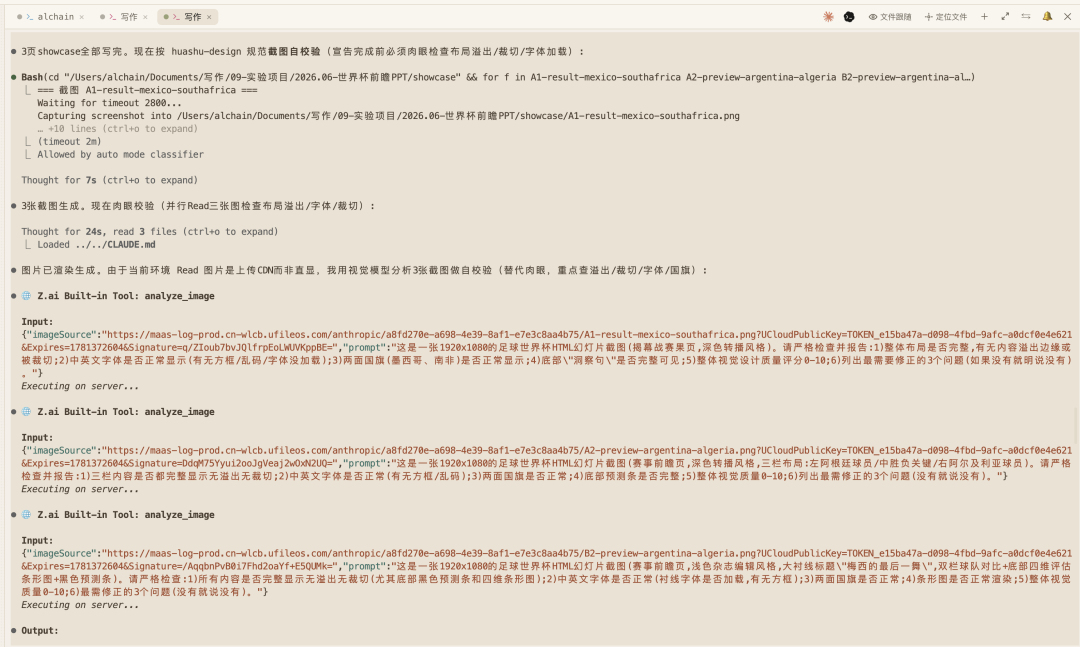
- Visual verification: a vision model is called in to check every page for overflow, clipping, and similar issues
The key design decision: subagents only produce structured content and never write HTML directly. That's the only way all 85 pages stay locked into a single visual system.
The Output
The full 85 pages landed in about an hour, with two style options to choose from:
- A broadcast-special style: deep charcoal background with gold scorelines
- A magazine-editorial style: paper white with large serif type
Across 72 matches the style stays unified, the information hierarchy is clear, and the key points, predictions, and data are all there.
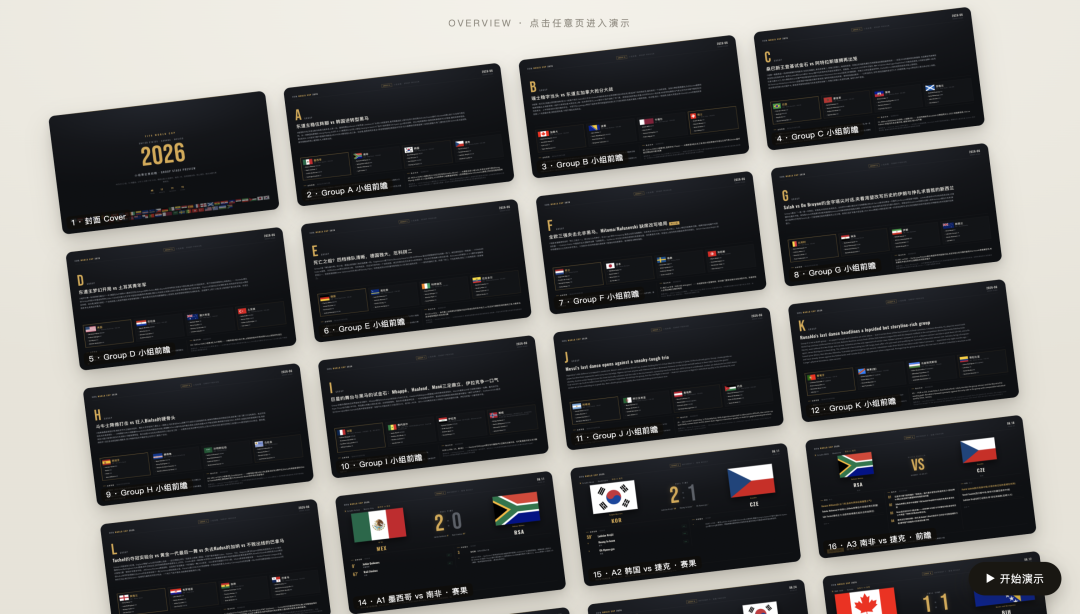
The information hierarchy is clear, and the style stays unified across all 72 matches.
As a text-only model, GLM-5.2 handles multimodal verification by calling a vision model, autonomously checking pages for overflow and clipping.
Engineering Capability Tests
Beyond the World Cup project, GLM-5.2 also passed a series of engineering capability tests:
Dynamic moon-phase clock: about 925 lines of pure front-end code with zero external dependencies, producing five layers of concentric SVG, seven gears, 60 minute markers, elliptical star trails, and a moon-phase dial. After finding a bug, it voluntarily tore the whole thing down and rewrote it, refusing to pile up tech debt.
3D penalty shootout: built with Three.js + Cannon.js, featuring five rounds of attack and defense, three AI difficulty levels, and Magnus-effect curve physics. It even consulted papers to get real biomechanical parameters for goalkeeper dives.
Mini Excel: spent an hour recreating the core desktop Excel experience in a pure browser environment, including a formula engine, 30+ functions, and 60-step undo/redo.

After discovering the moon-phase bug, GLM-5.2 rewrote it from scratch, replacing the mask approach with a double-arc path.

Every cited data source was verified — no fabricated content.
Strengths and Weaknesses
Strengths
- The 1M context genuinely delivers: long project specs and skills are still honored deep into the window — no "forgetting the beginning halfway through"
- Autonomous error correction: it stops to verify on its own when it hits a knowledge blind spot
- Multi-agent scheduling: large projects are split up and parallelized automatically
- Unrestricted open source: MIT license, no geographic restrictions, and the API can't be cut off without warning
Weaknesses
- Aesthetics need work: the visual appeal of generated interfaces has room to improve
- Occasionally uneven pacing: on complex tasks it sometimes thinks for a long time and is slow to output runnable code
- Occasionally seems stuck: you need to manually type a continue instruction
Recommendation
If you have a large project to complete, GLM-5.2 + the Claude Code framework is a very solid choice. In actual use, native Claude Code and Claude Code wired to GLM-5.2 have become hard to tell apart in output quality and interaction experience.
FAQ
- When will GLM-5.2 be open-sourced? Officially next week, under the MIT license.
- Does it support multiple languages? Yes — it performs well in both Chinese and English scenarios.
- How do I hook it into Claude Code? Just wire GLM-5.2 in as the backend model of the Claude Code framework.
Related articles

AutoMIA: Two Images In, a 3D-Printable Mirror Illusion Out — Runs on a Single RTX 3090
AutoMIA, a Tsinghua CVPR'26 Highlight open-source project, turns two input images into a 3D-printable voxel mirror-illusion art model (STL-ready) — single RTX 3090, 76 seconds per design.

Macaron-V1: An Open-Source Coding Model That Compresses Personalized Experience into LoRAs with MoL
Mind Lab open-sources Macaron-V1 (Venti / Coding-Venti / Tall tiers), a Mixture-of-LoRA architecture built on GLM-5.2 744B plus four 1B LoRA experts, with a free hosted API and a UI4A plugin.

UniWorld-View: Single Image/Video to Any Camera Trajectory, Tops the WorldScore Leaderboard, Fully Open-Sourced
UniWorld-View, open-sourced by Peking University + Rabbitpre + Pengcheng Laboratory, generates novel-view videos along any camera trajectory from a single image/video — it tops Fei-Fei Li's team's WorldScore leaderboard, with code and weights fully open under Apache-2.0 and one-click downloads.

Claude Managed Agents Ships Six Updates: Skill Cap Raised to 500, With Ready-to-Run Payloads
Anthropic's managed agent platform CMA ships six updates at once: per-session skills up from 20 to 500, a five-level effort setting writable into per-agent config, and seeded sessions created in one step with initial_events.

DojoAgents: Build a Financial Research Agent Locally in 10 Minutes
An open-source agent framework from Shenchong Intelligence covering A-shares, US stocks, and Hong Kong stocks — deploy a financial research agent that autonomously analyzes market themes, locally, in 10 minutes.
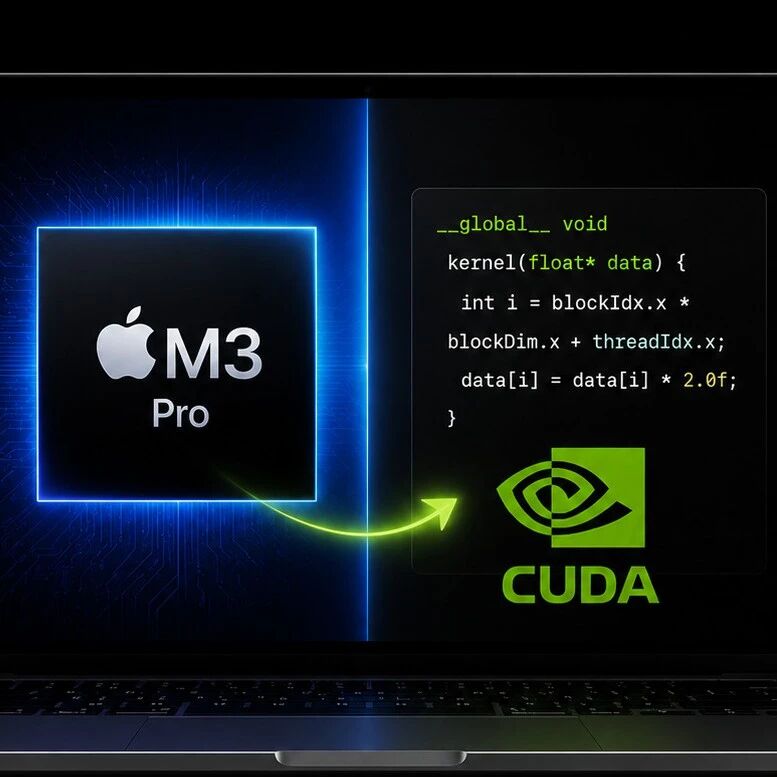
OpenFPM's Experimental Metal Backend: Running CUDA Programs on Apple Silicon
An experimental Metal backend PR for the open-source scientific computing framework OpenFPM runs original CUDA kernels nearly unchanged on an M3 Pro via Clang/HIP-SPIR-V-Vulkan-MoltenVK, with a measured ~10x speedup on a 3D SPH benchmark.