
OpenClaw 2026.6.1: Native Windows Support at Last
The world's largest open-source AI Agent project ships a major update: native Windows support, a Skill Workshop that lets Agents self-evolve, and multi-Agent Workboard collaboration — 1.6 billion PCs become compute nodes.

OpenClaw 2026.6.1: Native Windows Support at Last
The world's largest open-source AI Agent project ships a major update: native Windows support, a Skill Workshop that lets Agents self-evolve, and multi-Agent Workboard collaboration — 1.6 billion PCs become compute nodes.
OpenClaw is currently the world's largest open-source AI Agent project, and its community skill library ClawHub has accumulated more than 13,000 skills. Version 2026.6.1 is a landmark update: three core changes give its coverage and capabilities a qualitative leap.
Update 1: Native Windows Support
This is the biggest change of the release. In the past, Windows users could only run OpenClaw through a Docker container or the WSL2 subsystem, where cross-filesystem I/O penalties made file reads 10x slower and plugin installs threw errors at every turn.
Now Windows can join OpenClaw's distributed node network directly as a "first-class citizen." Your gaming laptop, your office machine, the old desktop gathering dust at home — all of them can become Agent runtime nodes.

What does this mean? Behind Windows sits an installed base of 1.6 billion devices. OpenClaw's potential hosted-node count doubles outright.
WSL users weren't left behind either: the WSL clipboard is bridged through the shell, and the desktop client now recognizes manually updated launchd jobs.
Update 2: Skill Workshop
The Skill Workshop is the most imaginative part of this update. Skills used to be written by humans for AI to use. Now, AI can write skills for itself.
The workflow goes like this:
- OpenClaw discovers mid-task that it's missing a certain skill
- It files a "skill proposal" through the
skill_workshoptool - The proposal enters a pending-review list, where a human can approve, reject, or quarantine it
- Before approval, the proposal can go through versioned revisions
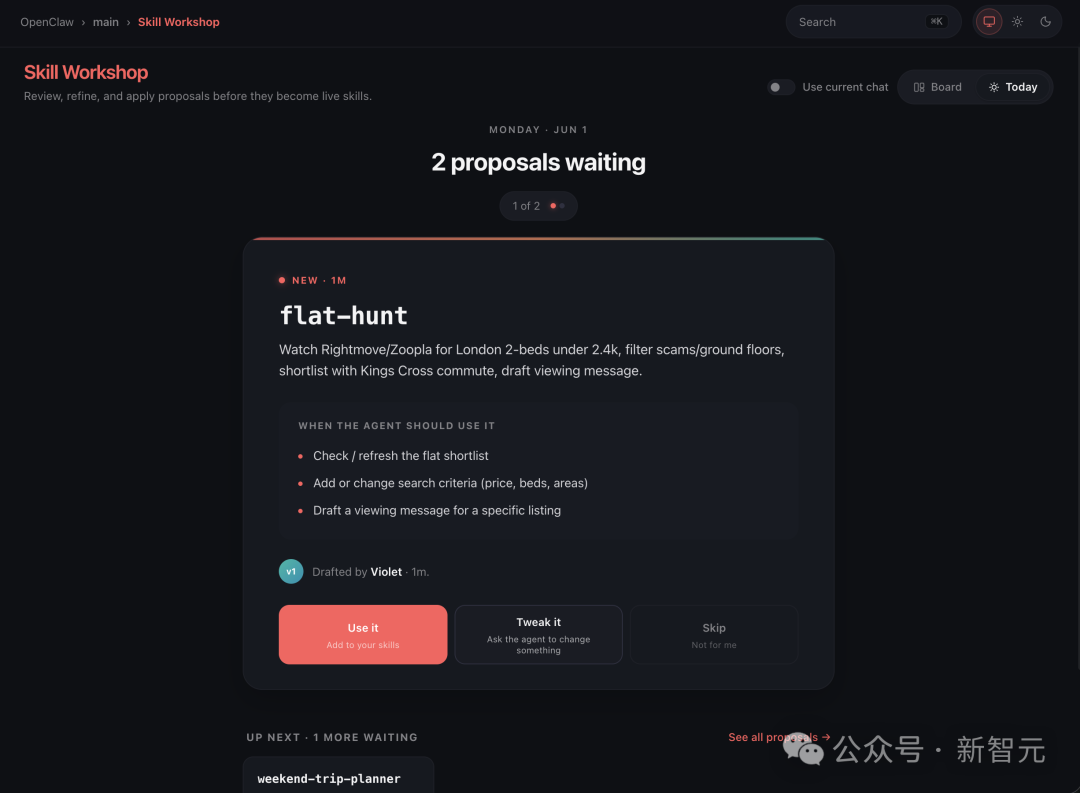
Proposals also come with scanners, hash verification, and rollback protection. If something goes wrong, one click rolls it back. The AI can keep evolving, but every step leaves a trail and a way back.
Update 3: Multi-Agent Workboard
The Workboard gives the AI team a kanban board, letting Agents collaborate like a real project team.
Hand the main Agent a big job, and it breaks down the task, distributes it to sub-agents, tracks each subtask's progress, and consolidates the delivery. The whole process is laid out plainly on the Workboard.
Combined with the newly added Code mode internal namespace and a precise tool distribution mechanism, multi-Agent collaboration is no longer just talk.
Other Notable Updates
- Model lineup expansion: MiniMax M3 fully integrated; GitHub Copilot Claude 1M long context connected
- Official plugins: Tokenjuice and the GitHub Copilot runtime land on npm and ClawHub as official plugins
- Under-the-hood optimization: heavy adoption of SQLite in place of filesystem scans, greatly improving response speed for local service probing, media downloads, and state restarts
- 178 commits: landed into the mainline in a single update
How to Update
openclaw updateOr download the latest release straight from GitHub: https://github.com/openclaw/openclaw/releases/tag/v2026.6.1
Who It's For
- Windows developers: no more putting up with the performance penalties of Docker and WSL2
- Agent developers: the Skill Workshop gives Agents the ability to self-evolve
- Team users: the Workboard supports multi-Agent collaboration on complex tasks
- Individual users: even the old computer at home can become an Agent node
Related articles
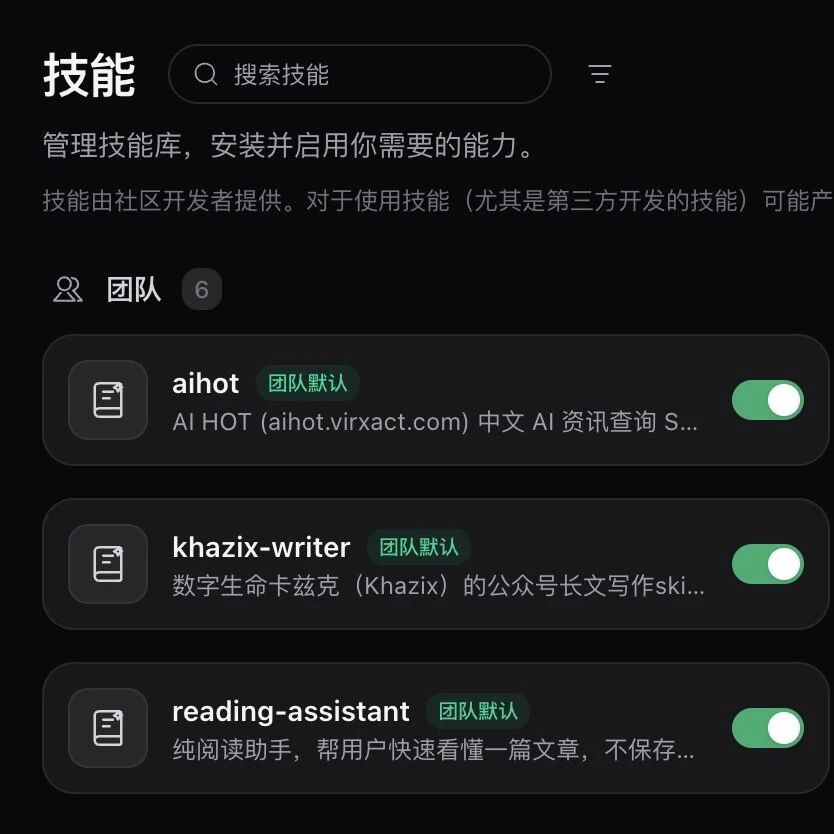
Accio Work Enterprise: One-Click Team Sharing for Skills and Agents
Alibaba's Accio Work launches its enterprise edition with one-click team sharing and auto-updates for Skills and Agents, solving a collaboration pain point for small and mid-size teams.

Alipay Token Pay: Payment Infrastructure for Agents That Spend for You
Alipay launches four products — the world's first Token Pay service, AI Wallet, AI Pay, and AI Collect — forming a full-stack AI-native payment system that has already completed 300 million agent payments.
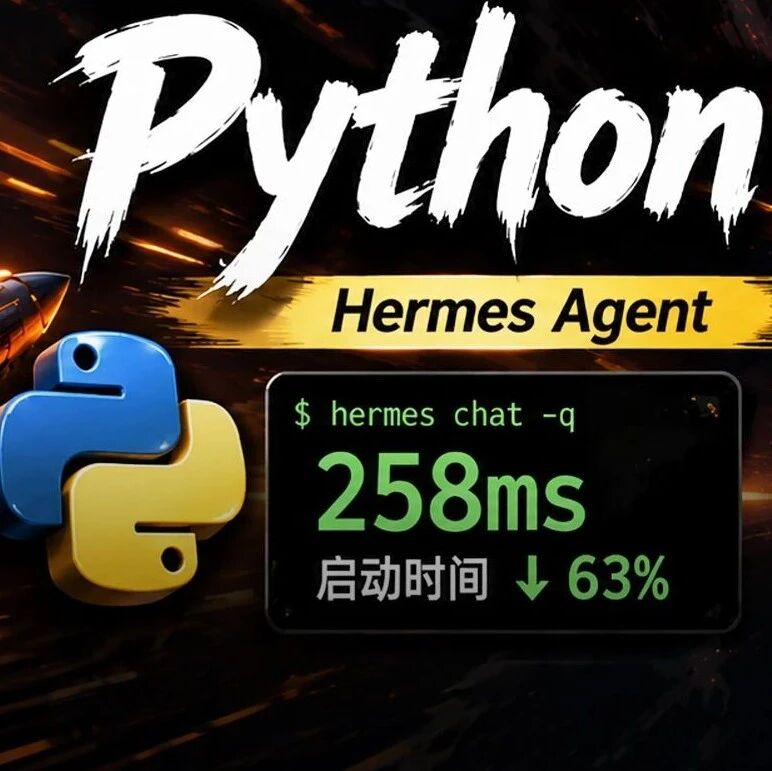
Hermes Agent: The Open-Source Python Project That Beat OpenAI Codex
Hermes Agent cut its startup time by 63% through three engineering optimizations and beat the Rust-written OpenAI Codex 6:5 across 11 CLI benchmarks, with GitHub stars passing 160,000.

skill-cleaner: An Open-Source Tool to Put Your Agent Skills on a Diet
Peter, the 'father of the lobster,' has open-sourced skill-cleaner: 5 core features that audit and optimize your Agent skill descriptions, saving Token costs and improving Agent selection accuracy. Now open on GitHub.

SkyClaw-v1.0: A Free Agent Model Closing In on Opus 4.6
Kunlun Tech releases the SkyClaw-v1.0 Agent model: performance approaching Claude Opus 4.6 at half the price of mainstream models, OpenAI-interface compatible, free for a limited time.

CODA: Letting LLMs and Novices Write Speed-of-Light GPU Kernels
An open-source project from MIT, Princeton and others rewrites the scattered computations in Transformer training into the GEMM-Epilogue pattern, speeding up backpropagation by 1.6-1.8x