
Cerebras
An ultra-fast AI inference cloud running on in-house wafer-scale chips
Tool details
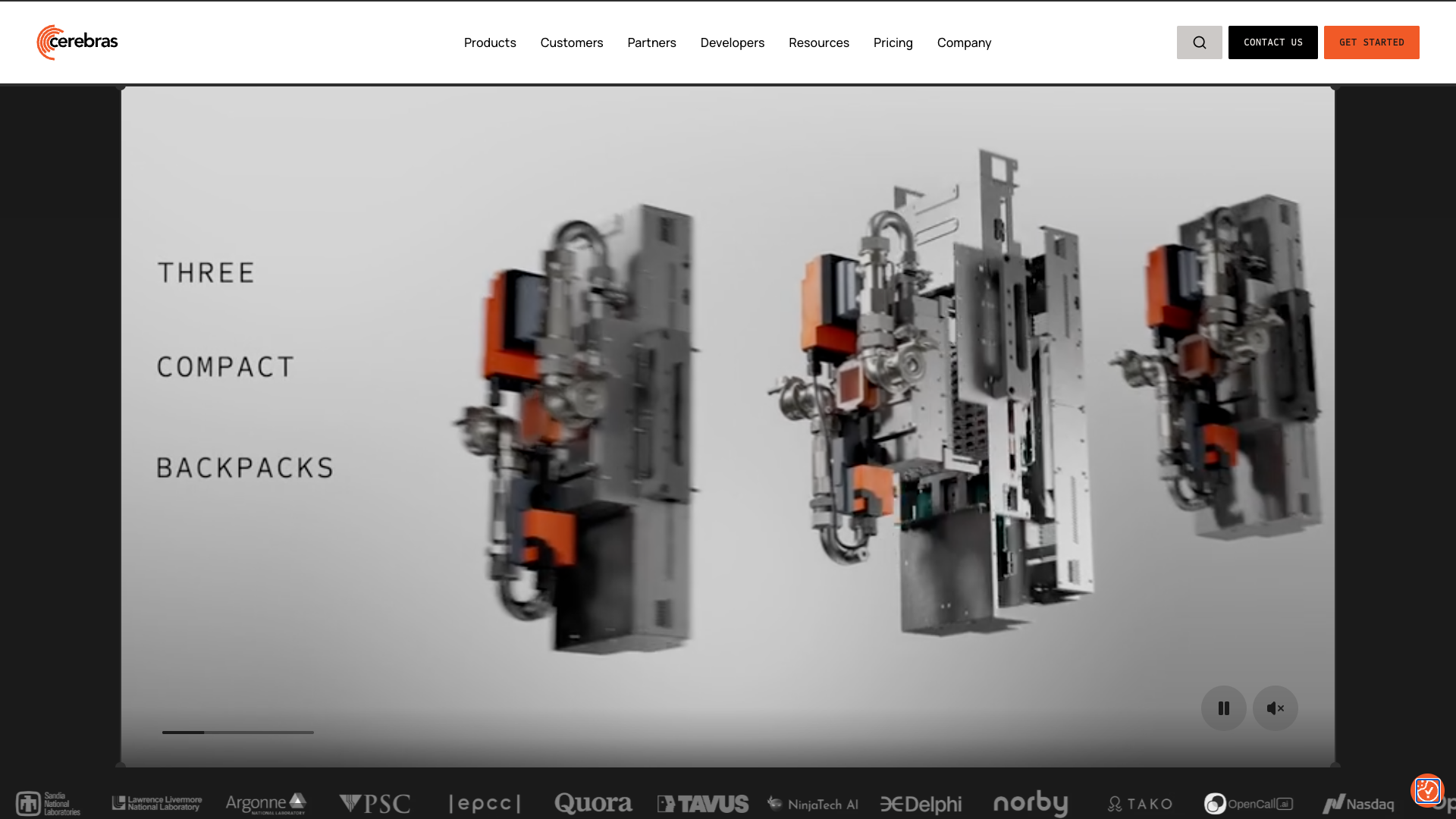
Cerebras is an AI infrastructure company that sells speed: it builds its own wafer-scale engine, the WSE-3, along with the CS-4 rack system, using a whole silicon wafer plus on-chip SRAM to sidestep the memory-bandwidth bottleneck that limits GPUs. It does not train foundation models of its own. What it hosts are third-party open weights such as GPT OSS and Qwen, served at 1000+ tokens per second through an OpenAI-compatible API.
Core capabilities
- Wafer-scale hardware, built in-house: WSE-3 Turbo fits 4,000 billion transistors and 900,000 AI-optimized cores on a single piece of silicon, replacing a GPU cluster with one wafer
- Extreme inference speed: GPT OSS 120B is rated at about 3000 tokens/s and Qwen 3.8 27B at about 1850 tokens/s
- Two-line migration: fully OpenAI-compatible, so changing base_url and api_key is all it takes to switch over and run an A/B comparison
- Third-party open-model hosting: the public API offers gpt-oss-120b and qwen-3.8-27b, while dedicated enterprise tiers can extend to a much larger catalog including Llama, Kimi, GLM and DeepSeek
- Enterprise deployment options: reserved dedicated capacity, custom weights, on-premises systems and a training cloud, with data residency support
Use cases Real-time voice conversation, generative UI and multi-turn agent tool loops, where latency gets amplified; also high-throughput batch inference on open models and public-sector or enterprise projects that need on-premises deployment and data residency. Teams that need very large closed models or self-serve fine-tuning are better served elsewhere.
Standout advantages On the same model, sustained throughput runs at roughly 10–30x a GPU setup (30x is the vendor claim, third-party reviews put it at 10–20x and up to 75x on the largest models), while precision stays full and no distillation is involved. Rival Groq is cheaper and has a wider catalog; Cerebras wins by pushing latency to the limit.
Editorial take The speed advantage is real and third parties can reproduce it, and a $0.35/M entry price plus OpenAI compatibility keeps the cost of experimenting tiny, which makes it the default inference substrate for latency-sensitive products. Three things come with it: no permanent free tier (the $5 credit expires after 30 days), only two models on the public API, and production-grade quotas that have to be negotiated in an enterprise contract.
Pricing
Subscription$0.35 per 1M input tokens (GPT OSS 120B, pay-as-you-go)Free Trial: $5 promotional credit, payment method required, expires after 30 daysGPT OSS 120B unit pricing; Qwen 3.8 27B is $0.99/M input and $1.49/M output; no monthly fee, billed on actual usage
Includes production-grade capacity, top priority with higher rate limits, custom model weights, and fine-tuning plus training services; no public price list
Additional notes
• No permanent free tier: the official FAQ states the $5 credit expires after 30 days, and no automatically renewing free allowance exists. • The free trial is rate-limited to 5 RPM. • Cerebras Code is a separate subscription product (Pro $50/month, Max $200/month) and is not part of pay-as-you-go inference pricing. • The minimum top-up is $10. • Input and output tokens are priced separately.
FAQ
User reviews
User Reviews
No reviews yet
No one has reviewed this tool yet