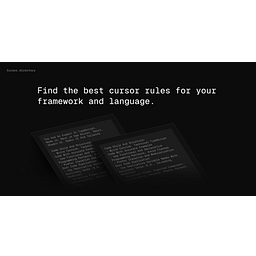
Cursor Directory
Officially listedA community-driven library of Cursor rules and MCP servers for AI code editors.
Cursor Directory
Cursor Directory is an open-source community resource library built specifically for the Cursor AI code editor. It gathers optimized instruction sets and extension tools for over a hundred tech frameworks, dedicated to helping developers thoroughly solve pain points in AI coding such as "hallucinations," inconsistent code style, and missing context — an essential golden companion for boosting Cursor development productivity.
Core Capabilities
- Massive tech stack rules library: Collects best-practice instructions for over a hundred frameworks (such as Next.js and Rust) across frontend and backend, ready to apply with one click.
- Automatic project-level rule generation: Supports parsing your tech stack or
package.jsonfile to intelligently generate highly customized project-level constraint rules. - Aggregated MCP server directory: Fully integrates Model Context Protocol (MCP) servers to quickly extend Cursor's database connectivity and external retrieval capabilities.
- Multi-file rules system support: Perfectly supports Cursor's latest
.mdcfile system, enabling rules to trigger precisely on demand for specific code file paths. - One-click deep link integration: Provides convenient "Add to Cursor" deep links that simplify configuration, making high-quality prompts plug-and-play.
Use Cases If you are a developer who uses Cursor AI heavily, especially when facing intricate frontend and backend tech stacks, or if your team urgently needs to unify code style and implement strict development standards, this treasure trove is tailor-made for you. Whether you are an independent developer or a startup team, it can greatly reduce your repeated instructions when communicating with AI, letting you focus on implementing business logic.
Unique Advantages As the most active and most authoritative unofficial community resource center in the Cursor ecosystem, it has irreplaceable value. Unlike generic prompt aggregation sites that speak in vague generalities, all of its rules are deeply customized as system-level instructions for AI agents, so you can immediately enjoy an enterprise-grade code development constraint system without starting from scratch.
Editor's Review There is no doubt this is a "cheat-code-level" essential that every Cursor user should bookmark. It is completely free and extremely high in content quality, and it can instantly turn your general AI assistant into a "senior colleague" who knows your project architecture inside out. Although in practice developers need to actively guard against context token redundancy caused by over-relying on rules, it remains the best solution today for standardizing AI coding.
Pricing
### 💰 定价模式:免费 **起步价**:免费 #### 主要方案 - **开源免费版**:免费 - 访问所有 `.cursorrules` 指令、`.mdc` 规则库及 MCP 服务器目录。 #### 试用/其他信息 该项目由开源社区维护,所有功能无需注册即可直接使用。
FAQ
Is Cursor Directory free?
Yes. Cursor Directory is a community-driven, fully open-source project; all rules and resources are free for public use with no payment required.
What can Cursor Directory be used for?
It mainly provides large numbers of `.cursorrules` and `.mdc` rules tailored to specific tech stacks, helping developers standardize the style of AI-generated code, and it also catalogs MCP servers that extend capabilities.
How do I apply Cursor Directory rules to my project?
You can copy rules from the website into a `.cursorrules` file created at your project root, or create `.mdc` files under the `.cursor/rules/` directory for precise, per-feature matching.
Do Cursor Directory rules consume tokens?
Yes. All globally included rules are sent to the AI as context, so it is recommended to use the `.mdc` format with file paths for on-demand triggering, avoiding token waste from blindly piling up rules.
How is Cursor Directory different from general prompt sites?
General prompt sites usually focus on conversational techniques, while Cursor Directory's rules are system-level constraints written specifically for Cursor's agentic environment, with greater emphasis on coding standards and framework best practices.
Are the rules in Cursor Directory up to date?
The rules on the site are mainly contributed and maintained by community developers. Rules for most popular frameworks are updated promptly, but because tech stacks change frequently, rules for some niche frameworks may need your own fine-tuning.