
fal
Generative media inference platform for developers
Tool details
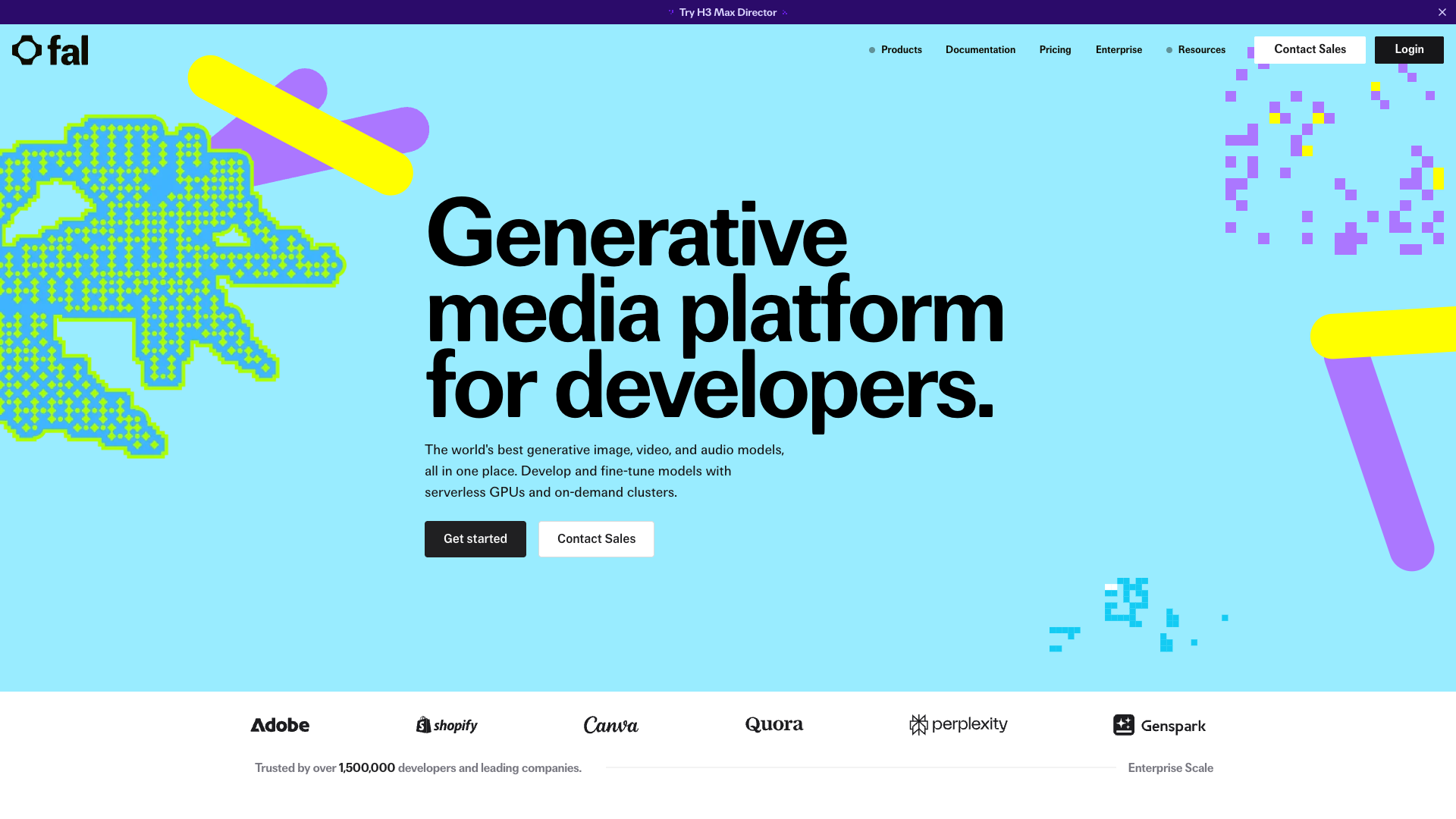
fal is a generative media inference platform for developers: a single API key unlocks 1,000+ production-ready image/video/audio/3D models. It is essentially "third-party model hosting + an inference orchestration layer": what fal builds itself is the fal Inference Engine™ and the serverless runtime, while the model layer is mostly third-party, aimed at teams that do not want to run their own GPU queues.
Core capabilities
- Unified model API: one SDK and one key for 1,000+ image/video/audio/3D endpoints, with instant switching between models
- In-house inference engine: optimized for diffusion models, officially up to 10x faster with near-zero cold starts
- Serverless deployment: host your own models/containers on the same runtime, auto-scaling from 0 to thousands of GPUs and billed by the second
- Dedicated compute: fal Compute provides SSH-enabled H200/B200/B300 instances for training and fine-tuning
- Day-0 model availability: FLUX, Veo, Nano Banana, GPT Image, Seedance, Kling and others often go live on launch day
Who it is for AI application developers, startup teams and generative media product teams that need to call cutting-edge image/video/audio models quickly in production through a unified API while balancing latency and cost; model labs can host their own models. It is not suited to complete beginners, or to teams that require full control over GPU operations.
What sets it apart Compared with Replicate's general-purpose community registry (50,000+ models, billed by GPU-second), fal curates 1,000+ selected endpoints, bills per output and delivers lower latency, with the same models often 20–40% cheaper; compared with Modal's pure GPU serverless, fal delivers the models together with an optimized engine, making it "results as a service".
Editorial review fal is a leading infrastructure player in the generative media inference space, described by third parties as "AWS for generative media", with customers including Canva, Perplexity and Poe. Its strengths are model coverage, speed and developer experience; it loses points for being fundamentally a third-party model aggregator (which means paying an aggregation premium), for having no long-term free tier, for billing that is easy to lose control of at scale, and for documentation with a high barrier to entry. Rating: 4.5/5.
Pricing
Subscription$50/month (Starter credit pack)$50 in credits per month; credits roll over and can be used site-wide (fal Agent subscription credit pack)
$200 in credits per month, 5% off fal Agent credits
$1,000 in credits per month, 10% off fal Agent credits
Additional notes
The main billing model is usage-based: Model APIs are billed per output (e.g. MiniMax H3 Max $0.05/second, Nano Banana 2 $0.08/image, ElevenLabs TTS $0.1/1,000 characters); Serverless GPU is billed per GPU hour (H100 $4.50/hour, as low as $2.49; B300 $12.99/hour, as low as $5.99). There is no long-term, permanently free tier: the official /pricing page does not list a free tier, third parties disagree on signup credits (buildaicurrent, checked against the official terms, records None), and one section of the official docs states that there is no standard signup credit. Enterprise plans require contacting sales. The above reflects the official terms during the research period (2026-10-16); third-party figures serve only as corroboration, and no currency conversion is performed.
FAQ
User reviews
User Reviews
No reviews yet
No one has reviewed this tool yet