
Miragic
A one-stop AI image creation suite that grew out of virtual try-on
zh-CN
Free
AI虚拟试穿
Tool details
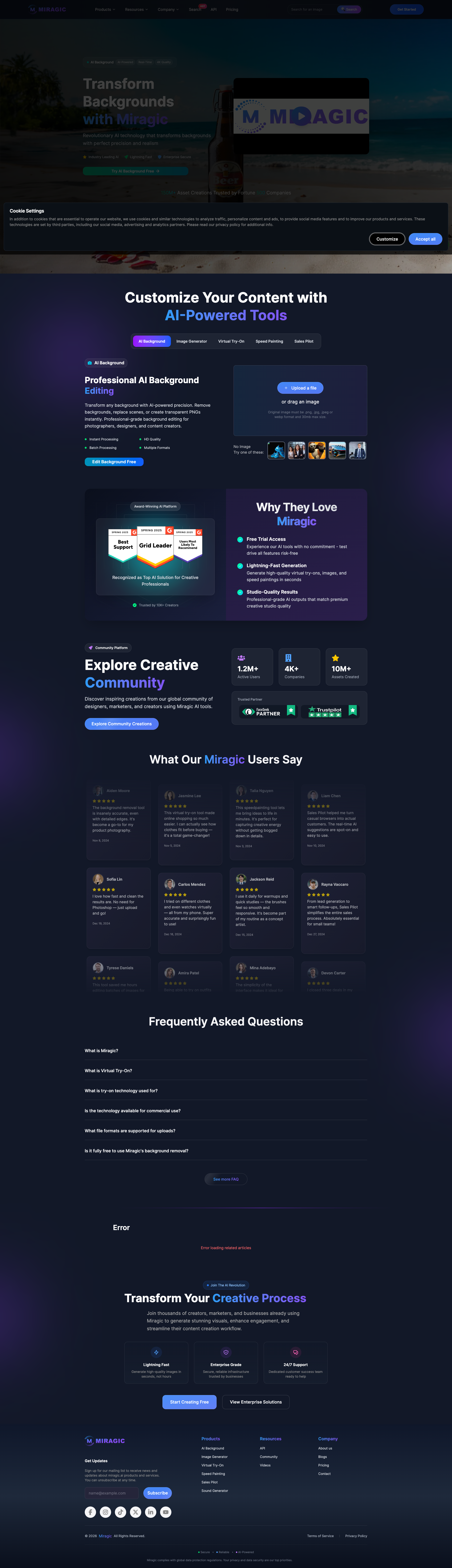
<h4>Tool Overview</h4><p>Miragic is a generative AI creation platform that started with virtual try-on and has expanded into six product lines, officially positioned as 'Generative AI Software / AI Art Creation Tool.' It bundles background processing, text-to-image, virtual try-on, speed painting video, sales analysis, and voice generation into one dashboard, targeting e-commerce sellers, content creators, marketing teams, and SMBs with a one-stop 'no tool-switching' experience. Virtual try-on remains a core product, costing 2 credits per run.</p><h4>Core Capabilities</h4><ul><li><strong>AI virtual try-on</strong>: Upload a portrait photo plus a garment image to composite realistic wear effects, supporting top-bottom combinations, 250+ clothing categories, and 4K output; officially claimed to lift e-commerce conversion about 40% on average.</li><li><strong>AI Background processing</strong>: One-click cutout, scene replacement, transparent PNG, and batch processing with fine hair/fur edges — currently the homepage's flagship product.</li><li><strong>AI Image Generator text-to-image</strong>: Style presets for photorealistic, illustration, anime, 3D, and product photography, with negative prompts, aspect ratio, and seed control; 1 credit per run.</li><li><strong>Speed Painting video</strong>: Turns static images into hand-drawn time-lapse videos 'from blank canvas to finished piece,' outputting 720p/1080p/4K MP4.</li><li><strong>Sales Pilot sales analysis</strong>: Upload CSV/Excel to generate sales forecasts (officially >95% accuracy) and action recommendations; v1.2 adds conversational analysis.</li><li><strong>AI Sound Generator voice</strong>: TTS covers 800+ voices and 140+ languages, with STT transcription as well; officially advertised as free TTS.</li></ul><h4>Pricing and Credits</h4><p>Freemium: the free layer grants credits, unlimited background removal, and 5 virtual try-ons, but outputs are watermarked and non-commercial. Payment is mainly one-time credit packs ($5-$200 for 100-8,000 credits; try-on 2/run, image 1/photo, speed painting 5/video); third-party reviews also mention a $15-29/month subscription (unconfirmed on the official site). 30-day refunds supported, and credits are valid for 2 years from purchase.</p><h4>Use Cases</h4><p>Budget-limited small e-commerce sellers (virtual try-on + batch backgrounds + ad creatives), social media creators (outfit inspiration + speed painting videos), marketing teams (Sales Pilot insights), and developers needing quick try-on/image API access. Users seeking professional video, top image quality, or real-time AR try-on should pick Runway, Midjourney, or ZERO10 instead.</p><h4>Unique Advantages</h4><p>The core differentiator is 'breadth' — packaging virtual try-on with background removal, image generation, speed painting, and sales analysis into an AI creation Swiss Army knife, paired with a unified credit pool and a low-price route (about $0.05-0.10/credit). For small sellers it is a cost-saving one-stop option. But the per-item ceiling is not high: video trails Runway, image generation trails Midjourney, backgrounds trail PhotoRoom, and try-on is static compositing rather than real-time AR.</p><h4>Company Transparency and Risk Notes</h4><p>The company launched mid-2025 with about 45K monthly visits — an emerging long-tail tool with only single-digit independent user reviews. Note: the official pricing page does not publish plan prices; the About Us page contains placeholder text, headquarters and registered addresses conflict, WHOIS is hidden, there is no funding record, and the G2 badge is unverifiable; developer project showcases indicate outsourced/white-label SaaS, with AI dependent on external ML APIs and unproven in-house depth. ScamAdviser judges it 'Very Likely Safe,' but treat it as a lightweight entry tool to sample — not a core production dependency.</p><h4>Editorial Review</h4><p>Rating ⭐⭐⭐☆☆ (3/5). Virtual try-on quality has earned Trustpilot praise (4.0/5) and itirupati's 4.8/5, with a low free barrier and complete APIs — good for e-commerce/creators testing cheaply; but pricing is opaque, company backing is thin, and the tech depends on third parties — verify licensing terms and stability before commercial or large-scale reliance.</p>
Pricing
FreemiumFreeFree
$0
Free credits + unlimited background removal + 5 virtual try-ons, watermarked output, no commercial use
Credit top-up packs
$5–$200 one-time for 100–8,000 credits
Virtual try-on 2 credits/run, image generation 1 credit/image, speed sketch 5 credits/clip
Professional
About $15–29/mo
More credits, no watermark, API, batch processing (third-party claim, unverified by the official site)
Enterprise
Custom
SLA, dedicated models, SSO, on-premise deployment
Additional notes
30-day money-back guarantee; credits valid for 2 years from purchase; the free tier needs to pay to remove the watermark and obtain a commercial license
FAQ
There is a free tier: free credits + unlimited background removal + 5 virtual try-ons, startable without a credit card, but outputs are watermarked and non-commercial; payment unlocks watermark-free, commercially licensed output on a credit system.
User reviews
User Reviews
No reviews yet
No one has reviewed this tool yet