
Building a Cost-Effective AI Coding Environment with Claude Code + MiMo-V2.5-Pro
Pair Xiaomi's MiMo-V2.5-Pro open-source model with Claude Code: API pricing at just 40% of Opus, support for 1M-token context, plus a detailed setup tutorial
Building a Cost-Effective AI Coding Environment with Claude Code + MiMo-V2.5-Pro
Pair Xiaomi's MiMo-V2.5-Pro open-source model with Claude Code: API pricing at just 40% of Opus, support for 1M-token context, plus a detailed setup tutorial
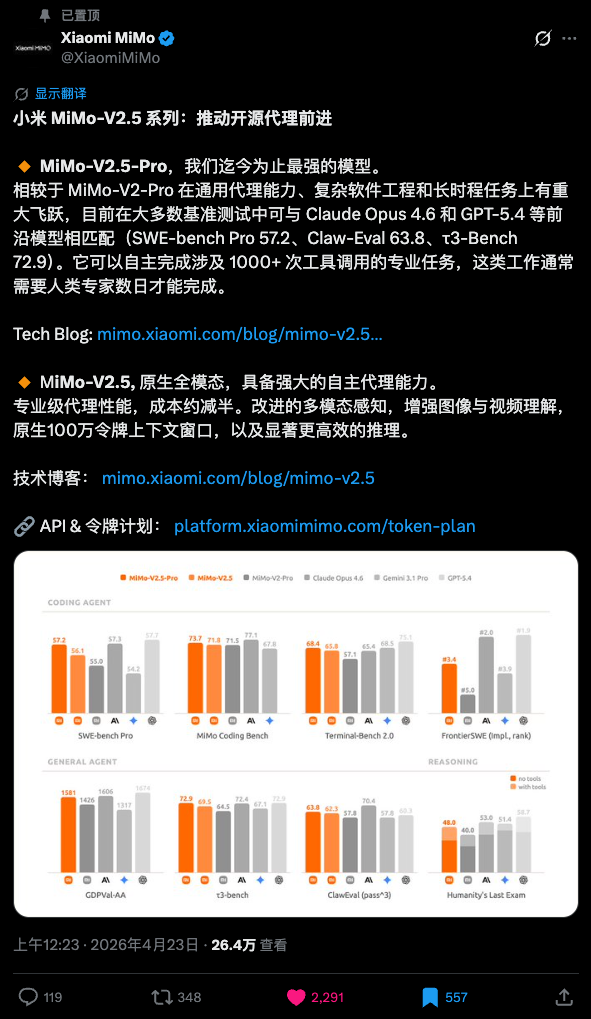
If you can't get access to Claude Opus or GPT-5 but still want to set up a usable AI coding environment locally, Xiaomi's newly released MiMO-V2.5-Pro is one of the most cost-effective options available right now. It ties with Kimi K2.6 for first place among open-source models on the AA leaderboard, supports 1M-token context, has extremely low API latency, and costs only 40% of Opus's price. Even better -- it works with Claude Code beautifully smoothly.
Why This Combination
- Cheap: MiMo-V2.5-Pro API pricing is 7/21 RMB per million tokens (input/output, 0-256K), roughly 60% cheaper than Opus 4.6 ($5/$25 per million tokens)
- Fast: it just launched and has few users, so API latency is extremely low -- in real-world tests it beats many Chinese models
- Capable: tool calling and coding ability feel close to Opus 4.6 -- it "speaks plainly" and its output is well organized
- 1M context: a context window in the same class as GPT-5.5
Preparation Before You Start
You need to prepare the following:
- Claude Code: installed and configured (if you haven't installed it yet, see this step-by-step tutorial)
- cc-switch: a model-switching tool for Claude Code, used to hook up third-party models
- Xiaomi API key: apply for one on the Xiaomi Open Platform
- Estimated time: 10 minutes
Step-by-Step Instructions
Step 1: Get a Xiaomi API Key
Head to the Xiaomi Open Platform, register, and apply for an API key for the MiMo models.
MiMo-V2.5-Pro API pricing plans:
| Context range | Input price (RMB/million tokens) | Output price (RMB/million tokens) |
|---|---|---|
| 0 - 256K | 7 | 21 |
| 256K - 1M | 14 | 42 |
Note: MiMo also has a Token Plan that does not distinguish between 256K and 1M contexts and charges one flat rate, which suits users who need long context.
Step 2: Add MiMo in cc-switch
-
Double-click to open cc-switch
-
Under the Claude tab, click the plus sign in the top-right corner
-
For the provider, choose Xiaomi MiMo
-
Enter your API key
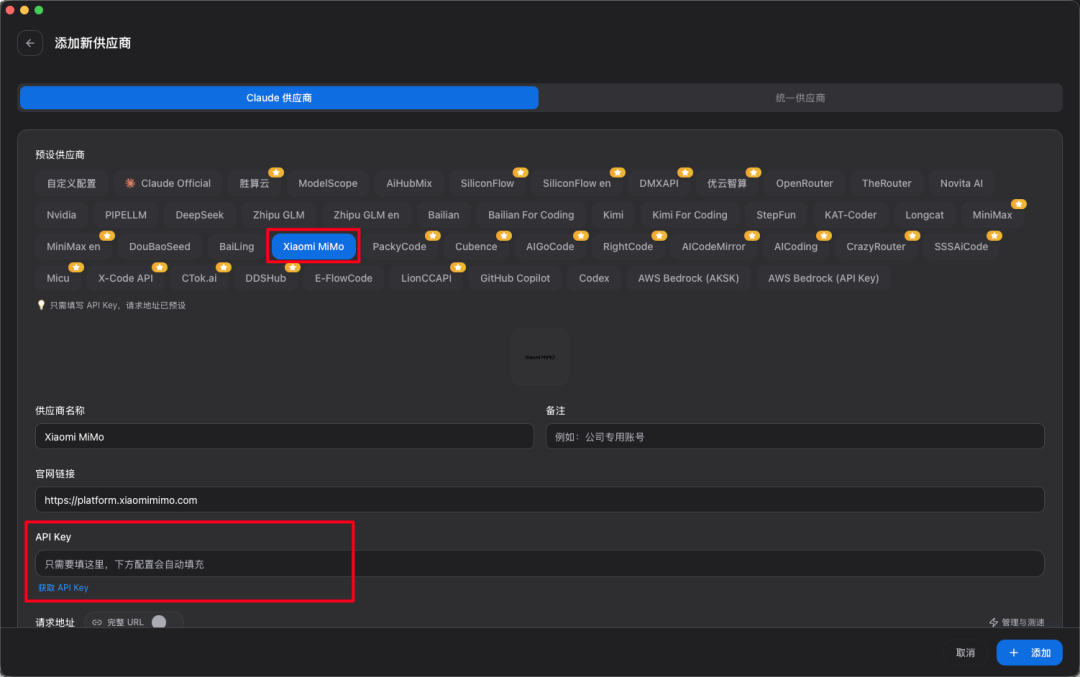
- For the model name, enter mimo-v2.5-pro
Step 3: Enable and Start Using It
- Once added, enable MiMo-V2.5-Pro on the cc-switch home screen
- Open Claude Code and you can start using it immediately
Real-World Results
One user built a complete WeChat official account analytics platform with Claude Code + MiMo-V2.5-Pro:
- Dictated the requirements by voice directly in Claude Code
- The model produced a complete tech stack, architecture design, and data analysis logic
- Automatically developed the frontend and backend and wired up a Feishu Base (multidimensional table) database
- Finally deployed it to an internal server and set up enterprise permission management
Throughout the whole process, MiMo-V2.5-Pro performed close to what you would expect from Opus 4.6 -- organized output, smooth tool calling, and a deployment that passed on the first attempt.
Tip: if you have been coding with GLM-5.1 or Kimi K2.6, MiMo-V2.5-Pro is a new option worth trying alongside them. All three models have their own strengths, so switch flexibly depending on the specific task.
FAQ
-
What is the difference between MiMo-V2.5 and MiMo-V2.5-Pro? The Pro version is the flagship model, with more parameters and stronger capabilities. The standard version is suited to lightweight tasks.
-
How is the latency? Since it has just launched with few users, real-world latency is currently very low. It may change as the user base grows.
-
Which programming languages are supported? All the mainstream ones. In real-world tests, web development (HTML/CSS/JS/React) was especially impressive.
Related articles

Astribot T1: An 89,900-Yuan Humanoid Robot Goes on Sale
Astribot launches the T1 humanoid robot starting at 89,900 yuan, with a three-in-one architecture of tendon-driven body + in-house AI model + embodied OS, shipping from June 1.
Volcano Engine AI Trust: A Three-Layer Architecture Guarding Agent Security
Volcano Engine launches the AI Trust security product family, covering trustworthy models, controllable agents, and AI-driven security operations, with 10 billion detection calls per day

Xiaomi MiMo API Prices Cut Up to 99% for Good: How Developers Can Grab the Deal
Xiaomi's MiMo-V2.5 series API gets a permanent price cut of up to 99%, Token Plan allowances grow 5-8x, and pricing now squarely matches DeepSeek

Darwin Skill 2.0: Let Your AI Skills Evolve on Their Own
darwin-skill 2.0 is an open-source Skill/Prompt auto-optimization tool that distills the best of two Microsoft papers, using multi-judge independent review plus human checkpoints to lift your AI skill documents from 80 points to over 90.

An Open-Source Social Card Skill: Say Goodbye to AI-Looking Images
guizang-social-card-skill is an open-source AI text-and-image card generator with 11 built-in content category adaptations, a magazine-grade layout engine, and free commercial-use image libraries, helping you one-click generate RedNote-grade card images.
Hy-Memory: Give Your AI Agent a Supercharged Memory
Hy-Memory is an OpenClaw memory plugin from Tencent. With a three-part architecture — a 6-layer memory framework, System1/System2 dual processing, and evolution chains — it lets an Agent truly remember your preferences, decisions, and history, cutting memory fragments by over 70%.