
A Field-Tested Method for Managing a 700,000-Line Codebase with Claude Code
Build a three-layer context system with CLAUDE.md, Skills, and MCP so the AI truly understands your codebase — with a comparison against OpenAI's Symphony parallel-orchestration approach
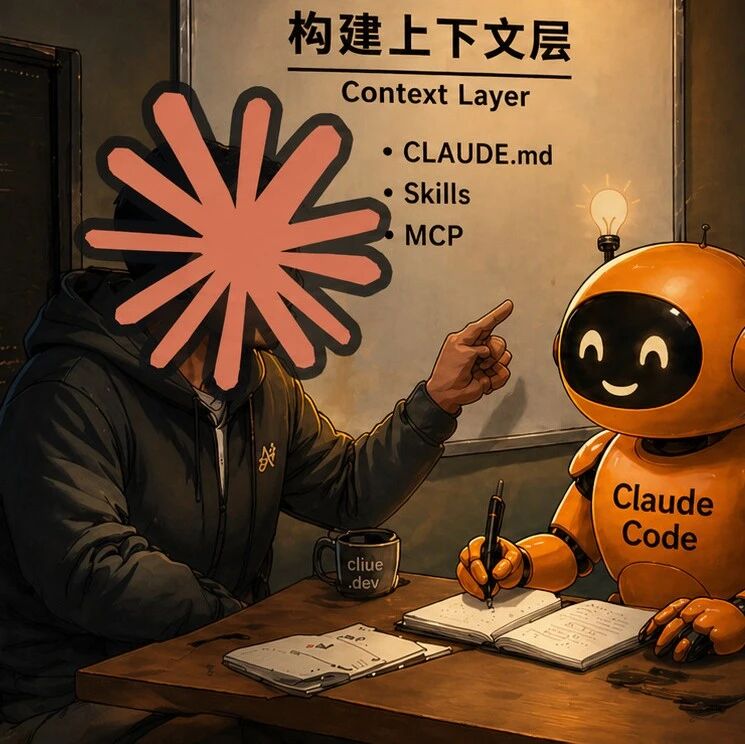
A Field-Tested Method for Managing a 700,000-Line Codebase with Claude Code
Build a three-layer context system with CLAUDE.md, Skills, and MCP so the AI truly understands your codebase — with a comparison against OpenAI's Symphony parallel-orchestration approach
A 700,000-line C# codebase. The core developer graduated and left. Feature modules sat frozen for three years, too risky for anyone to touch. Brendan MacLean, lead developer at the MacCoss Lab at the University of Washington, used Claude Code to finish this abandoned build in two weeks. His method wasn't making the AI smarter — it was giving the AI a complete context system, the way you'd bring up an intern. This article breaks down exactly how he did it, alongside a comparison with Symphony, the parallel orchestration scheme OpenAI shipped the same day.
The Core Idea: Bring Up the AI Like an Intern
Brendan's insight is plain: every time a newcomer joins the lab, they don't know the project's full picture, how the code fits together, or the unwritten rules. The difference is that a newcomer learns over time, while Claude forgets everything the moment a conversation ends.
So his core strategy: turn tacit knowledge into explicit, AI-readable assets.
The Three-Layer Context System
Layer 1: CLAUDE.md — the Project's Terrain Map
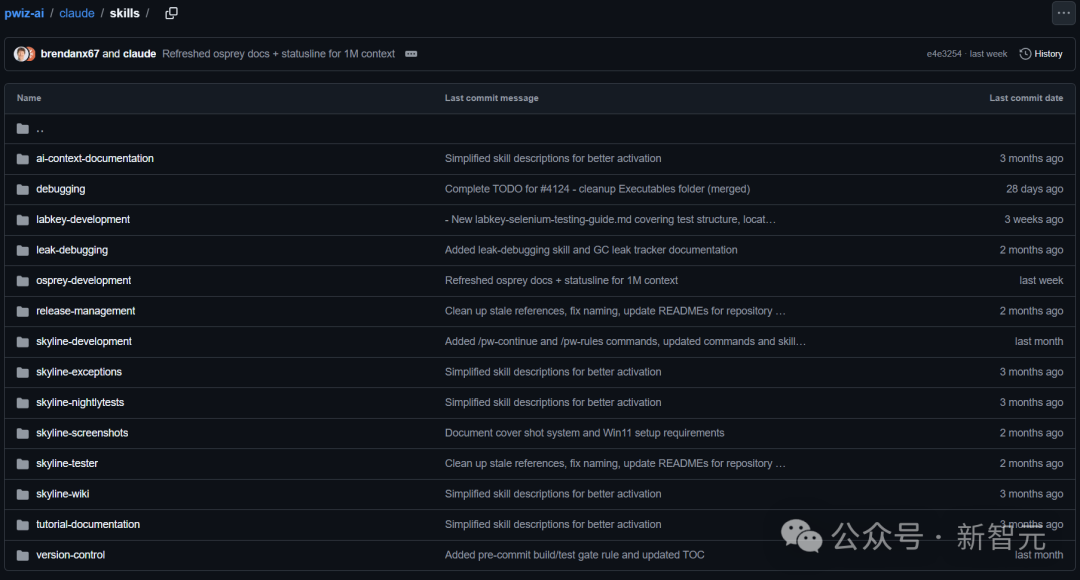
Brendan set up a separate repository, pwiz-ai, dedicated to context written for the AI to read. The CLAUDE.md at the root is the 'terrain map,' telling Claude:
- What the project is and what it's for
- The codebase structure
- How to build it
- The testing workflow
Project address: github.com/ProteoWizard/pwiz-ai
The key principle: CLAUDE.md solves 'knowing where things are.' It does not solve 'knowing how to do the work.'
Layer 2: Skills — the Domain Knowledge Base
The real domain expertise lives in skills. Brendan wrote a debugging skill, for example, described as 'always load when investigating bugs, failures, or unexpected behavior' — it forces Claude to do root-cause analysis before acting, instead of blind guessing and poking.
Layer 3: MCP — Let the AI See Real Data
Through MCP (Model Context Protocol) integration, Claude can read real test data, exception reports, and user tickets. With all three layers stacked, every interaction starts from 'already understands' instead of 'blank slate.'
Results in Practice
With the context in place, Brendan began clearing years of accumulated technical debt:
- A three-year abandoned module: a test-management module written in Java, on a stack completely different from the main C# codebase. Done with Claude Code in a day.
- 2,000+ tutorial screenshots: once maintained entirely by hand, now fully automated and nearly 100% reproducible.
- A daily automatic report: generated by Claude, summarizing overnight test failures, exceptions, and unresolved tickets.
- A brand-new feature dashboard: the developer in the lab least interested in AI coding tools built and shipped a brand-new data-visualization dashboard with Claude Code.
OpenAI's Answer: Symphony
The same week, OpenAI released the open-source project Symphony (over 18,000 stars on GitHub already).
Project address: github.com/openai/symphony
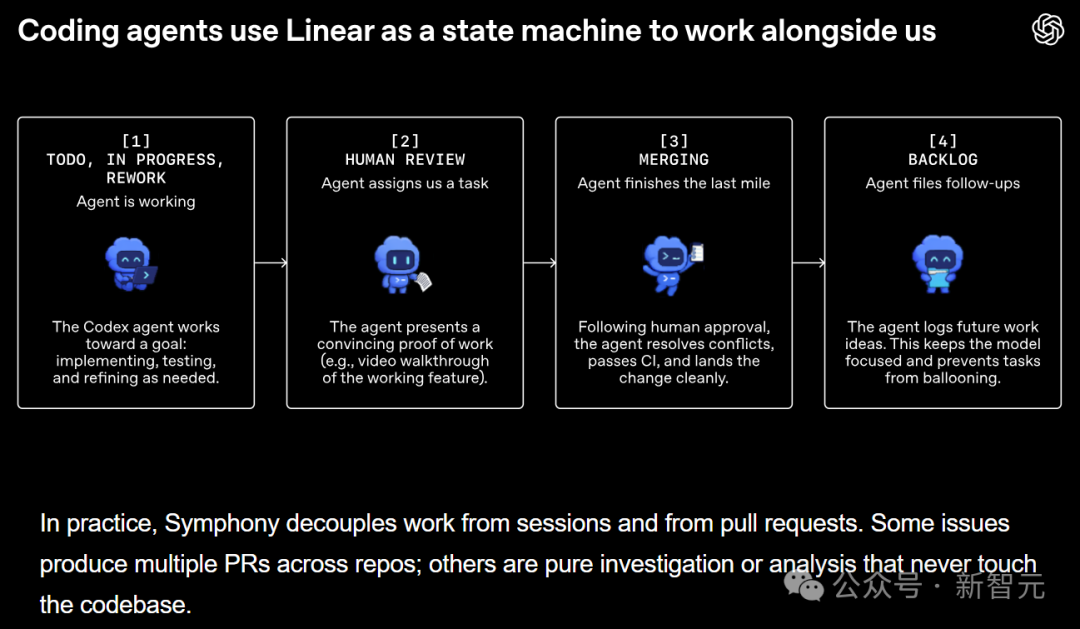
Symphony takes a completely different approach: it turns a Linear project board into the control center for AI coding. Every Issue in the Open state gets an Agent assigned automatically; the Agent keeps running in its own workspace and restarts automatically if it crashes.
In some teams' first three weeks on Symphony, the number of successfully merged PRs surged 500%.
Choosing Between the Two Routes
| Dimension | Claude Code (deep context) | Symphony (parallel orchestration) |
|---|---|---|
| Core philosophy | Context quality decides everything | Orchestration efficiency decides everything |
| Analogy | Master and apprentice | Running an automated factory |
| Best for | Large legacy codebases, complex business logic | Team-level new projects, many parallel tasks |
| How knowledge is captured | CLAUDE.md + Skills | WORKFLOW.md + SPEC.md |
| Human's role | Teaching the AI the project | Reviewing the results on the board |
Shared finding: what used to travel by word of mouth and muscle memory now has to be written down in black and white before the AI can carry it. Whichever route you take, turning tacit knowledge into explicit assets is a step you cannot skip.
What You Can Do Now
If you're coding with AI assistance, three things worth doing today, whatever the tool:
- Write a CLAUDE.md (or your equivalent context file): project structure, build commands, test workflow, red-line rules — spelled out line by line.
- Turn common operations into Skills: debugging procedures, code-review checklists, deployment steps — so the AI never starts from zero.
- Keep the docs current: code on iteration 7 or 8 with docs still at version 1.0 is far too common. Stale docs are more dangerous than no docs.
Toolin Editorial Team
Categories
Related articles

Xiaomi MiMo API Prices Cut Up to 99% for Good: How Developers Can Grab the Deal
Xiaomi's MiMo-V2.5 series API gets a permanent price cut of up to 99%, Token Plan allowances grow 5-8x, and pricing now squarely matches DeepSeek
Darwin Skill 2.0: Let Your AI Skills Evolve on Their Own
darwin-skill 2.0 is an open-source Skill/Prompt auto-optimization tool that distills the best of two Microsoft papers, using multi-judge independent review plus human checkpoints to lift your AI skill documents from 80 points to over 90.
An Open-Source Social Card Skill: Say Goodbye to AI-Looking Images
guizang-social-card-skill is an open-source AI text-and-image card generator with 11 built-in content category adaptations, a magazine-grade layout engine, and free commercial-use image libraries, helping you one-click generate RedNote-grade card images.
Hy-Memory: Give Your AI Agent a Supercharged Memory
Hy-Memory is an OpenClaw memory plugin from Tencent. With a three-part architecture — a 6-layer memory framework, System1/System2 dual processing, and evolution chains — it lets an Agent truly remember your preferences, decisions, and history, cutting memory fragments by over 70%.
PilotDeck: The Open-Source Agent Operating System from Tsinghua
PilotDeck is an open-source Agent operating system jointly released by Tsinghua University's THUNLP Lab and partner teams, featuring independently isolated WorkSpaces, white-box memory management, smart routing that saves money, and Always-on proactive execution.
Five Models Tested: Is Qwen3.7 Max Actually Good at Coding
Qwen3.7 Max climbed to second place globally on competitive coding leaderboards, behind only Claude Opus 4.7. Using four tasks — liquid simulation, hexagonal 2048, a metro museum, and a browser operating system — this hands-on test compares the coding performance of Qwen3.7 Max, GPT-5.5, Gemini 3.5 Flash, DeepSeek V4, and Claude Opus 4.7.