
A Hands-On Guide to Claude Code /workflows
A detailed look at when and how to use the Claude Code /workflows feature, using multi-agent parallelism for codebase sweeps and hard-problem research.
A Hands-On Guide to Claude Code /workflows
A detailed look at when and how to use the Claude Code /workflows feature, using multi-agent parallelism for codebase sweeps and hard-problem research.
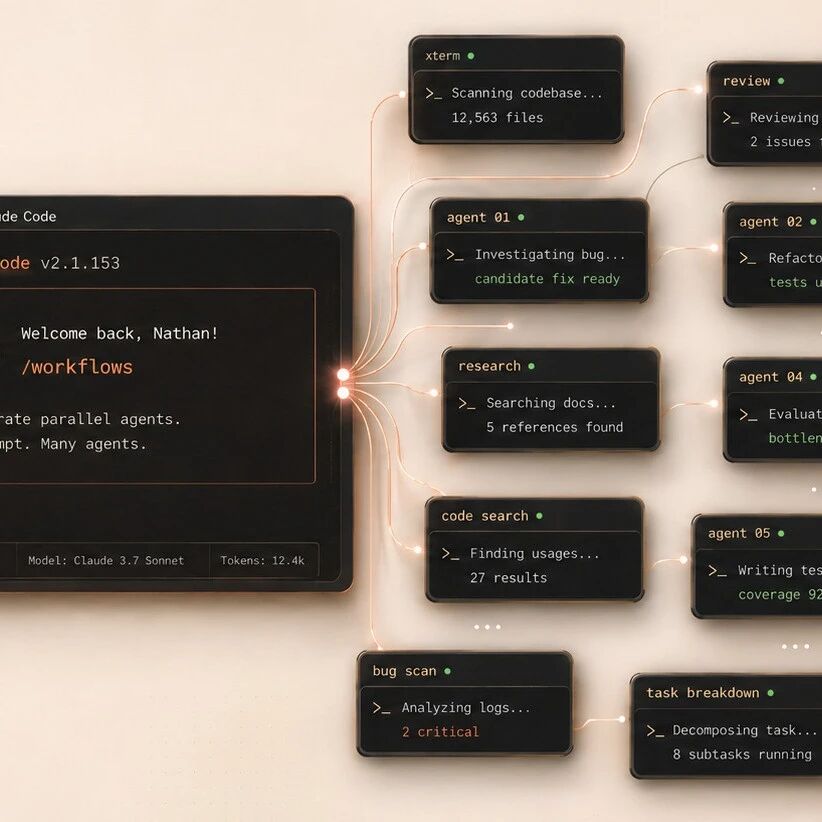
The new /workflows feature in Claude Code solves one essential problem: it turns AI from "one person doing the work" into "a crowd doing the work in parallel." When a task can be broken into multiple independent subtasks, /workflows automatically plans how many agents are needed and what each one handles, then executes them in parallel. Based on real usage, this article boils it down to the two scenarios where /workflows is most worth using.
When to Use /workflows
There is only one test: is the task a "labor problem" or a "judgment problem"?
Anything that needs a flash of insight or a coherent sense of taste — that's a judgment problem, and /workflows is the wrong tool.
But anything where "one smart person finds it tedious, while fifty ordinary people working separately would finish it" — that's a labor problem, and letting /workflows loose on it works extremely well.
Two typical scenarios:
- Codebase cleanup: sweeping for old bugs, finding tech debt, batch-checking conventions
- Hard-problem research: searching for industry solutions, comparing how competitors implement things, compiling best practices
Scenario 1: Sweeping Old Bugs out of the Codebase
This is the most direct use of /workflows. Your codebase certainly has a pile of bugs that "obviously should be fixed but nobody ever has" — not fatal, not urgent, but you know they're there.
Steps
- Open Claude Code and enter your project directory
- Enter a prompt like the following:
Please scan the entire codebase and find all the low-risk, safe-to-fix old bugs.
Focus on:
- Deprecated code that was never deleted
- Unhandled exceptions and edge cases
- Inconsistent error-handling patterns
- Obvious logic errors

Sort by confidence; drop anything with insufficient confidence.- Append
/workflowsto the end of the prompt
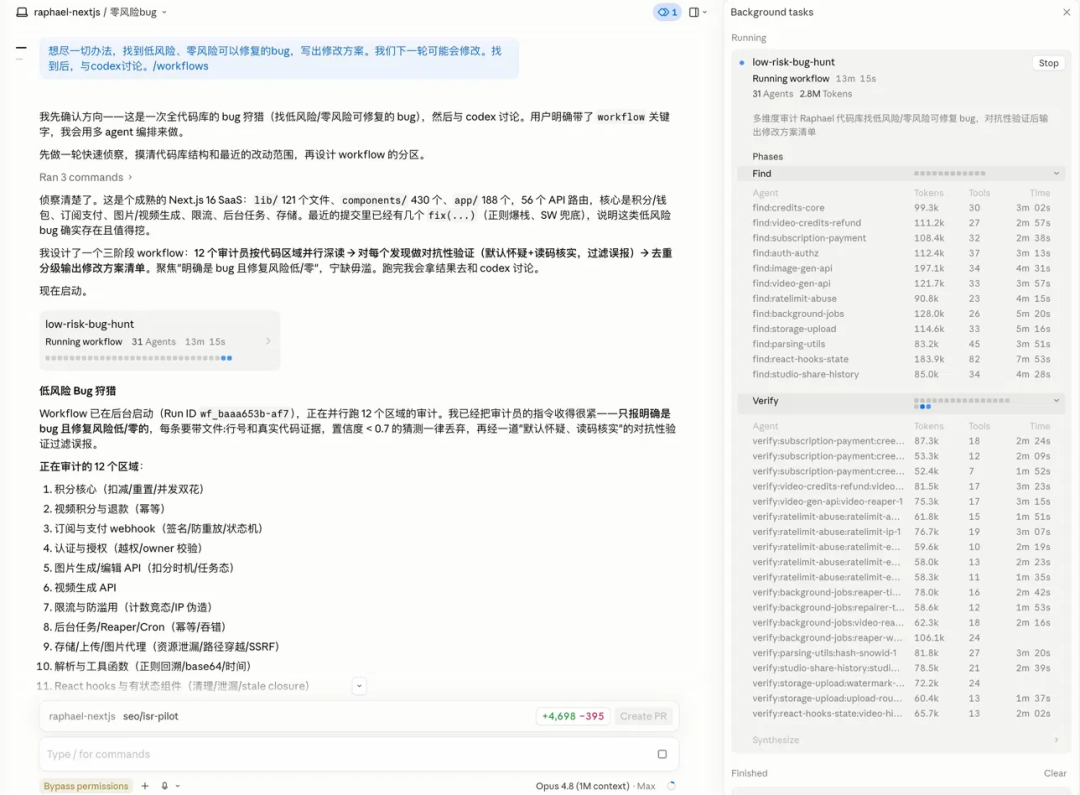
Claude Code automatically slices the codebase into multiple regions and assigns dozens of agents to scan them simultaneously. One batch hunts, another batch nitpicks, and anything below the confidence bar gets filtered straight out.
Results
In testing, /workflows automatically split the codebase into 12 regions with 31 agents scanning in parallel, and about two hours later it produced a high-confidence list. These were exactly the kind of bugs that make you feel a little guilty every time you walk past that code but that you'd never dedicate an afternoon to fixing.
Scenario 2: Researching Solutions to a Hard Problem
When you hit a genuinely hard technical problem and want to know "how do people usually solve this," you can use /workflows and /deep-research together.
Steps
- Describe your problem normally, for example:
I'm running into [specific problem] in [specific scenario].
So far I've tried [solution A] and [solution B], but both have [flaw].
Please research the mainstream solutions in the industry for me.- Append both
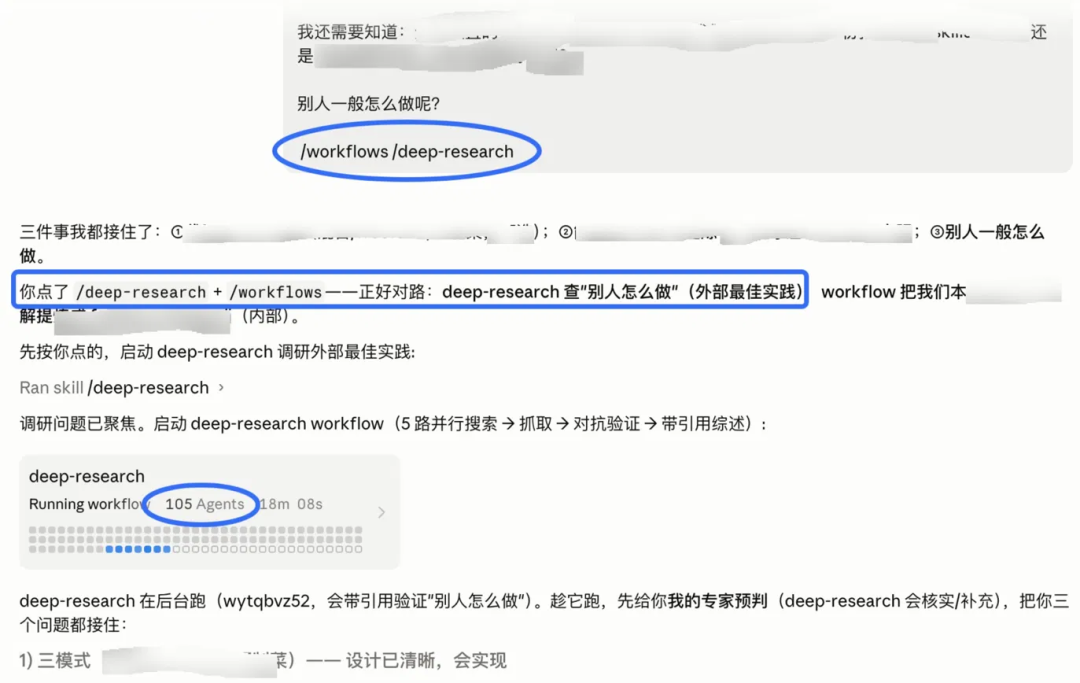
/workflows /deep-researchat the end
What stacking the two features does:
/deep-researchhandles web searches and pulls in external knowledge/workflowsreads your current codebase and understands the project context- The two run in parallel, so the information doesn't live in a bubble
Results
In testing, a single sentence spun up 105 agents doing both code analysis and web research, and the quality of the final solution far exceeded using either feature alone.
Things to Watch
Token consumption: /workflows starts large numbers of agents, and token usage is significant. Use it for scenarios that genuinely need massive parallelism; simple tasks aren't worth it.
Model version: /workflows shipped with the new Claude Code release (alongside Opus 4.8), so make sure your Claude Code is updated to the latest version.
Combining with other commands: /workflows can be stacked with /deep-research for double the effect. That's the recommended "killer" combination right now.
Summary
When you hit a genuinely hard problem in Claude Code, appending
/workflows /deep-researchto a normal problem description works wonders.
The core judgment: labor problems go to /workflows; judgment problems are still yours. Once AI's intelligence is good enough, the bottleneck is often "not enough hands" rather than "not smart enough" — and that is exactly the problem /workflows solves.
Related articles

Netflix Open-Sources Headroom: Cutting 90% of Wasted Tokens and Saving $700,000
Headroom, an open-source tool built by a senior Netflix engineer, trims redundant tokens before prompts ever reach the LLM — reversible compression, lossless context — and has already saved users $700,000.

Running LLMs Locally, Hands-On: Building an Agent Coding Environment with Pi + LM Studio
Use the Pi agent framework with the LM Studio inference engine to run Gemma 4 on a local Mac for agent coding tasks, with the complete Docker configuration and a models.json example included.

STAR-PólyaMath: The Open-Source Reasoning Framework That Teaches LLMs to Correct Their Mistakes
A multi-agent reasoning framework open-sourced jointly by Tsinghua and Microsoft, where the Reasoner, Verifier, and Meta-Strategist roles make long-horizon reasoning verifiable and traceable — beating GPT-5.5 on the Apex benchmark by 13.5%.
Baidu Open-Sources Unlimited OCR: Reading an Entire Book in One Forward Pass
Unlimited OCR, Baidu's model built on DeepSeek OCR, achieves 32K-context long-document parsing through the R-SWA mechanism, with an end-to-end SOTA of 93.23% on OmniDocBench v1.5.

FineVLA Goes Open Source: One Sentence Tells the Robot Which Hand to Use and Where to Grab
HKU and Alibaba jointly open-source FineVLA, a controllable VLA framework that lets language specify the executing arm, contact region, and other details, with an 86.8% success rate in RoboTwin simulation.
Hooking Doubao Seed 2.1 Pro into Claude Code: Swap Your Main Model in Three Steps
Volcano Ark speaks the Anthropic protocol; three environment variables let Claude Code switch to Doubao Seed 2.1 Pro — verified by fixing real bugs in a complex project.