
Claude Opus 4.8 Is Here: More Honest, Less Lazy, Plus Dynamic Workflows
Anthropic releases Claude Opus 4.8 with the code-defect miss rate cut to a quarter of the previous generation, Dynamic Workflows launching alongside it to run hundreds of subagents in parallel, and effort control opened to all users.

Claude Opus 4.8 Is Here: More Honest, Less Lazy, Plus Dynamic Workflows
Anthropic releases Claude Opus 4.8 with the code-defect miss rate cut to a quarter of the previous generation, Dynamic Workflows launching alongside it to run hundreds of subagents in parallel, and effort control opened to all users.
Just 43 days after Opus 4.7 shipped, Anthropic has released Claude Opus 4.8. This is not a simple benchmark bump — it takes targeted aim at the two pains developers complain about most: AI laziness and overconfidence. The Dynamic Workflows feature launching at the same time lets Claude Code spin up hundreds of subagents at once to finish tasks in parallel.
Three Key Improvements in Opus 4.8
1. More honest, no more laziness
Anyone who has written code with Claude knows the pattern: it rattles off a big chunk of code, confidently declares everything works. You run it, and something else breaks. You go back and ask; it says it found the issue, definitely fine now. You run it again — another error.
Opus 4.8 is specifically optimized for this. Official numbers:
- The code-defect miss rate is down to 1/4 of Opus 4.7's
- The rate of overconfident behaviors like "hardcoding answers" is down to 1/10 of Opus 4.7's
- On laziness-detection metrics, Opus 4.8 is the only model achieving a 0% bad-behavior rate
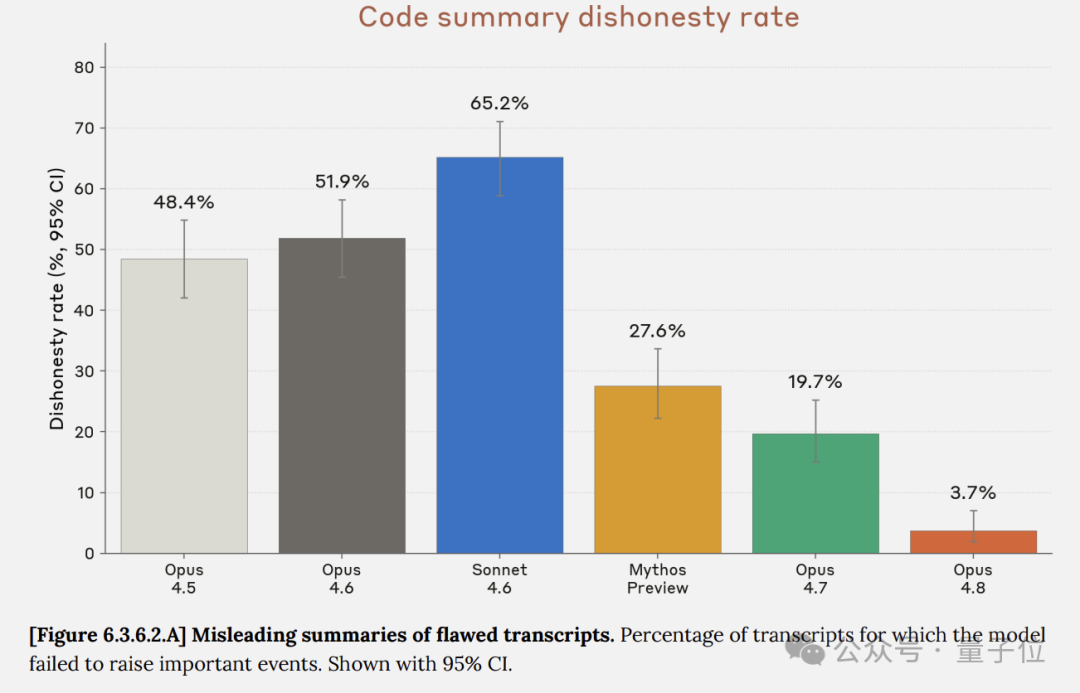
In hands-on testing, Opus 4.8 reviews code thoroughly and in great detail, hunting for every spot that could use optimization, instead of wrapping up hastily like the previous generation.
2. More precise, but also more "obedient"
Opus 4.8 has become more precise — it goes exactly where you point and follows instructions more closely. For professional developers that is a good thing -- both error rates and hallucination rates are falling.
But it brings a change: its initiative has diminished. Ask it to do A, and now it does only A — it will no longer take it upon itself to also handle B. If your habits depend on the AI's "guess what you meant" ability, you will need to adjust how you interact and state requirements more explicitly.
3. Effort control open to all users
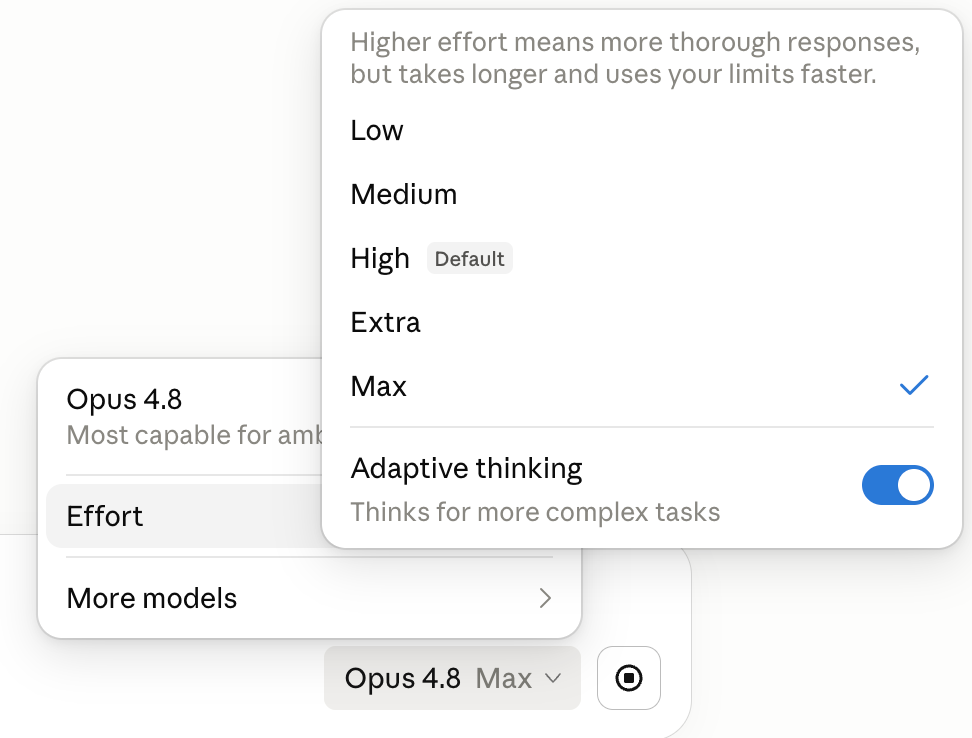
Every plan (including free users) can now adjust the model's effort level in Chat mode, across four settings from Low to Max. Combined with adaptive thinking, you can choose flexibly based on task complexity.
Dynamic Workflows: Hundreds of Subagents in Parallel
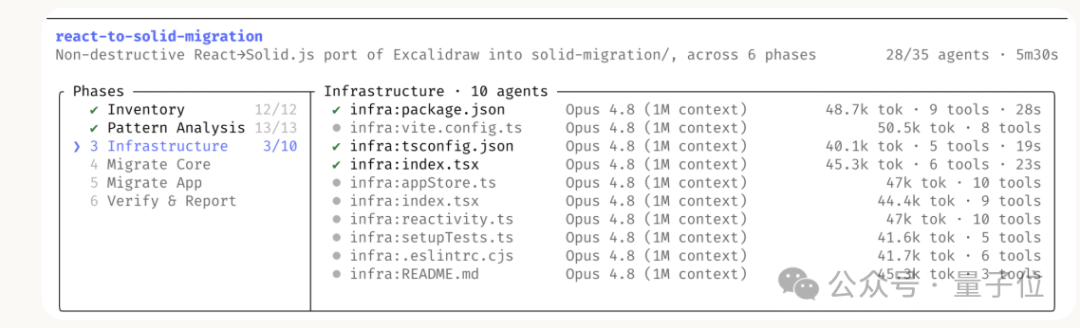
Dynamic Workflows, launched the same day as Opus 4.8, is a major Claude Code upgrade, currently available as a research preview in the CLI, the desktop app, and the VS Code extension.
How it works
- Claude dynamically generates a JavaScript orchestration script from the prompt
- It decomposes the task into subtasks and distributes them across dozens or even hundreds of subagents running in parallel
- One batch of subagents attacks the problem from different angles while another batch rebuts the first batch's findings
- The whole process iterates until the results converge
- Everything merges into a unified output handed back to the user
This differs fundamentally from Claude Code's earlier subagent mechanism: previously, intermediate results returned to the conversation context and consumed tokens, whereas Dynamic Workflows moves the orchestration logic into a code script, keeping only the final result in Claude's context.
Flagship case: porting Bun from Zig to Rust
Bun founder Jarred Sumner used Dynamic Workflows to port the JavaScript runtime Bun from Zig to Rust:
- One workflow mapped the correct Rust lifetime for every struct field
- The next workflow wrote a behavior-matching .rs version for every .zig file
- Hundreds of agents worked in parallel
- First commit to merge took 11 days, producing roughly 750,000 lines of Rust code
- 99.8% of the existing test suite passes
How to trigger it
Two ways:
- Option 1: in Claude Code, just say "create a dynamic workflow..." (with the keyword "workflow" in the prompt)
- Option 2: enable the Ultracode setting and Claude decides on its own when to use workflows
Note: Dynamic Workflows burns noticeably more tokens than an ordinary Claude Code session. On first trigger, Claude Code shows you what it is about to run and asks you to confirm.
Pricing and Model Details
| Item | Details |
|---|---|
| Standard pricing | $5/M input tokens, $25/M output tokens |
| Fast mode | 2.5x speed, $10/M input, $50/M output (two-thirds cheaper than the previous generation's Fast) |
| Context length | Same as Opus 4.7 |
| Maximum context | Same as Opus 4.7 |
Who Should Use It
- Professional developers: Opus 4.8's precision and honesty are greatly improved; pair it with Dynamic Workflows for large-scale code migrations
- Team collaboration: Dynamic Workflows suits bulk edits and defect hunts across hundreds of files
- Long-running tasks: Opus 4.8 can work for extended stretches without a human checking back in frequently
Things to Watch
- Dynamic Workflows is currently a research preview and still iterating
- If you rely on the AI's initiative ("guess what you meant"), adjust your interaction style and state requirements more explicitly
- Creative writing has improved over Opus 4.7, but still trails Opus 4.6
Toolin Editorial Team
Categories
Related articles

Claude Artifacts Finally Gets Public Sharing + Real-Time Multiplayer Editing
Anthropic has added public link sharing and simultaneous multiplayer editing to Artifacts. This article explains what the capability is, how to use it, and how it differs from Claude Code Artifacts.

HunyuanOCR-1.5 Hands-On: SOTA End-to-End OCR from a 1B-Parameter Model
Tencent Hunyuan's HunyuanOCR-1.5 packs document parsing, text recognition, information extraction, and image-text translation into a single 1B-parameter VLM, and pushes inference speed up 6x. This guide walks you through running it locally or on vLLM.
WorkBuddy in Practice: An Open-Source Blueprint for Office Agents
A community author spent 7 days compiling an open-source WorkBuddy playbook (GitHub: AlephAITech/WorkBuddyGuide, MIT) covering tutorials, Skills, MCP, automation, and multi-agent practice. This article helps you quickly find the chapters you need.

AnySearch: Turning Search into Infrastructure for Agents
AnySearch, which topped the Product Hunt weekly chart, isn't a search box — it's a unified API that feeds AI agents pre-filtered, deduplicated, structured information. This article breaks down its positioning, integration options, and why it saves tokens.
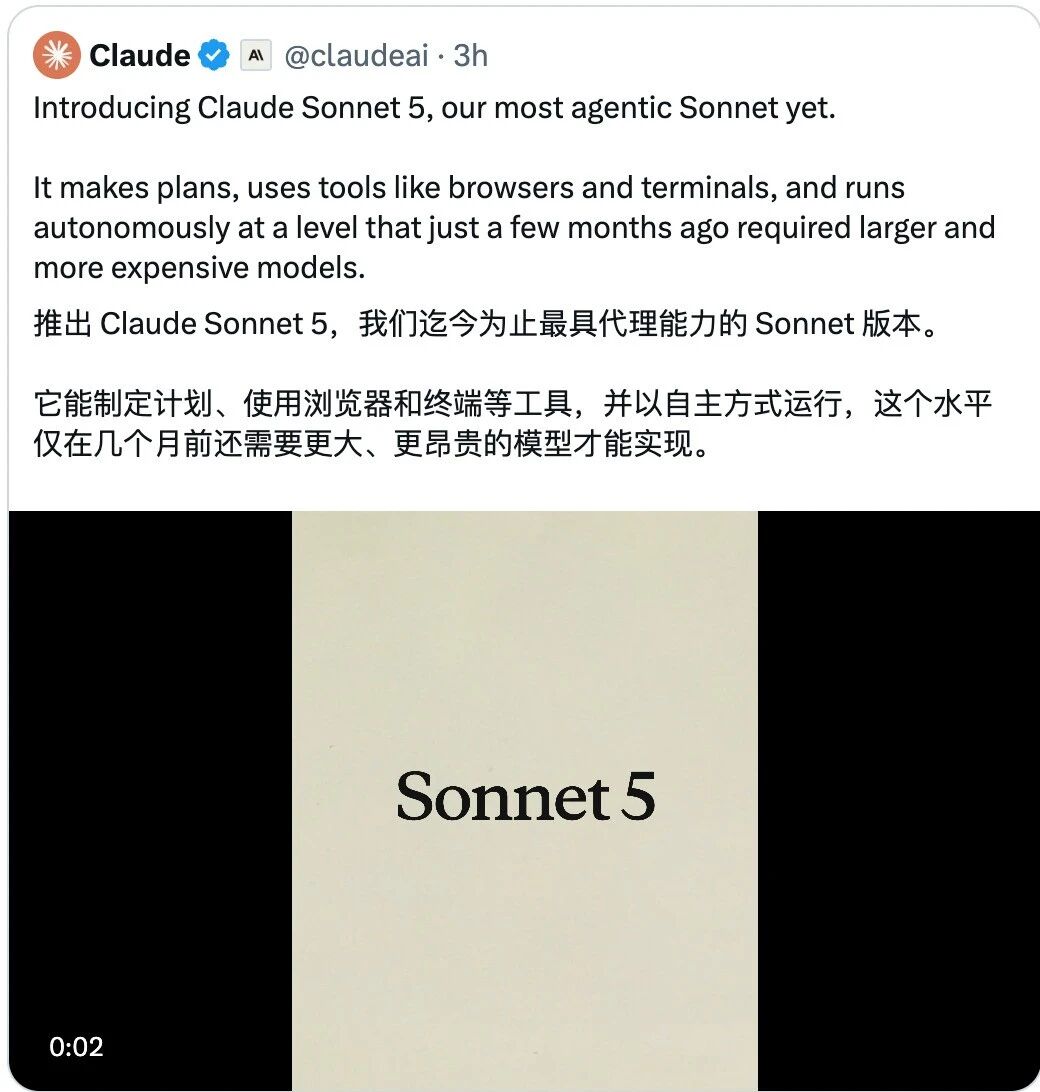
Claude Sonnet 5 Arrives: Near-Opus 4.8 Performance at 60% of the Price
Anthropic releases Claude Sonnet 5 with adaptive thinking on by default and a new tokenizer. Pricing stays at $3/$15, with a limited-time $2/$10 rate through August 31.

Mandol in Practice: Building Agent Long-Term Memory with Zero LLM Calls
The Institute of Software, Chinese Academy of Sciences, open-sources Mandol, which unifies KV/vector/graph storage via SemanticMap + SemanticGraph — zero LLM calls at retrieval, 5.4x faster retrieval, and best-in-class results on both LoCoMo and LongMemEval.