
ClawGuard Auditor: A Security Shield for OpenClaw
A Beihang University team open-sources a security defense tool for OpenClaw that identifies malicious Skills and outputs audit reports, mapping 9 major high-risk issues and their mitigations.

ClawGuard Auditor: A Security Shield for OpenClaw
A Beihang University team open-sources a security defense tool for OpenClaw that identifies malicious Skills and outputs audit reports, mapping 9 major high-risk issues and their mitigations.
OpenClaw has taken off — but the more permission you give an AI, the bigger the security risk. Beihang University's National Key Laboratory of Complex and Critical Software Environment has stepped in, open-sourcing ClawGuard Auditor — a security defense tool purpose-built for OpenClaw.
Core capabilities: detect malicious Skills, produce security audit reports, and protect the entire lifecycle.
Three Core Strengths
1. Comprehensive Security Coverage
Beyond traditional system vulnerabilities, it also covers risks unique to agents:
- Prompt injection and instruction hijacking
- Sandbox escape and unauthorized execution
- Path traversal and file operations
- Sensitive data stored in plaintext
- Third-party dependency vulnerabilities (CVE)
- Plugin poisoning and supply chain attacks
2. Full-Lifecycle Coverage
Breaking past the single-point detection limits of traditional tools, it delivers protection across the whole pipeline — code loading, model interaction, and dynamic execution:
- Static reviewer: intercepts malicious code before a Skill runs through lexical analysis and behavior modeling
- Proactive security kernel: transparently supervises at runtime and immediately blocks sensitive operations on detection
- Data leak prevention engine: monitors memory state and network egress end to end, protecting sensitive assets like API Keys
3. Plug and Play
Its flexible adapter design means no tedious configuration. ClawGuard is anchored at the system's highest-privilege layer and holds ultimate veto power over every external instruction, prompt, and Skill.
Four Defense Axioms
Every behavior verdict ClawGuard makes rests on four tamper-proof principles:
- Absolute coverage and zero trust: all external code is hostile by default, and no mechanism can bypass the rules
- Semantic intent matching: it looks beyond the code itself to judge whether actual behavior matches declared intent
- Capability token model: least privilege strictly enforced — tokens are issued on demand and automatically revoked when the task ends
- Data sovereignty isolation: guarding local assets is the supreme principle, protecting digital assets on every front
Nine High-Risk Issues for OpenClaw
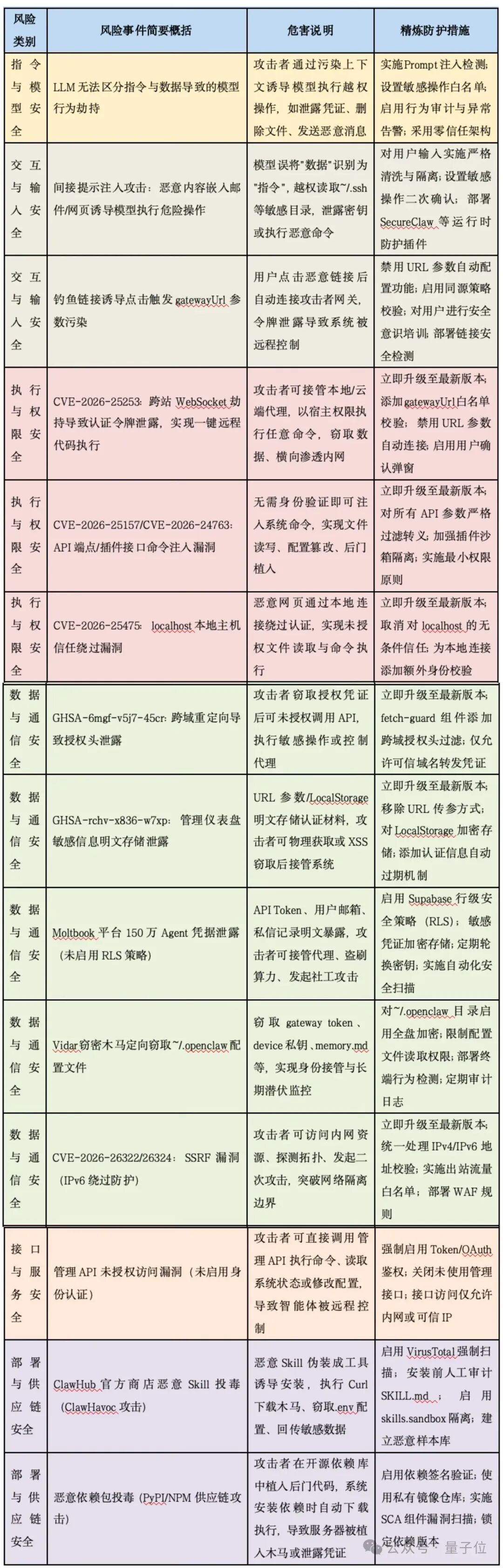
The team's “OpenClaw Agent Security Risk Report” maps out nine core high-risk issues:
1. Prompt Injection and Instruction Hijacking
Attackers craft malicious inputs that lure the agent into bypassing security constraints.
2. Sandbox Escape and Unauthorized Execution
Exploiting flaws in isolation mechanisms to run system commands or reach sensitive resources.
3. Path Traversal and Unauthorized File Operations
Using sequences like ../ to reach configuration files, key files, or logs.
4. Unrestricted Execution of High-Risk Actions
Missing permission controls make it possible to delete files, shut down services, and perform other dangerous operations.
5. Sensitive Data Stored in Plaintext
Logs, credentials, and API keys kept in plaintext carry a high risk of leakage.
6. Unauthorized Access and Default Passwords
Default accounts or weak authentication are easy to brute-force.
7. Interface Privilege Escalation and Abuse
Interfaces lack fine-grained permission control and can be invoked beyond their authorization.
8. Third-Party Dependency Vulnerabilities (CVE)
Depended-on open-source components carry publicly known vulnerabilities that can be exploited to run malicious code.
9. Untrusted and Poisoned Plugin Sources
Plugins from unofficial channels may carry malicious code or backdoors.
Six Protection Recommendations
Against the risks above, the team lays out systematic defenses:
Instruction and Model Security
- Build a feature library of maliciously manipulative text
- Tighten model output review and mask sensitive information
- Lock down security instruction boundaries
Interaction and Input Security
- Establish input security filtering
- Set interaction frequency thresholds to break up chained manipulation
- Use fixed reply templates in high-risk scenarios
Execution and Permission Security
- Enable strict-mode sandbox isolation
- Enforce whitelists for commands, files, and paths
- Add a second confirmation step for high-risk actions
Data and Communication Security
- Encrypt sensitive data at rest and forbid plaintext
- Enable HTTPS/TLS 1.3 across the board
- Establish data access control and auditing mechanisms
Interface and Service Security
- Close public exposure and allow only trusted IPs
- Disable default accounts, set strong passwords, and rotate them regularly
- Authenticate interfaces along the full chain and set rate limits
Deployment and Supply Chain Security
- Scan third-party dependencies for CVE vulnerabilities regularly
- Download plugins only from official channels and enable signature verification
- Turn on full-pipeline log collection with encrypted storage
Toolin's Take
Who is it for?
- Enterprises deploying OpenClaw in production
- Developers with strict security requirements
- Teams that handle sensitive data
Core strengths:
- Full-lifecycle protection: not single-point detection but end-to-end guarding from loading to execution
- Proactive defense mechanism: defense built on behavior modeling, not just passive blocking of known threats
- Systematic risk report: nine high-risk issues + six protection recommendations — a complete security playbook
Limitations:
- As a low-level security daemon, it may take some performance toll
- It takes some security knowledge to get the most out of it
- It currently targets OpenClaw; how well it fits other Agent frameworks is unknown
Pricing and Availability
- Fully open source and free
- GitHub: https://github.com/SafeAgent-Beihang/clawguard
- Companion “OpenClaw Agent Security Risk Report”
ClawGuard Auditor moves OpenClaw from “workable” to “safe to bet on”. For enterprises that have held off on deploying Agents in production over security worries, this is a solution worth a close look.
Toolin Editorial Team
Categories
Related articles
Deemos Hyper3D Rodin Gen-2.5: 3D Generation Enters Its Thinking Era
The world's first 10M-polygon-class 3D generation model: 1M polygons in 4 seconds, 12K high-res textures, five switchable thinking depths, with B2B revenue exceeding the rest of its niche combined.

Xiaomi MiMo-V2.5-Pro-UltraSpeed: A 1T-Parameter Model Running at 1000 tokens/s
Xiaomi's flagship ultra-speed inference model breaks 1000 tokens/s of output on a standard 8-GPU commodity node, with output priced at 18 RMB per million tokens.

Google Ships Two Lightweight Creative Models: Images in 4 Seconds, Video in 10
Google releases the Nano Banana 2 Lite image model and the Gemini Omni Flash video model, built for speed and savings — $0.034 per image and $0.10 per second of video, already embedded in the Gemini App and YouTube Shorts for free.
Claude Tag Turns Claude Into a Team AI Colleague That Lives in Slack
Anthropic releases Claude Tag, evolving Claude Code into a team collaboration agent with shared context, persistent memory, and proactive intervention, now in Beta for Enterprise and Team users.

Doubao Seed 2.1 Pro Hands-On: Coding Crosses the Usability Line, and Multimodal Recognition Holds a Surprise
Volcengine launches the Doubao Seed-2.1 series: the Pro tier reaches production-grade usability for coding and agent calls, photo-based fish recognition outperforms Gemini 3.1 Flash, with 6 tested prompts included.

Headroom: A Token-Slimming Tool for AI Bills, Open-Sourced by a Netflix Engineer, Cuts 90% of Redundant Tokens
Netflix senior engineer Tejas Chopra open-sources Headroom, which losslessly compresses context before it reaches a large model; it has already saved users about $700,000 and 200 billion tokens.