
Deemos Hyper3D Rodin Gen-2.5: 3D Generation Enters Its Thinking Era
The world's first 10M-polygon-class 3D generation model: 1M polygons in 4 seconds, 12K high-res textures, five switchable thinking depths, with B2B revenue exceeding the rest of its niche combined.
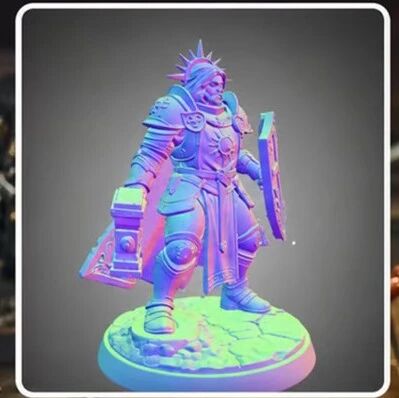
Deemos Hyper3D Rodin Gen-2.5: 3D Generation Enters Its Thinking Era
The world's first 10M-polygon-class 3D generation model: 1M polygons in 4 seconds, 12K high-res textures, five switchable thinking depths, with B2B revenue exceeding the rest of its niche combined.
If you tried early AI 3D generation (the image-to-3D generation), you were probably driven away by misaligned multi-view geometry, messy topology, and stretched textures. Deemos Technologies' newly released Hyper3D Rodin Gen-2.5 aims to end that — it brings the language-model paradigm of "think first, then generate" into 3D, achieving the world's first 10M-polygon-class generation, 1M polygons in 4 seconds, and native 12K textures, while in its first month online, subscribers and ARR both grew more than 400% month over month. This article breaks down its core capabilities, controllability design, and real use cases, to help modelers, product designers, and embodied-AI developers judge whether it's worth paying for.
What Is Deemos Hyper3D
Hyper3D is the native-3D generative model family from Deemos Technologies (founded in 2020, with a team from ShanghaiTech University). Its underlying framework, CLAY, was among the first in the industry to abandon the "lift 2D into 3D" route in favor of training on native 3D data, and it earned a SIGGRAPH best paper nomination. The latest generation, Rodin Gen-2.5, introduces LLM-like Test-time Scaling into 3D generation, letting the model "think before it generates," with five thinking-depth levels ranging from quick drafts to high-precision assets.
In Rodin Gen-2.5's first month online, subscribers and ARR both grew more than 400% month over month, and the consumer side began to overtake B2B.
One-line analogy: Rodin Gen-2.5 is to 3D what the GPT/o series is to code — not "a good-enough image," but production-ready assets.
Core Features
10M-Polygon-Class Generation + 1M Polygons in 4 Seconds
Gen-2.5 is the world's first 3D generation model at the 10M-polygon scale, and in Extreme-High mode it resolves details like skin microstructure, texture, and pores; in fast mode it generates a 1M-polygon model in 4 seconds. This effectively closes the gap that used to separate 3D assets meant for "getting the idea across" from those ready to go straight into film or game post-production.
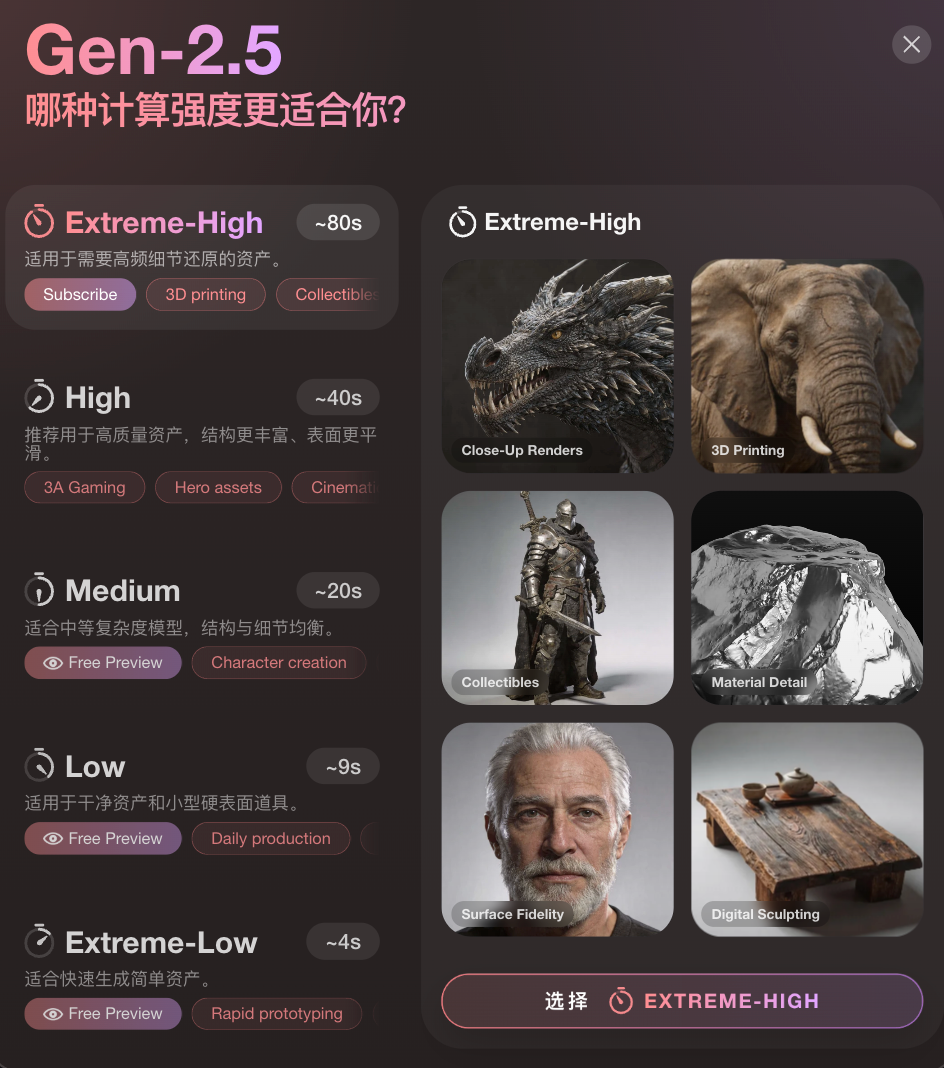
The five thinking-depth levels correspond to generation times from 4 to 80 seconds; switch as needed.
Five Thinking-Depth Levels
Borrowing from LLM Test-time Scaling, users choose the model's thinking time and depth:
- Fast mode: 1M polygons in 4 seconds, for quick drafts and concept validation
- Extreme-High mode: the 10M-polygon class, for high-precision final deliverables
- Intermediate levels: trade off quality against speed per scenario
This design lets one model cover the whole path from inspiration to delivery, with no switching between tools.
Native 12K 3D Textures
Traditional texturing generates materials via projection, which commonly suffers from color banding, bleeding, and blurry logos. Deemos' companion native 3D texture model generates materials in parallel with the geometry stage, keeping logos and text crisp, and supports physically based PBR materials. Combined with the concurrently released 12K native textures, geometric precision and material fidelity can now surpass real-world scans.
Strong Controllability: 3D ControlNet + Partial Editing + Part Splitting
This is Deemos' most important differentiator. On the platform you can:
- Control the length, width, height, and shape of the generation with its in-house 3D ControlNet
- Make natural-language partial edits to platform-generated or third-party models ("make the ears a bit smaller")
- Auto-split 3D assets into parts, with splitting supported again on parts, for articulable assets
Part-splitting extends 3D assets from "static" to "articulable," which matters especially for games and embodied AI.
The Deemos team's core view: the second half of 3D generation has moved from chasing visual quality toward balancing controllability, efficiency, and quality. The seemingly tedious back-and-forth confirmation flow is precisely why paying customers choose them.
Real-World Experience and Positioning
Strengths
- Controllability crushes image-to-3D approaches: trained directly on native 3D data, avoiding multi-view alignment errors
- Confirm step by step, pay only when satisfied: a sign of confidence in the model's usability
- Deep enterprise bench: ByteDance, Unity, Figma, and Canva are all on the client list, and its B2B revenue exceeds that of all other companies in its niche combined
- Dense academic grounding: 30+ papers at SIGGRAPH and other top venues since 2020, with CAST winning SIGGRAPH 2025 Best Paper (in this field, the only award-winning commercial companies are Google, Meta, and Deemos)
Model Iteration Cadence
Four major iterations in the past two years — a fast pace for the 3D space:
- Rodin Gen-1: the world's first native 3D large model
- Rodin Gen-2 (September 2025): added part-splitting
- Rodin Gen-2 Edit (January 2026): the first 3D editing model, making AI 3D editable for the first time
- Rodin Gen-2.5 (June 2026): introduced the thinking mechanism, the 10M-polygon class, and 12K textures
Use Cases
Deemos' product positioning is unambiguous: serve the professionals who actually pay first. On the consumer side the profile is Pro-C (professional consumers); on the enterprise side it spans several high-value scenarios:
| Scenario | Usage |
|---|---|
| E-commerce | 3D product displays, animated poster assets |
| 3D printing | Direct output of printable, production-ready assets |
| Games | Character, prop, and scene assets, with part-splitting for articulated models |
| Industrial design | Rapid generation and iteration of concept prototypes |
| Embodied AI | Sim-Ready assets that enter NVIDIA simulation environments for physics simulation in one click |
| Spatial computing | 3D content production for XR scenes |
Embodied AI deserves a special mention. It places particular demands on 3D assets: physical feedback (weight, colliders) and interactive assets (how parts move once split). Deemos has already shipped physical feedback and published academic work on interactive assets. Within the world-model landscape, Deemos has chosen the vertical but practical route of "making simulatable assets."
How to Get Started
- Platform subscription: visit hyper3d.ai to sign up and subscribe; billing is by model and generation volume
- Enterprise API / on-prem deployment: for enterprise-scale batch calls and customization
- Payment model: confirm the generation step by step and pay only when satisfied
If you work on e-commerce 3D, game assets, or robot simulation environments, Rodin Gen-2.5 is one of the few 3D generation models currently capable of production-ready output, and it merits evaluation as a production tool.
Toolin Editorial Team
Categories
Related articles

Mashangfei: Open an AI Shop in 30 Seconds and Run a Full Vibe Business
Mashangfei generates a complete business system from natural language, covering the full chain of product creation, promotional customer acquisition, and AI customer service. It includes 200 yuan in trial-operation credit, suited to one-person companies closing the business loop fast.

GitHub Cuts Agent Token Costs 62% with Daily Audits
GitHub's gh-aw CLI tool builds an audit-optimize loop through daily token audits and MCP pruning; the Auto-Triage task has sustained a 62% reduction in equivalent token cost.

PawBench: An Open-Source Agent Benchmark with 4050 Test Cells to Help You Pick Models and Frameworks
PawBench v1.0 builds an agent evaluation set of 150 tasks and 4050 test cells, putting base models and runtime harnesses into the same system to help you find the best model + harness combination.

Codex from Install to Real-World Use: A Complete Beginner's Guide for Non-Programmers
A step-by-step tutorial for mastering the OpenAI Codex desktop app from scratch, covering installation and setup, a tour of the interface, creating projects, using skills and plugins, and remote control from your phone.

Coze 3.0: Put a Team of AI Agents to Work for You
Coze 3.0 is officially out, with multi-agent collaboration, remote control of your computer from your phone, one-click import of local agents, and the ability to turn a story idea straight into video.

Kimi Work Beta: From an Agent That Writes Code to an Agent That Does Work
Moonshot AI launches Kimi Work Beta, a general-purpose local agent for knowledge workers supporting 300 sub-agents in parallel, 13-hour long-running tasks, browser control, and skill installation.