
DeepSeek V4 Practical Guide: Costs Just One-Tenth of GPT-5.5
DeepSeek V4 has been released open-source under the MIT license, with a 1M-token context window and output at just $3.48 per million tokens. Real-world tests show coding costs dropping 83% — this is the best window to migrate.

DeepSeek V4 Practical Guide: Costs Just One-Tenth of GPT-5.5
DeepSeek V4 has been released open-source under the MIT license, with a 1M-token context window and output at just $3.48 per million tokens. Real-world tests show coding costs dropping 83% — this is the best window to migrate.
DeepSeek V4 is here. MIT open-source license, a 1 million-token context window, and output at just $3.48 per million tokens — roughly one-tenth of GPT-5.5. Better yet, hands-on tests show its coding ability beating Claude Opus 4.6 and GPT-5.4. If you've been thinking about migrating away from Claude or GPT, this is the best window to do it.
What Is DeepSeek V4
The DeepSeek V4 series includes two models:
| Model | Parameter scale | Activated parameters | Pricing (per million tokens) |
|---|---|---|---|
| DeepSeek-V4-Pro | 1.6T | 49B | Input $5.22 / Output $3.48 |
| DeepSeek-V4-Flash | 284B | 13B | Input $0.14 / Output $0.28 |
Note: The above are standard API prices. On cache hits, V4-Pro input drops to $0.145 and V4-Flash input drops to $0.02. V4-Pro is currently 75% off for a limited time (through May 5), and the cache-hit price is a permanent price cut.
Price comparison
The cost of processing 1 million input tokens + 1 million output tokens:
- GPT-5.5: $35 (standard API)
- Claude Opus 4.7: $30
- DeepSeek-V4-Pro: $5.22 (cache miss) / $3.625 (cache hit)
- DeepSeek-V4-Flash: $0.42 (cache miss) / $0.308 (cache hit)
API pricing comparison of mainstream models — DeepSeek V4-Flash costs less than 2% of GPT-5.5
Before You Start
- A DeepSeek API account (sign up at platform.deepseek.com)
- Your coding tool (Claude Code, Cursor, Aider, etc.)
- Estimated migration time: 10-30 minutes
Step by Step
Step 1: Get your API key
- Log in to the DeepSeek open platform
- Go to the API Keys page and create a new key
- Copy and save it (it is shown only once)
Step 2: Configure the DeepSeek endpoint in your coding tool
Tech blogger Sean Donahoe shared his migration experience: no OpenRouter, no proxy — just use the DeepSeek native API directly.
Claude Code configuration example:
# Set the DeepSeek API endpoint
export DEEPSEEK_API_KEY="your-api-key"
export DEEPSEEK_BASE_URL="https://api.deepseek.com"

# Configure a custom model endpoint in Claude Code
claude config set model deepseek-v4-pro
claude config set apiBase https://api.deepseek.com
claude config set apiKey $DEEPSEEK_API_KEY
Cursor configuration:
Open Settings -> Models -> OpenAI API Key, enter your DeepSeek API Key and Base URL https://api.deepseek.com, and select the model deepseek-v4-pro.
Tip: If you use several tools at once, a good approach is to run V4-Flash for everyday lightweight tasks (it's cheaper) and save V4-Pro for complex coding and reasoning work.
Step 3: Verify your cache hit rate
DeepSeek V4's cache hit rate is very high (about 95% for V4-Pro and 91% for V4-Flash), which means most tokens are billed at the cache-hit price.
# Check your API usage and cache hit rate
import requests

response = requests.get(
    "https://api.deepseek.com/usage",
    headers={"Authorization": f"Bearer {API_KEY}"}
)
print(response.json())
Step 4: Compare results
We recommend running the same task on both models first to compare results and costs.
QbitAI's real-world numbers: a coding job of 35 million tokens cost RMB 31.73 before the discount and just RMB 5.34 after — an overall saving of about 83%.
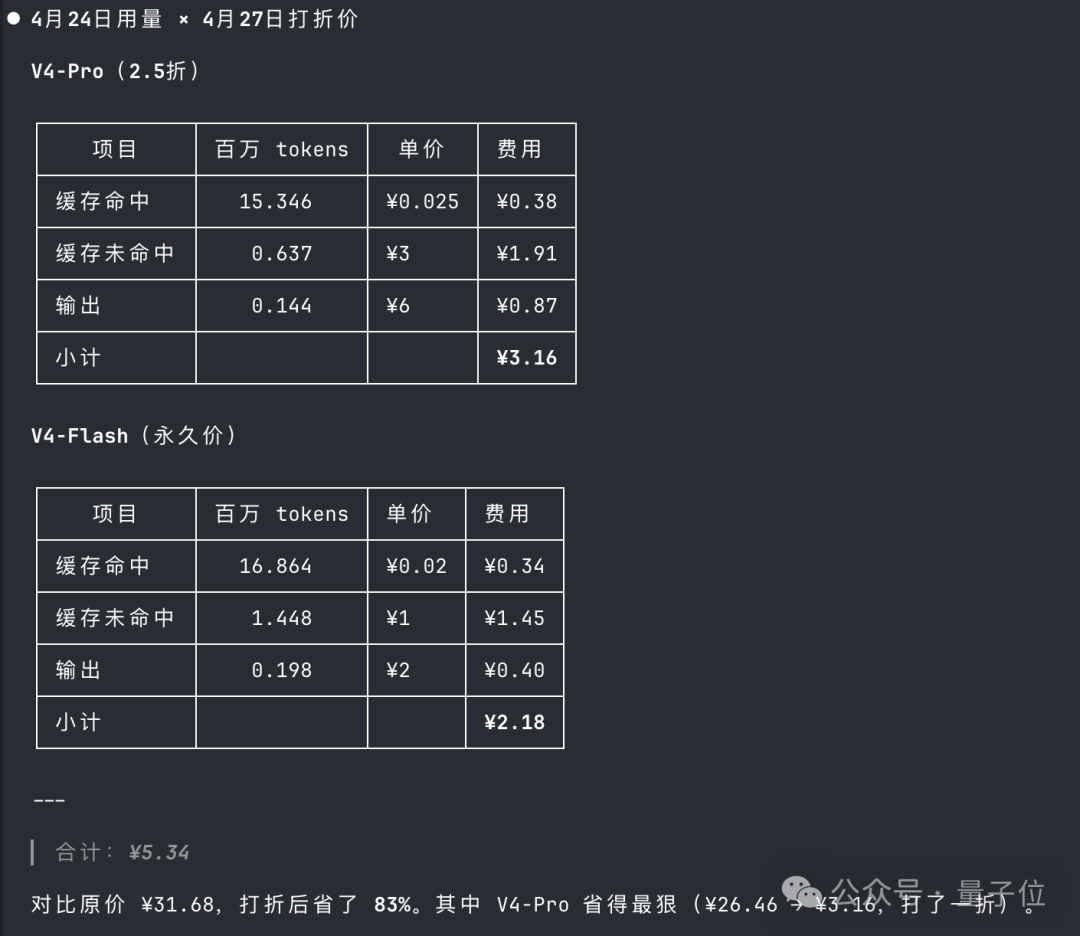
DeepSeek V4 cost comparison before and after the discount — an overall saving of 83%
Technical highlights
- 1M-token context window: Up from 128k in V3 to 1M, well suited to working with large codebases
- MIT open-source license: Self-deploy to bypass API billing, ideal for compliance-sensitive scenarios
- 90% smaller KV cache: Inference efficiency improves dramatically in million-token context scenarios
- Support for Huawei Ascend NPUs: Inference traffic may eventually run on domestic Chinese compute
FAQ
- How big is the gap between V4 and GPT-5.5?: DeepSeek officially acknowledges it is still about 3-6 months behind the frontier models, but in real-world everyday coding tasks it performs on par or better
- When does the Pro limited-time discount end?: Through May 5 at 23:59; the cache-hit input price cut is permanent
- What setup does self-deployment need?: V4-Flash's smaller parameter count can be deployed on a single multi-GPU machine; V4-Pro's 1.6T parameters require a cluster
Related articles
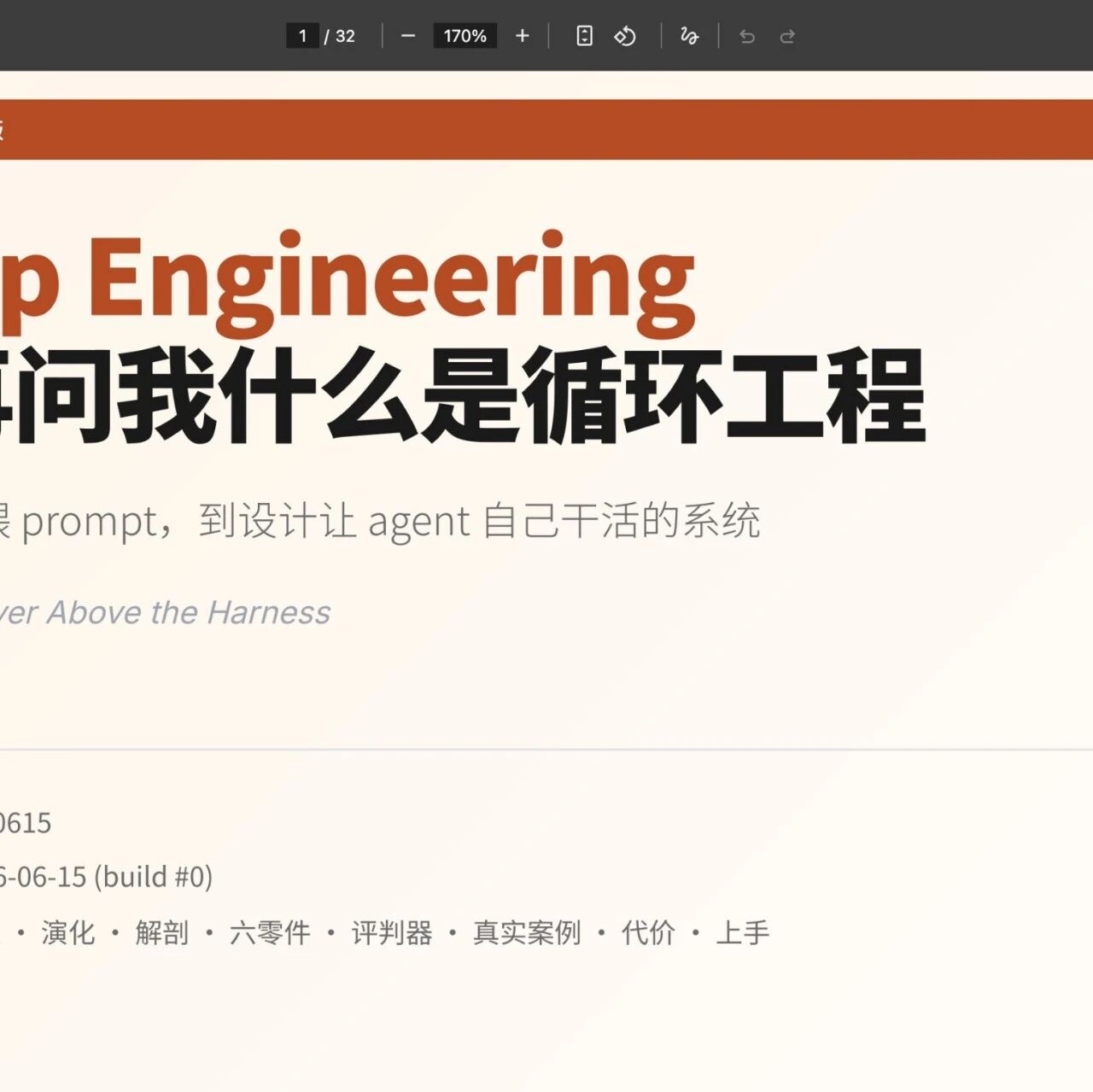
Loop Engineering in Practice: the 32-Page Orange Book, Free and Open Source
The Loop Engineering Orange Book systematically unpacks the concept of loop engineering, its five-step workflow and six core components, with hands-on Claude Code commands; free to read on GitHub and WeChat Reading.

UniRL: Tencent Hunyuan Open-Sources Its Multimodal RL Training Framework
Tencent Hunyuan's Pang Tianyu team has open-sourced UniRL, a single framework covering reinforcement learning training for image, video, and LLM multimodal generative models, supporting mainstream models like SD3, HunyuanVideo, and Qwen.

The Complete Guide to Codex /goal Autonomous Task Scheduling
One sentence of intent is all it takes for Codex to decompose tasks, spawn subagents, and finish 14 features in 18 hours — plus a setup tutorial and the pitfalls to avoid

Cursor: From VS Code Challenger to a $4 Billion AI Coding Powerhouse
A deep dive into Cursor's core features, its in-house Composer 2.5 model, its compute partnership with SpaceX, and how it came to serve 60% of the Fortune 500

AgentDoG 1.5: An Open-Source Security Diagnostics and Guardrail Framework for AI Agents
A lightweight open-source agent security tool from Shanghai AI Lab that analyzes execution-trace risks with three-dimensional diagnostics and supports online guardrail deployment
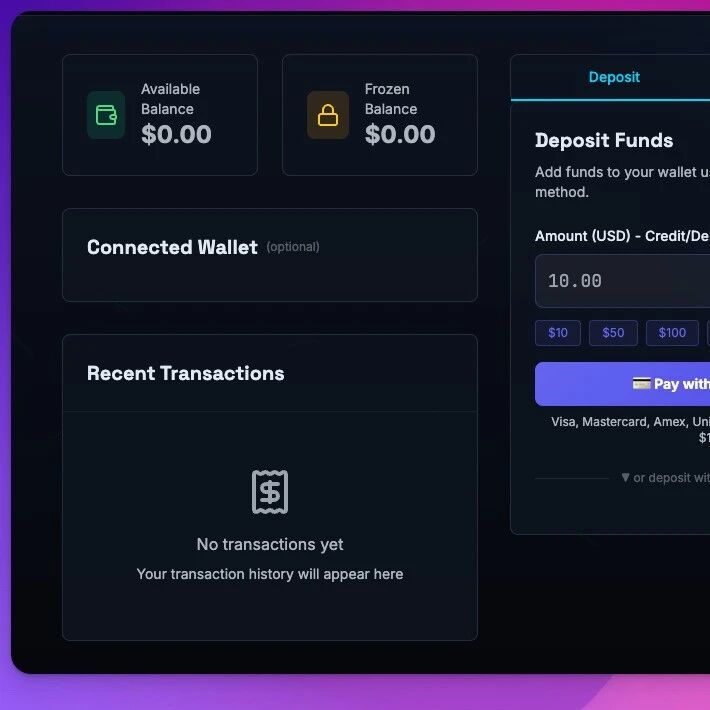
Let AI Agents Take Jobs and Earn Money Automatically: A Hands-On ClawHunt Guide
From deploying an agent to bidding on tasks automatically, a complete walkthrough of how AI agents take on gigs and get paid on the ClawHunt platform