
Cursor: From VS Code Challenger to a $4 Billion AI Coding Powerhouse
A deep dive into Cursor's core features, its in-house Composer 2.5 model, its compute partnership with SpaceX, and how it came to serve 60% of the Fortune 500

Cursor: From VS Code Challenger to a $4 Billion AI Coding Powerhouse
A deep dive into Cursor's core features, its in-house Composer 2.5 model, its compute partnership with SpaceX, and how it came to serve 60% of the Fortune 500
Cursor is an AI code editor built on VS Code, founded by Michael Truell in 2022. It doesn't just bolt an AI plugin onto VS Code — it redesigns the coding workflow from the ground up. It has been adopted by millions of developers, serves 60% of the Fortune 500, and has surpassed $4 billion in revenue.
Core Features
An AI-Native Code Editing Experience
Cursor is not a simple "VS Code + Copilot" mashup. It deeply integrates AI capabilities into every interaction layer of the editor:
- Intelligent code completion: it goes beyond completing the current line, understanding your entire project's context to predict your coding intent across files
- Natural language coding: select a snippet, describe the change you want in plain language, and Cursor makes it for you directly
- Whole-codebase understanding: you can ask Cursor "where is this function called" and it will scan the entire codebase for an accurate answer
The In-House Composer Model
Facing an overreliance on Anthropic's models (Cursor at one point accounted for roughly 40%-50% of Anthropic's revenue), Cursor made a key decision in early 2025: build its own model.
The Composer model suite is built on Moonshot AI's open-source models, but the Cursor team did over 85% of the work themselves. The core strengths of the latest version, Composer 2.5:
- Fast: inference latency is markedly lower than general-purpose large models
- Cheap: optimized for coding scenarios, with lower token consumption
- Strong at coding: steadily climbing multiple coding benchmarks

Multi-Agent Orchestration with /orchestrate
In May 2026, Cursor launched /orchestrate, following closely on Anthropic's multi-agent orchestration. It lets Cursor:
- Automatically split complex tasks into subtasks
- Spawn multiple agents to handle them in parallel
- Aggregate each agent's output
Together with Codex's /goal and Claude's multi-agent orchestration, this forms a three-way race.
Enterprise Capabilities
Cursor's enterprise features are what let it serve large teams:
- Code privacy: the enterprise edition supports on-premises deployment, so code never leaves the intranet
- Team collaboration: shared AI configuration, code style, and project context
- SSO and permission management: enterprise-grade identity authentication
- Compliance auditing: complete operation logs and audit trails
Hands-On Experience
Strengths
- Quick to pick up: if you've used VS Code, migration cost is nearly zero. All VS Code extensions work directly in Cursor
- Strong AI comprehension: the Composer model excels at code generation and modification, especially cross-file refactoring
- Reasonably priced: compared to juggling multiple AI tools at once, Cursor's subscription is more economical
Things to Watch Out For
- Model selection strategy: Cursor supports Claude, GPT, and Composer side by side; different models perform differently on different tasks, so you'll need to feel out the optimal mix yourself
- Hiring controversy: Cursor's internal practice of long unpaid trial work periods has sparked controversy in the community
Use Cases
Indie Developers
Aneesh Dharani, founder of an AI flashcard startup, has no software engineering background, yet he used Cursor to successfully build his product's front end. For founders who don't know a given tech stack but have a clear product vision, Cursor dramatically lowers the barrier to development.
Startup Teams
The story of Devon Lim, founder of a sales startup, is even more telling: he outsourced work to an engineer who then "went dark." In the end he replaced that contractor with Cursor and finished the development work on his own.
Large Enterprises
60% of Fortune 500 companies already use Cursor, spanning finance, tech, manufacturing, and other industries. Cursor's enterprise edition provides code privacy protection and team collaboration features that meet the compliance requirements of large organizations.
The Compute Partnership with SpaceX
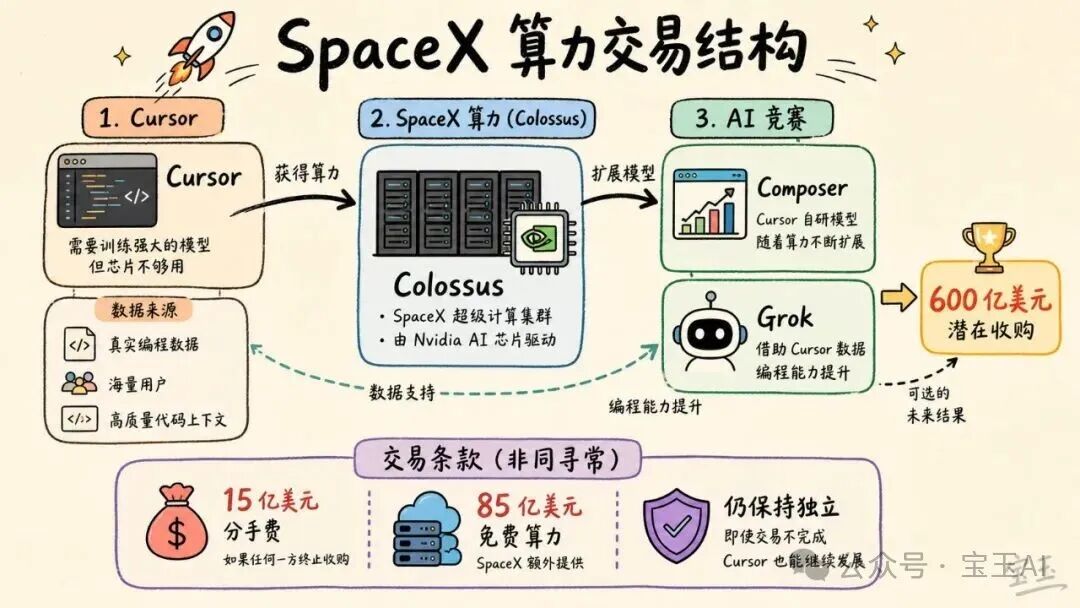
In April 2026, Cursor struck a partnership with SpaceX potentially worth $60 billion. Cursor gained access to Colossus, a supercomputer powered by hundreds of thousands of NVIDIA AI chips, to train and run the Composer models.
The deal's terms are quite unusual: if either party decides to walk away from the acquisition, SpaceX will pay Cursor a $1.5 billion breakup fee, plus an additional $8.5 billion in free compute. That means Cursor gets ample compute support whether or not the acquisition ultimately closes.
Competitive Landscape
The AI coding tools market is in a fierce race:
| Tool | Core Strength | In-House Model | Multi-Agent |
|---|---|---|---|
| Cursor | Editor experience + Composer | Composer 2.5 | /orchestrate |
| Claude Code | Model capability + MCP protocol | Claude | Multi-agent orchestration |
| Codex | Autonomous task scheduling | GPT | /goal |
All three are converging on the same direction: let the AI decompose tasks and dispatch agents on its own. The difference lies in each one's strategic choice -- Codex goes all-in on parallel spawning, Claude caps it at one layer, and Cursor takes the middle road.