
Understanding New Concepts Through Fables: A Prompt Technique from Anthropic
A method from the lead of Claude's personality alignment team: have AI explain any new concept through a fable, with an improved prompt template included
Understanding New Concepts Through Fables: A Prompt Technique from Anthropic
A method from the lead of Claude's personality alignment team: have AI explain any new concept through a fable, with an improved prompt template included
Have you ever had this happen: you learn a new concept, feel like you understand it in the moment, and forget it two days later? This method comes from Anthropic's Amanda Askell (who leads the team responsible for Claude's personality alignment). The core idea is to have AI use a fable to help you grasp the essence of a concept. It doesn't explain the concept directly — it first tells you a story and lets you "realize" it inside the story.
Where the Method Comes From
Amanda Askell is the person behind Claude's Constitution. She shared this idea in a podcast interview: use fables to help understand new concepts.
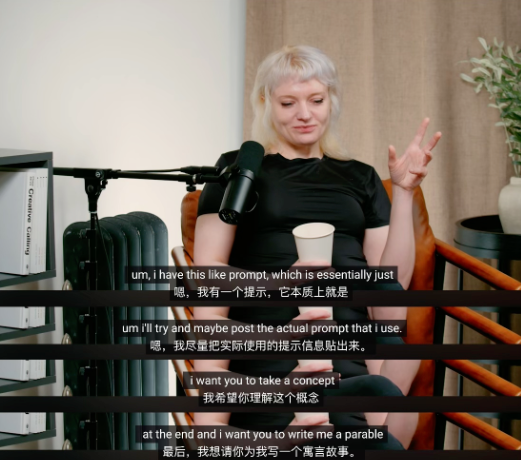
The core design of the original prompt:
- Have AI write a fable around a concept from a given domain
- The concept's name and domain jargon never appear at any point
- Only near the end does the reader vaguely sense what it's about
- The story itself carries all the meaning
Why Fables Work
In the past, learning new knowledge mostly meant grinding straight through concepts and definitions. But the path a fable takes is completely different:
- It first gives you an engaging story
- When you finish reading, you may well feel it has nothing directly to do with what you're supposed to learn
- Yet you have already "grasped" the core essence of the concept
- Stories are, in any form of learning, forever the most effective vehicle
The Improved Prompt Template
The original prompt has a few problems in practice: AI-written fables tend to fall into the same narrative structures (rivers, clocks, and mountains show up constantly), and GPT in particular loves writing eerie place names like "Echo City".
Below is the optimized version, which adds anti-formula constraints and two check questions:
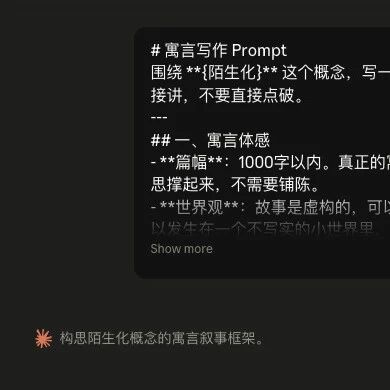
# Fable-writing prompt

Around the concept {concept}, write a fable that explains it completely.
Tell it indirectly, the way a true fable does — never state it outright.

---

## 1. Fable feel

- Length: under 1,000 words. A true fable is lean; one core scene and one or two turns carry the meaning. No padding.
- Worldbuilding: the story is fictional and may be anthropomorphized — talking animals, plants, or objects are all fine;
  it can unfold in an unreal little world, or land in a seemingly everyday micro-scene.
- Characters: no more than three, two is best. Their relationships or interactions should themselves carry the moral.
- Reveal pacing: the concept's name never appears, and no jargon from the field is used.
  Only near the end does the reader vaguely sense what it's about.
- Narrative discipline: let the plot and details carry the meaning; don't let characters step out and act as narrators.

---

## 2. Anti-formula self-check

Before writing, run through the checklist below and avoid each item.

### Image blacklist
Clocks, rivers, mirrors, mazes, looms, maps, lighthouses, chessboards, echoes, shadows,
hourglasses, wind, candles, seeds, bridges, stars, butterflies, spider webs.

### Place-name blacklist
No over-poetic fictional place names like "Echo City," "Village of Memory," "Sea of Forgetting," or "Silent Valley."
Use a plain geographic noun, or don't name the place at all.

### Structure blacklist
- A traveler seeks out a sage
- A strange omen strikes a village, and everyone attains enlightenment
- A child's single sentence awakens the adults
- A master-apprentice debate
- Deathbed last words

### Character blacklist
Watchmakers, librarians, hermits, storytellers, old ferrymen, brewers, blacksmiths, scribes.

### Opening blacklist
No openings like "Once upon a time there was a place..." "One day someone encountered something..." "Deep in the distant mountains..."
Get straight into the scene.

---

## 3. Angles of approach

The following directions are encouraged first and may be combined:

- Non-human perspective: a tool, an animal, a plant, or an institution narrating itself.
- Specific modern jobs and settings: insurance claims adjuster, elevator maintenance worker, market-stall vendor, night-shift nurse.

---

## 4. Ending

After the story ends, pose two questions:

1. One that tests whether the reader truly understood the core of the concept.
2. One that tests whether the reader can transfer what they learned to other domains.
How to Use
Copy the prompt above into any AI chat tool (ChatGPT, Claude, and DeepSeek all work), and replace {concept} with the concept you want to understand.
Usage examples:
Around the concept "defamiliarization", write a fable that explains it completely.Around the concept "regularization", write a fable that explains it completely.Around the concept "marginal cost", write a fable that explains it completely.Design Highlights of This Prompt
The anti-formula mechanism is the key innovation. AI story writing has a chronic flaw: elements that appear frequently in training data get reused over and over. Ask an AI to pick any number and it will most likely pick 7, 13, or 42. The blacklist mechanism forces the AI to approach from an unusual angle and avoids the same-old-same-old.
Specify a concept, not a domain. The original version only specified a domain and let the AI pick the concept, but in practice you usually want to understand one specific concept. The improved version specifies the concept directly.
Two closing questions. The first tests whether you have truly understood the core of the concept; the second checks whether you can transfer it to other domains. That adds a learning loop on top of simply reading the story.
Who It's For
- Team managers: when sharing new concepts with your team, use a fable instead of a dry definition
- Content creators: explain complex concepts to non-expert readers
- Students and self-learners: quickly build intuitive understanding of new concepts
- Product managers: use stories to lower the comprehension barrier in cross-team communication
Related articles

ChatGPT's Memory System Gets a Full Overhaul: Dreaming V3 Is Live
OpenAI ships the new Dreaming V3 memory architecture — ChatGPT now "dreams" in the background to organize what it knows about you. Free access for 1 billion users for the first time, with doubled memory capacity for Plus/Pro.

Cloudflare Integrates Claude Managed Agents: A Developer's Practical Guide
Cloudflare adds support for Claude Managed Agents, letting developers run Claude agents on Cloudflare's platform, connect to private systems, and deploy AI agents securely.

Claude Code vs Codex: A Panoramic Timeline of 24 Features
A timeline breakdown of the 24 features both AI coding agents share — Claude Code shipped 18 of them first, but the gap is now closing in days, not months.

Higress: The AI-Assisted K8s Gateway Migration Tool
An AI-assisted migration approach showcased by CNCF converts 60 ingress-nginx resources into Higress configuration automatically in about 30 minutes, slashing K8s gateway migration costs.

JoyAI-Echo: An Open-Source Framework for 5-Minute Long-Video Generation
JD's open-source AI long-video framework generates cross-shot audio-video up to 5 minutes in a single pass, supports local edits, and says goodbye to gacha-style rerolling.

OpenSquilla: A Token-Saving Middleware Layer for Agents
An open-source Agent Harness framework that cuts Agent token costs by more than 50% through intelligent routing, context management, and self-evolution.