
Gamma-World: An Open-Source Multi-Agent World Model
NVIDIA and Tsinghua have open-sourced a multi-agent world model: trained on two players, it generalizes directly to four, supporting zero-shot real-time rollouts of multiplayer scenarios
Gamma-World: An Open-Source Multi-Agent World Model
NVIDIA and Tsinghua have open-sourced a multi-agent world model: trained on two players, it generalizes directly to four, supporting zero-shot real-time rollouts of multiplayer scenarios
Existing video world models (Sora, Cosmos, Genie) all assume there is only one participant in the world. But in real scenarios, multiplayer games, factory production lines, and robot collaboration all require multiple agents sharing one evolving world. Gamma-World, released by NVIDIA together with Tsinghua University and the University of Toronto, redesigned position encoding and attention from the ground up to make multi-agent world models truly scalable and generalizable.
The Core Problem: Why Multi-Agent Is So Hard
A single-agent world model only needs to maintain temporal consistency. The multi-agent setting requires the model to simultaneously maintain three kinds of consistency:
- Temporal consistency: The footage stays coherent over time
- Cross-view consistency: How player A appears in player B's view matches A's trajectory
- Interaction consistency: Multiple agents' operations on the shared environment produce consistent state changes across all views
The previous strongest approach, Solaris, had two structural flaws: identity encoding broke symmetry (players 1 and 2 were learned as different roles), and the compute of fully connected attention grew quadratically with the number of players.
Three Core Designs
1. Simplex Rotary Agent Encoding
Gamma-World adds a fourth axis to the three axes of standard video RoPE (time, height, width): the player axis. The key lies in how the player axis is encoded.
It places all players on the vertices of a regular simplex:
- 2 players = the two ends of a line segment
- 3 players = the three vertices of an equilateral triangle
- 4 players = the four vertices of a regular tetrahedron
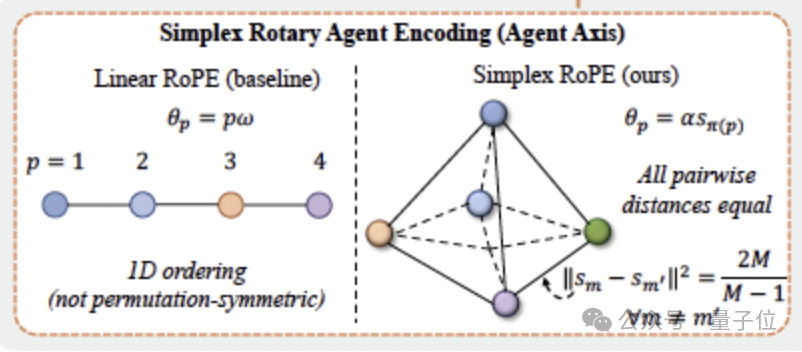
For any two players, their distance in rotary-angle space is exactly the same — nobody is more special than anyone else. This encoding requires no learnable parameters at all; to support more players at inference, just take a few more vertices from the vertex pool — no architecture changes, no retraining.
2. Sparse Hub Attention
Fully connected attention makes every pair of tokens interact, and compute reaches 7.6T with 8 players. Gamma-World introduces a set of learnable hub tokens as a shared communication hub:
- Each agent interacts only with its own history and the hub tokens
- The hub tokens aggregate information from all agents and broadcast it back
- The information path becomes two hops: agent -> hub -> agent
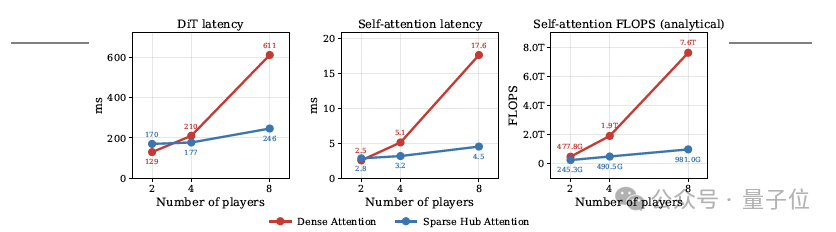
Computational cost drops from quadratic to linear complexity. With 8 players, Gamma-World's compute consumption is only 1/8 of the fully connected approach, and latency drops from 17.6ms to 4.5ms.
3. Three-Stage Distillation
From a bidirectional teacher (highest quality but cannot stream) to a causal student (supports streaming but with quality loss), conditional Self-Forcing distillation compresses multi-step sampling into 4-step sampling, ultimately achieving 24 FPS streaming rollouts.
Key Results
Zero-Shot Four-Player Generalization
The model was trained only on two-player data, yet at inference it directly generates four synchronized views, without modifying any architectural parameters.
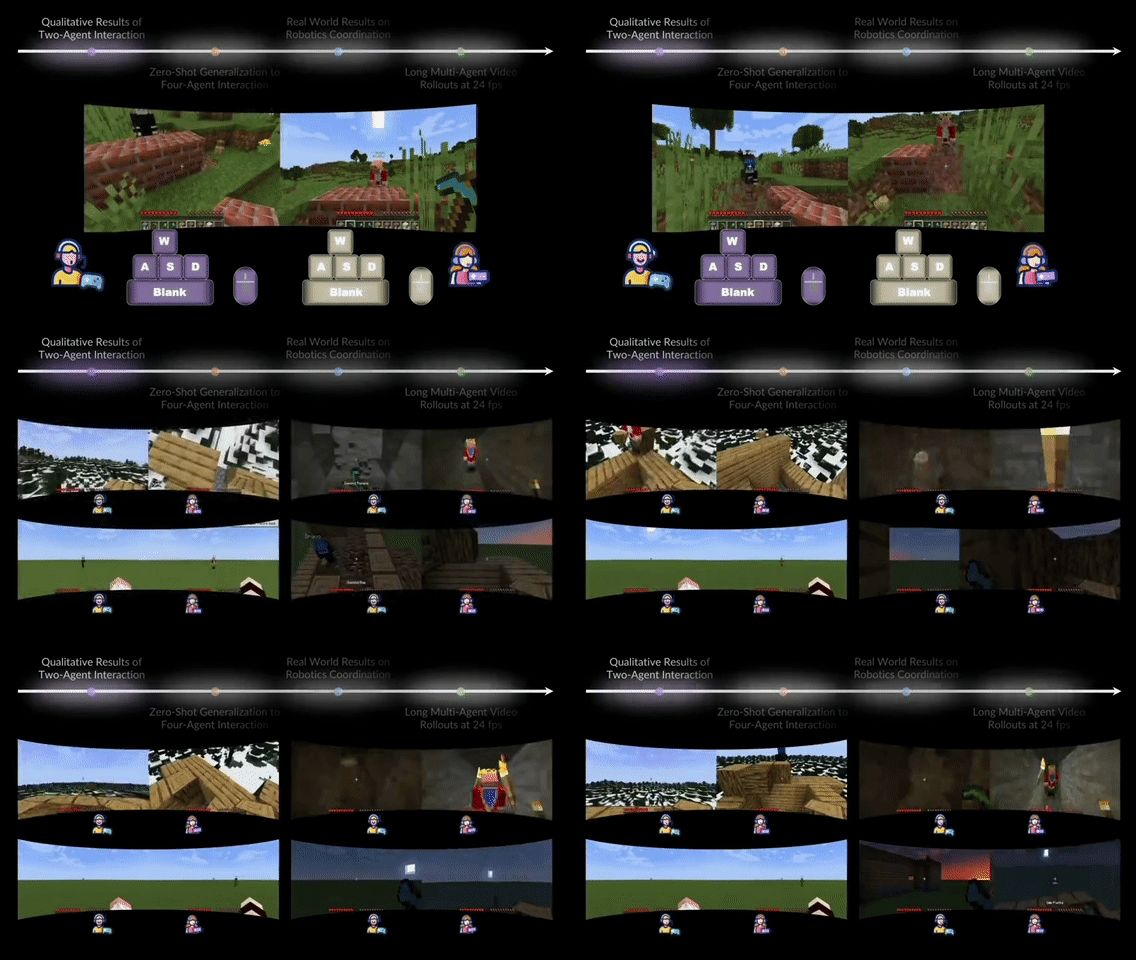
This is a direct validation of simplex encoding: generalizing to any player count requires no training data seen at that count.
From Games to Real Robots
The same framework transfers directly from Minecraft to real dual-arm robot collaboration tasks, with each of the left and right arms acting as an independent agent; the generated future frames preserve dual-arm coordinated motion and spatial layout, with no extra adaptation.
Comprehensively Surpassing Solaris
Across five categories of multiplayer Minecraft scenarios, Gamma-World's FVD (a video generation quality metric) drops by more than 40% on average. Ablations show the simplex encoding delivers the largest single-step gain.
Where to Get It
- Project page: https://research.nvidia.com/labs/sil/projects/gamma-world/
- GitHub: https://github.com/nv-tlabs/Gamma-World
- HuggingFace: https://huggingface.co/papers/2605.28816
Use Cases
- Real-time simulation and data generation for multiplayer game environments
- Simulation training for multi-robot collaboration tasks
- Multi-agent interaction research for embodied agents
- Neural simulation infrastructure for Physical AI
Gamma-World's core methodology is to encode the understanding of a problem's structure directly into the architecture, rather than hoping the model discovers it from data on its own. If you work on multi-agent simulation, robot collaboration, or game AI, this framework deserves a close look.