
GLM-5.2 Released as Open Source: 1M Context, No.1 Worldwide for AI Coding
Zhipu has released GLM-5.2 with a million-token context window, ranked first among globally available models on Code Arena, open-sourced under the MIT license so developers can deploy and use it commercially at will.
GLM-5.2 Released as Open Source: 1M Context, No.1 Worldwide for AI Coding
Zhipu has released GLM-5.2 with a million-token context window, ranked first among globally available models on Code Arena, open-sourced under the MIT license so developers can deploy and use it commercially at will.
GLM-5.2 is the flagship coding model released and open-sourced by Zhipu AI on June 17, 2026. It took first place among globally available models on Code Arena, a global blind-test platform, supports lossless context of 1 million tokens, and is designed for long-horizon tasks. The model weights follow the MIT license and can be freely downloaded, deployed, and used commercially.
If you are a developer who needs to work continuously on large codebases, or you need an AI coding foundation that can autonomously drive complex engineering tasks across many hours, GLM-5.2 is worth a try.
Core Capabilities
1M Lossless Context
GLM-5.2 achieves a true 1M (million-token) context window. Most previous long-context models started degrading noticeably past a few hundred thousand tokens. GLM-5.2 expanded its Coding Agent training environments to cover automated research, performance optimization, and other domains, and at 1M context its performance sometimes even exceeds Claude Opus 4.7.
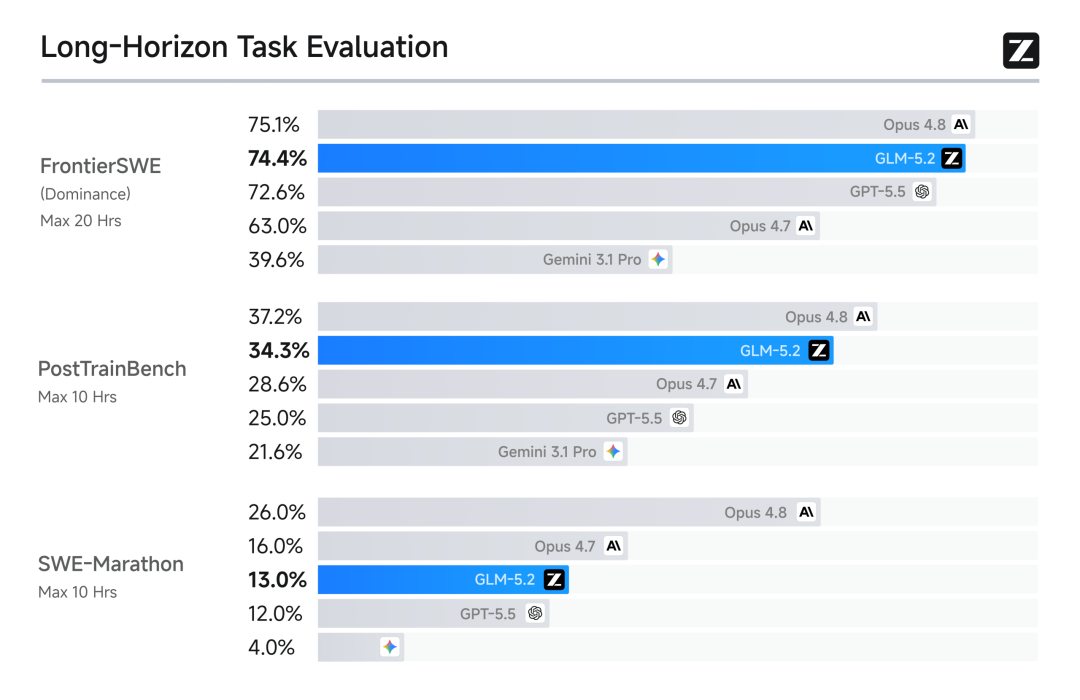
On FrontierSWE, GLM-5.2 trails Opus 4.8 by only 1%, ahead of GPT-5.5 and Opus 4.7.
In one real-world test, GLM-5.2 handled development, integration debugging, testing, packaging, and release, delivering a complete multi-platform app spanning web, mobile, and mini programs — processing 880K tokens in total, nearly filling the 1M context window.
Coding Ability
On Code Arena (the global blind-test platform for large models), GLM-5.2 scored 1595, ranking second on the overall board and first among globally available models. On Design Arena (a benchmark evaluating model taste), it took first worldwide.
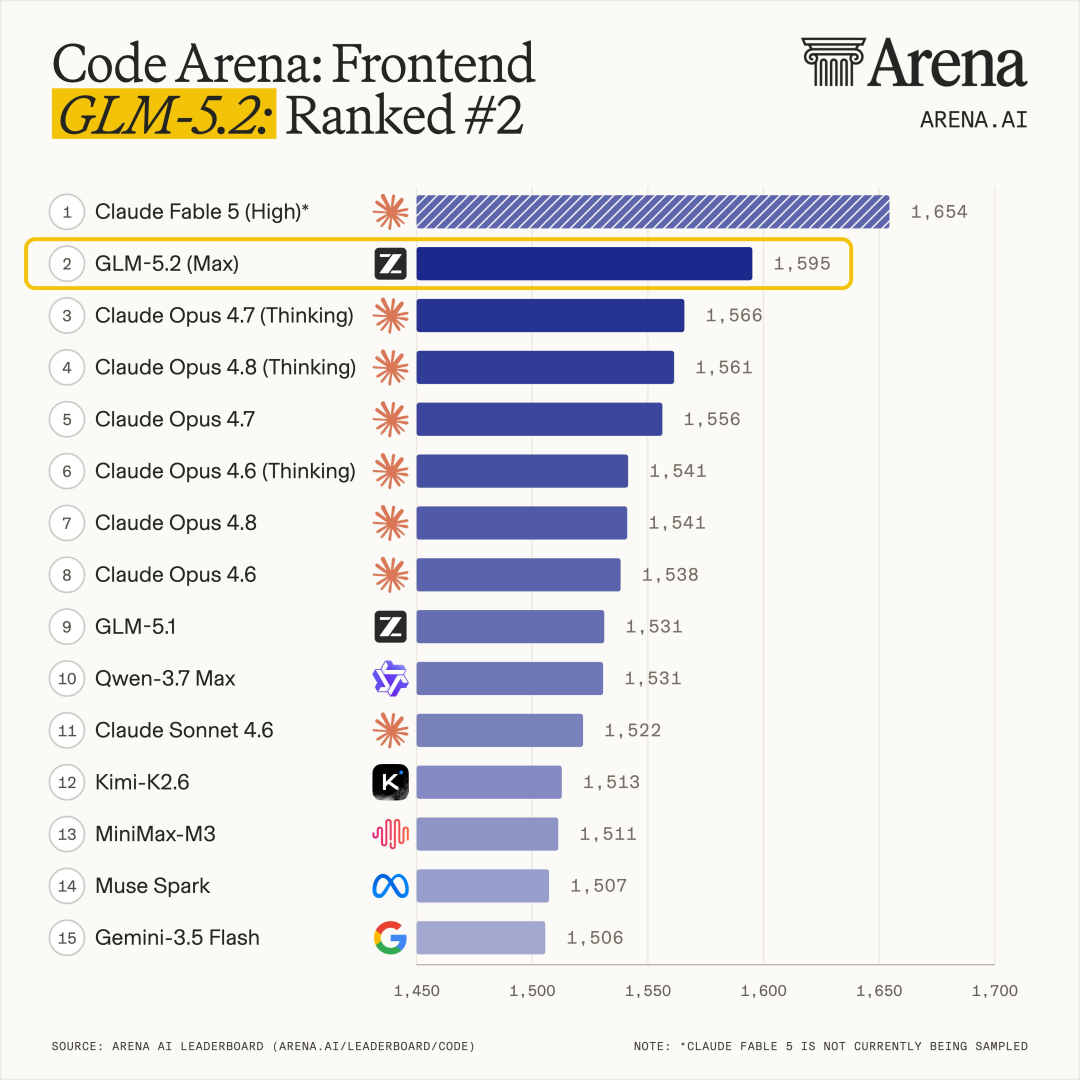
Code Arena coding evaluation system rankings.
Core improvements reported by developers include:
- Stronger project-level context handling — a full engineering project fits into a single reasoning chain
- More stable long-horizon task execution — complex tasks keep moving forward without going off track midway
- More reliable adherence to production-grade engineering standards, holding the hard constraints of team development workflows
- Stronger client-side and mobile engineering, closing the loop with real-device debugging
Thinking Effort Control
GLM-5.2 introduces effort level control, letting you balance capability, speed, and cost. Two thinking-intensity settings are available, High and Max; for complex coding tasks you can engage the higher level to ensure rigor in architecture-level logic.
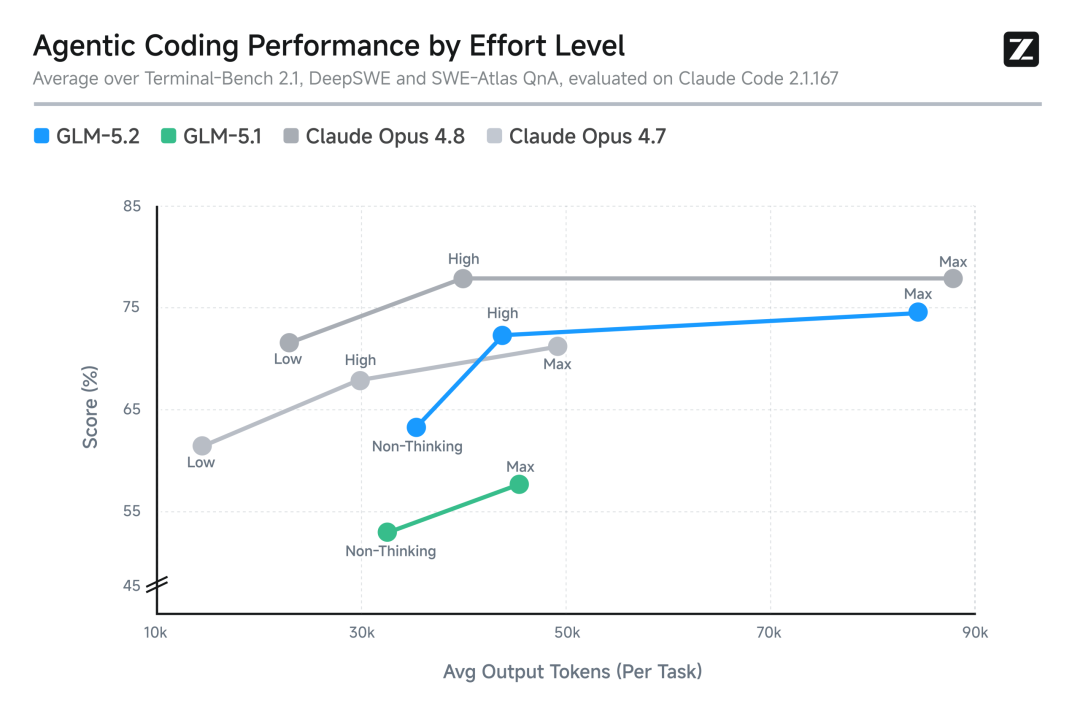
At similar token budgets, GLM-5.2's coding ability sits between Claude Opus 4.7 and 4.8.
How to Use It
Open-Source Downloads
- GitHub: https://github.com/zai-org/GLM-5
- Hugging Face: https://huggingface.co/zai-org/GLM-5.2
- ModelScope: https://modelscope.cn/models/ZhipuAI/GLM-5.2
The model weights follow the MIT License with no regional restrictions. Mainstream inference frameworks including vLLM, SGLang, and transformers already support it.
API Access
- BigModel Open Platform: https://docs.bigmodel.cn/cn/guide/models/text/glm-5.2
- Z.ai: https://docs.z.ai/guides/llm/glm-5.2
Online Trial
- Z.ai: https://chat.z.ai
- Zhipu Qingyan app/web version: https://chatglm.cn
Agent Products
- AutoClaw (office scenarios): https://autoglm.zhipuai.cn
- ZCode (coding tool): https://zcode.z.ai/cn
When to Use 1M Context
Not every task needs 1M context. The scenarios where it shines most:
- Whole-repository code understanding and architecture analysis
- Cross-file bug hunting (tracing along the call chain)
- Long-running refactors and large feature additions
- Research projects with multiple deliverables (reports, spreadsheets, charts, scripts)
- Ultra-long document review
For lightweight tasks like tweaking a small function or adding a simple script, providing only the necessary files is actually faster and cleaner.
Underlying Technical Optimizations
GLM-5.2's progress comes from co-design across model architecture, inference systems, and training infrastructure:
- IndexShare: reuses the same indexer between every four sparse attention layers, cutting per-token FLOPs to 2.9x
- Improved MTP layer: used for speculative decoding, boosting acceptance length by up to 20%
- In-house Slime framework: supports large-scale Agentic RL and OPD training
On day 0, inference adaptation was completed with domestic compute platforms including Huawei Ascend, T-Head, Moore Threads, Cambricon, Kunlunxin, MetaX, Hygon, and Biren.
Related articles
Finding Overseas Influencers with AI Employees: A Hands-On AhaCreator Guide
A step-by-step walkthrough of the full overseas influencer marketing workflow with AhaCreator — from creator sourcing and content review to cross-border payouts. Ideal for indie developers and teams going global.

AI Long-Video Generation: A Head-to-Head Review of Two Open-Source Frameworks
VideoClaw and JoyAI-Echo, two open-source frameworks released the same day, tackle AI long-video consistency through multi-agent collaboration and cross-modal memory banks respectively — this article compares their technical approaches.

ChatGPT's Memory System Gets a Full Overhaul: Dreaming V3 Is Live
OpenAI ships the new Dreaming V3 memory architecture — ChatGPT now "dreams" in the background to organize what it knows about you. Free access for 1 billion users for the first time, with doubled memory capacity for Plus/Pro.

Cloudflare Integrates Claude Managed Agents: A Developer's Practical Guide
Cloudflare adds support for Claude Managed Agents, letting developers run Claude agents on Cloudflare's platform, connect to private systems, and deploy AI agents securely.

Claude Code vs Codex: A Panoramic Timeline of 24 Features
A timeline breakdown of the 24 features both AI coding agents share — Claude Code shipped 18 of them first, but the gap is now closing in days, not months.

Higress: The AI-Assisted K8s Gateway Migration Tool
An AI-assisted migration approach showcased by CNCF converts 60 ingress-nginx resources into Higress configuration automatically in about 30 minutes, slashing K8s gateway migration costs.