
Kimi K3 Hands-On: A 2.8T-Parameter Open-Source Flagship That Clones a Paid Screen-Recording Tool in Half a Day
Moonshot AI has open-sourced Kimi K3: 2.8T parameters, 1M-token context, positioned against Sonnet 5's top tier. This piece breaks down its capability positioning, pricing strategy, and what you can actually verify.
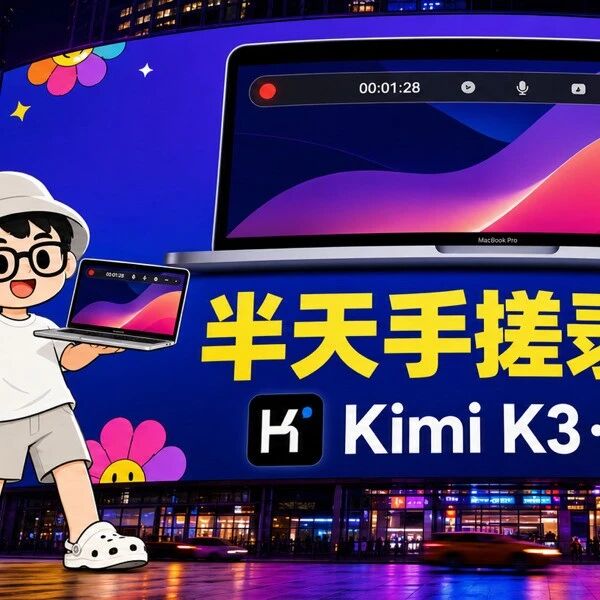
Kimi K3 Hands-On: A 2.8T-Parameter Open-Source Flagship That Clones a Paid Screen-Recording Tool in Half a Day
Moonshot AI has open-sourced Kimi K3: 2.8T parameters, 1M-token context, positioned against Sonnet 5's top tier. This piece breaks down its capability positioning, pricing strategy, and what you can actually verify.
On July 16, Moonshot AI released Kimi K3 — a natively multimodal open-source model with 2.8 trillion (2.8T) parameters, currently the largest open-source model by parameter count. The official pitch centers on three things: 1M-token context, long-horizon coding, and deep reasoning. The hottest community discussion isn't about the parameter count, though — it's about pricing positioned against Sonnet 5's top tier, and the fact that someone used K3 to clone a $29/month screen-recording tool into a free Mac app in half a day. This article lays out what K3 is, how to access it, how it's priced, and which capabilities can be independently verified — aimed at developers choosing an open-source coding model.
What Kimi K3 Is
Kimi K3 is an open-source model released by Moonshot AI on 2026-07-16, positioned for long-horizon coding, knowledge work, and deep reasoning.
Key facts:
- Parameter count: 2.8T, the largest among current open-source models
- Natively multimodal: text, images, and more unified in a single set of weights, with no bolt-on vision module
- Context: 1 million (1M) tokens — enough to feed an entire repository's code or long documents in one pass
- Open source: weights already released, repository at github.com/moonshotai
- API: official docs at platform.kimi.com/docs/guide/kimi-k3-quickstart
Think of it as "one of the top-scoring primary coding models in open source" — its benchmark target isn't the rest of the open-source field but directly Anthropic's Sonnet 5 top tier.
Core Capabilities (Ranked by Verifiability)
1. Arena Leaderboard Performance
K3 topped the lmarena Arena leaderboard and took first in the WebDev Arena. In head-to-head comparisons, the positioning from both officials and the community is:
- On par with / ahead of Fable 5 (one of Anthropic's primary coding models)
- Trades wins and losses with Opus 4.8 across multiple tasks
💡 Tip: Arena is a human blind-vote leaderboard — relatively neutral, but sample size and task distribution drift over time. Treat it as a reference line during model selection, not a conclusion.
2. Long-Horizon Autonomous Task Demos
Officials published two deliberately extreme demos:
- 48-hour autonomous chip design: from requirements to tape-out-level design, driven autonomously by the agent throughout
- Writing a GPU compiler from scratch: code generation covering the complete toolchain
Both demos lean toward "long-horizon agentic tasks," K3's headline differentiator. When watching demos like these, focus on the stop conditions and intermediate checkpoints rather than just the final result — that's the real test of whether an agent can sustain long tasks.
3. A Hands-On Sample: Cloning a Paid Screen-Recording Tool in Half a Day
Content creator "Hua Shu" ran a rather concrete engineering test: using a $29/month screen-recording SaaS as the reference product, he used Kimi K3 to clone it into a free native Mac app within half a day.
What makes this kind of test valuable:
- Clear task boundaries: there's a well-defined reference product
- Verifiable deliverable: a working Mac app, not "it feels smarter"
- Quantifiable time cost: half a day
If you're evaluating K3's viability for "0-to-1 small desktop apps," this is a benchmark worth reproducing.
Pricing Strategy
K3's API pricing is a signal worth watching:
| Dimension | Kimi K3 | Benchmark |
|---|---|---|
| Parameter count | 2.8T (open source) | Sonnet 5 (closed source) |
| Price tier | Top tier | Benchmarked against Sonnet 5 |
| Price increase | Nearly 4x vs. the previous generation | Directly benchmarked against Sonnet 5 |
| Video generation | Not pursuing for now | — |
Pricing an open model close to closed-source flagship levels reflects Moonshot AI's judgment: K3's capability justifies the tier. Whether it's worth it — run a benchmark round on your own real workload before drawing conclusions.
How to Get Started
Path A: Call the API Directly
# Docs: https://platform.kimi.com/docs/guide/kimi-k3-quickstart
# 1. Register at platform.kimi.com and create an API Key
# 2. Follow the official quickstart; compatible with the OpenAI SDK calling style
Suited to: developers building application integrations who need a stable SLA and don't want to self-host.
Path B: Deploy the Weights Yourself
# Repository: https://github.com/moonshotai
# Note: 2.8T parameters impose extreme VRAM demands; single-machine inference is not feasible
# Requires multi-GPU (H100/H200 class) tensor parallelism
Suited to: enterprise teams with GPU clusters, data-compliance requirements, or deep customization needs.
Use Cases
- Repository-scale code understanding and refactoring: 1M context fits a mid-sized project in one shot for cross-file changes
- Long-horizon agentic tasks: multi-step engineering work requiring continuous planning and self-checks (such as cloning a complete product)
- Frontend development: first place in the WebDev Arena, well suited to UI code generation and iteration
- Self-hosted primary coding model: open weights plus high capability, for environments that can't call external APIs
Before You Use It
- Benchmarks vs. real tasks: Arena standings and vendor demos are both "reference lines." Before selecting, pull at least 10-20 real tasks from your own business for an A/B against your current primary model.
- Deployment bar: 2.8T parameters won't run on just any consumer GPU. Work out inference cost and VRAM requirements before attempting self-hosting.
- Pricing vs. value: top-tier pricing benchmarked against Sonnet 5 — whether that's worth it depends on your task mix. If "long context + multi-step reasoning" dominates your tasks, K3's marginal value is higher; for short Q&A, a cheaper model may serve you better.
References
- Official API docs: platform.kimi.com/docs/guide/kimi-k3-quickstart
- Open-source repository: github.com/moonshotai
- lmarena Arena leaderboard: lmarena.ai