
MiniCPM-o 4.5: A Full-Duplex, Omni-Modal AI Assistant on a Consumer GPU
ModelBest's open-source 9B-parameter full-duplex omni-modal model runs locally on just 12GB of VRAM and can watch, listen, and speak at the same time. Online demo and one-click installer included.
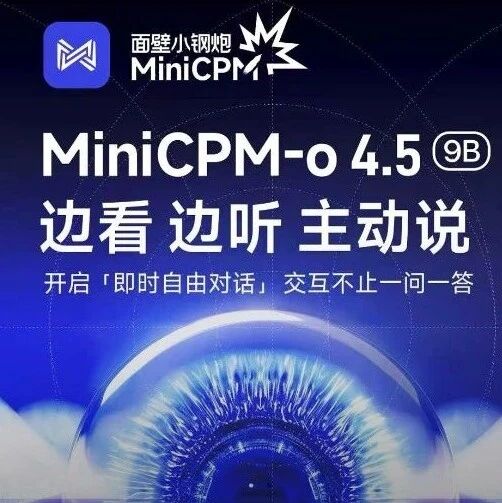
MiniCPM-o 4.5: A Full-Duplex, Omni-Modal AI Assistant on a Consumer GPU
ModelBest's open-source 9B-parameter full-duplex omni-modal model runs locally on just 12GB of VRAM and can watch, listen, and speak at the same time. Online demo and one-click installer included.
Without an internet connection, using just one consumer-grade graphics card, you can have a humanoid AI assistant on your personal computer that "watches, listens, speaks, and even proactively reminds you". This is not a concept -- MiniCPM-o 4.5 has already turned it into something that runs directly on your computer.
MiniCPM-o 4.5 is the industry's first end-to-end full-duplex omni-modal large model, released by ModelBest together with Tsinghua University. At just 9B parameters, it delivers a complete closed loop of multimodal perception plus streaming voice interaction. Downloads on Hugging Face have already broken 250,000+.
What Is MiniCPM-o 4.5
Simply put, it is an AI assistant model that can "watch video, listen to sound, talk back, and remind you proactively" all at the same time. Its biggest differences from traditional large models:
- Full-duplex interaction: you do not have to wait for it to finish before speaking -- you can interrupt or cut in at any moment, and it senses it in real time
- Omni-modal: video, audio, and text input plus text and speech output, all handled by a single model
- Works offline: everything runs locally, and your data never leaves your computer
How to Try It
Option 1: Online demo (zero barrier)
No registration, no downloads -- just open your browser:
- Desktop: https://minicpmo45.modelbest.cn/
- Mobile (recommended): https://minicpmo45.modelbest.cn/mobile/
The demo showcases three interaction modes -- traditional turn-based chat, full-duplex voice interaction, and full-duplex video interaction -- with full control over parameters such as the Prompt and reference audio.
Option 2: One-click installer Comni (recommended)
ModelBest provides Windows/macOS desktop installers that bundle model download, environment setup, and demo runtime.
Windows version:
- GitHub: https://github.com/tc-mb/llama.cpp-omni/releases/latest/download/Comni-Setup-win64.exe
- ModelScope: https://modelscope.cn/models/OpenBMB/MiniCPM-o-4_5-gguf/resolve/master/app/Comni-Windows-x64.exe
- Hardware requirement: a GPU with 12GB+ VRAM (RTX 4080/4090/5070/5080/5090)
macOS version:
- GitHub: https://github.com/tc-mb/llama.cpp-omni/releases/latest/download/Comni-macOS-arm64.dmg
- ModelScope: https://modelscope.cn/models/OpenBMB/MiniCPM-o-4_5-gguf/resolve/master/app/Comni-macOS-arm64.dmg
- Hardware requirement: M1-M5 Max/M5 Pro, 16GB+ of memory recommended
Option 3: Free API
API endpoint: https://api.modelbest.cn/minicpmo45/v1/
It is currently free and open, supports omni-modal full-duplex real-time interaction, and needs no VAD mechanism to control dialogue turns. API documentation: https://api.modelbest.cn/minicpmo45/docs
Option 4: Deploy from the open-source code
The demo's front-end and back-end code is fully open source: https://github.com/OpenBMB/MiniCPM-o-Demo
Linux users can clone the repository and deploy the complete demo service -- one of the first locally deployable full-duplex omni-modal interaction demo projects.
Core Technology: The Omni-Flow Streaming Omni-Modal Framework
MiniCPM-o 4.5's core breakthrough is the Omni-Flow streaming omni-modal framework. It creates a shared millisecond-level timeline that precisely aligns every information stream -- vision, audio, language -- onto time slices. The model refreshes its awareness of the environment at a high frequency of once per second and autonomously decides when to speak and when to remind.
The model architecture consists of four major modules:
- Vision encoder (0.4B): SigLIP-ViT, in charge of "seeing"
- Audio encoder (0.3B): Whisper-Medium, in charge of "listening"
- LLM base (8B): Qwen3-8B, in charge of "thinking"
- Speech token decoder (~0.3B): a lightweight Llama architecture that converts text into speech
Performance
Do not be fooled by the 9B parameter count -- MiniCPM-o 4.5 delivers standout results on several fronts:
- Vision: an OpenCompass composite score of 77.6 and an MMBench English score of 87.6, on par with Gemini 2.5 Flash
- Omni-modal interaction: fully surpasses Gemini 2.5 Flash and Qwen3-Omni on benchmarks such as Daily-Omni and Video-Holmes
- Inference efficiency: the INT4 quantized version needs only 12GB of VRAM and decodes at 212 tokens/s, 40%+ faster than Qwen3
- Speech generation: Chinese and English speech quality and emotional expressiveness both beat CosyVoice2
Application Scenarios
MiniCPM-o 4.5's full-duplex capability unlocks a series of scenarios that traditional turn-based dialogue models cannot handle:
- Proactive companion: real-time guidance and reminders while you cook, repair things, or exercise
- Accessibility assistance: serving as the "eyes" of visually impaired people, continuously observing the environment and proactively announcing key information
- Smart cockpit: continuously monitoring road conditions and the driver's state, proactively raising safety warnings
- Embodied intelligence: acting as the robot's "brain", continuously sensing a dynamic environment and making its own decisions
Related Links
- Technical report: https://github.com/OpenBMB/MiniCPM-o/blob/main/docs/MiniCPM_o_45_technical_report.pdf
- Hugging Face: https://huggingface.co/openbmb/MiniCPM-o-4_5
- ModelScope: https://www.modelscope.cn/models/OpenBMB/MiniCPM-o-4_5
- Demo repository: https://github.com/OpenBMB/MiniCPM-o-Demo
Toolin Editorial Team
Categories
Related articles
Loop Engineering in Practice: the 32-Page Orange Book, Free and Open Source
The Loop Engineering Orange Book systematically unpacks the concept of loop engineering, its five-step workflow and six core components, with hands-on Claude Code commands; free to read on GitHub and WeChat Reading.

UniRL: Tencent Hunyuan Open-Sources Its Multimodal RL Training Framework
Tencent Hunyuan's Pang Tianyu team has open-sourced UniRL, a single framework covering reinforcement learning training for image, video, and LLM multimodal generative models, supporting mainstream models like SD3, HunyuanVideo, and Qwen.

The Complete Guide to Codex /goal Autonomous Task Scheduling
One sentence of intent is all it takes for Codex to decompose tasks, spawn subagents, and finish 14 features in 18 hours — plus a setup tutorial and the pitfalls to avoid

Cursor: From VS Code Challenger to a $4 Billion AI Coding Powerhouse
A deep dive into Cursor's core features, its in-house Composer 2.5 model, its compute partnership with SpaceX, and how it came to serve 60% of the Fortune 500

AgentDoG 1.5: An Open-Source Security Diagnostics and Guardrail Framework for AI Agents
A lightweight open-source agent security tool from Shanghai AI Lab that analyzes execution-trace risks with three-dimensional diagnostics and supports online guardrail deployment
Let AI Agents Take Jobs and Earn Money Automatically: A Hands-On ClawHunt Guide
From deploying an agent to bidding on tasks automatically, a complete walkthrough of how AI agents take on gigs and get paid on the ClawHunt platform