
PixVerse Raises $439 Million to Build a Game Engine: Turning Video into Playable Worlds
PixVerse closed $439 million in Series C funding and launched its Game Engine, built on the R1 real-time world model to turn video generation into interactive worlds that respond to input instantly.
PixVerse Raises $439 Million to Build a Game Engine: Turning Video into Playable Worlds
PixVerse closed $439 million in Series C funding and launched its Game Engine, built on the R1 real-time world model to turn video generation into interactive worlds that respond to input instantly.
On July 14, AI video platform PixVerse announced the close of a Series C extension, bringing total Series C funding to $439 million. New investors include Alibaba, Lollapalooza Capital, Ivy Capital, Grand Mount Capital, Oriental Fortune Capital, Mirae Asset, BlueFocus, and CloudAlpha, with existing shareholders iGlobe Partners and OCBC's LionX Ventures following on. The same day, PixVerse published an official technical deep-dive on the PixVerse Game Engine, extending its video generation capabilities into games and interactive entertainment. This article clarifies what the Game Engine actually is, what the underlying R1 model does, and its current access status.
It's Not Another Video Generation Model
The PixVerse Game Engine isn't reskinned video generation — it replaces video generation with a game's rendering pipeline. In the official words: this is the first system to build a complete game experience on a continuously generated real-time video stream, substituting a real-time world model for the traditional pre-rendered state-query loop.
To understand it, first separate two layers:
- The underlying R1 real-time world model: released in January 2026, which officials called "the world's first real-time world model." It turned video from a fixed output into "a continuous interactive stream that responds to user input instantly"; the February 2026 update added integrated audio generation, and March added shared worlds and personalized avatars.
- The Game Engine on top: applies R1 to game creation — the genuinely new thing this time.
Core Architecture: A Three-Layer Design
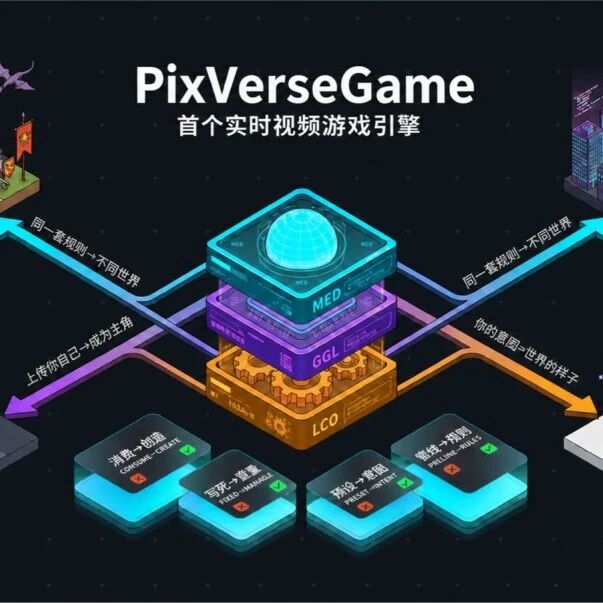
Per the official technical deep-dive (pixverse.ai/en/blog/pixverse-game-engine-deep-dive), the whole Game Engine consists of three layers, and PixVerse has given each a formal name:
Mechanics-Expression Decoupling (MED)
It strips game mechanics (numbers, logical conditions, state-transition rules) entirely away from visual expression. Mechanics are abstract structures with no narrative identity, defined by a mechanics engine; visuals, narrative, and tone are generated at runtime by the real-time world model. The same mechanics can be expressed as a medieval epic, a cyberpunk thriller, or a world starring the player themselves.
Generative Game Loop (GGL)
Player input enters the AI agent layer → is interpreted under the current mechanics state → returns as continuously generated visual and audio output. It's a real-time loop in which every round generates world state that "did not exist before this interaction."
Live Coherence Orchestration (LCO)
The AI agent layer keeps mechanics state, narrative context, and generated output consistent with each other at all times, across five functions: intent parsing, mechanics evaluation, narrative-world coherence, game-state communication, and conflict resolution.
Put simply: the mechanics engine governs "what kind of game this is," the world model governs "what this world looks like," and the AI agent layer governs "how the two stay in sync in real time."
What Players and Creators Each Get
The value points officials list:
For players
- Open-ended interaction: input is parsed semantically rather than matched against a preset option list — anything the system can understand semantically, it can respond to.
- Infinite reskinning: the same mechanics can instantly swap into entirely different worldviews and character identities.
- Cinematic visuals as the baseline: high-quality visual output is an intrinsic property of the generation approach, independent of production budget.
For creators
- Freedom from pre-production: modeling, animation, sound design, and narrative scripts are no longer prerequisites; creators define only abstract mechanic structures, and the generation layer handles expression.
- Low-code / no-code toolchain: visual interface + type templates + AI coding agents, configuring game mechanics in natural language.
- AI as a creative partner: agents handle connecting abstract mechanics to real-time visual and narrative output; creators focus on rules and experience design.
Can You Play It Now: An Early-Stage Research System
This has to be stated plainly: don't be misled by the funding figure. In the deep-dive's "Limitations and Open Problems" section, officials write explicitly:
PixVerse Game Engine represents an early-stage research system.
Known limitations include:
- Real-time generation latency: still a bottleneck for fast-paced game genres that need sub-100ms responses.
- Limited game-genre coverage: evaluated so far only on a limited set of genres; generalization to physics-heavy or competitive multiplayer genres is unverified.
- Per-session compute cost: at equal visual quality, more expensive than traditional rendering pipelines.
Officials have not published any public Early Access or Beta signup. Third-party coverage (TechNode, TechTimes) describes only the funding and product vision, with no mention of a playable entry point. At this stage it is more like a research project with its complete architecture documentation published than a product anyone can pick up and play. PixVerse's own video generation product (the V6 model) is open for use at pixverse.ai, already covering more than 177 countries and over 150 million users.
Who Should Follow This
- Game developers and engine researchers: the MED / GGL / LCO architecture is a valuable reference for the "generative games" direction.
- AI interactive-entertainment product managers: the paradigm of separating a real-time world model from game mechanics may shape the future of interactive storytelling, virtual hosting, and interactive livestreaming (PixVerse has also mentioned launching real-time interactive livestreams).
- Creators tracking the frontier: be first in line when Early Access opens; for now, read the technical article to understand the design.
Setting Expectations Before Use
- R1 was released in January (not the new thing this time); the new development is the Game Engine product form + the $439 million raise.
- The Game Engine is not an openly playable product right now; officials position it as an early-stage research system with no public signup or waitlist.
- To experience PixVerse's mature capabilities, use the V6 video generation product at pixverse.ai.
References
- Official funding announcement: pixverse.ai/blog/pixverse-closes-series-c-extension-and-announces-expansion-into-interactive-entertainment
- Game Engine technical deep-dive: pixverse.ai/en/blog/pixverse-game-engine-deep-dive
- R1 introduction: pixverse.ai/en/blog/pixverse-r1-next-generation-real-time-world-model
- TechNode Global: PixVerse raises 439M Series C
- TechTimes: PixVerse Closes 439M Round, Targets AI Game Engines