
RynnWorld-Teleop: DAMO Academy Open-Sources Digital Teleoperation — Robot Training Data Without Real Hardware
Alibaba DAMO Academy has open-sourced RynnWorld-Teleop, a digital teleoperation scheme that uses gesture-driven world models to generate robot visual demonstrations and automatically produce training data with joint-level labels. This piece breaks down the core idea, what's open-sourced, and where it fits.
RynnWorld-Teleop: DAMO Academy Open-Sources Digital Teleoperation — Robot Training Data Without Real Hardware
Alibaba DAMO Academy has open-sourced RynnWorld-Teleop, a digital teleoperation scheme that uses gesture-driven world models to generate robot visual demonstrations and automatically produce training data with joint-level labels. This piece breaks down the core idea, what's open-sourced, and where it fits.
On July 17, Alibaba DAMO Academy open-sourced RynnWorld-Teleop — an embodied-data collection scheme built on "digital teleoperation." The paper is up on arXiv (2607.06558), and the code lives at github.com/alibaba-damo-academy. Its core selling point in one sentence: you can collect robot data that's ready for training without real hardware. For teams working on embodied AI who are bottlenecked by the cost of real-robot data collection, this is a scheme worth a serious look. This article lays out the core idea, what's open-sourced, where it sits in DAMO's embodied ecosystem, and where it fits.
What RynnWorld-Teleop Is
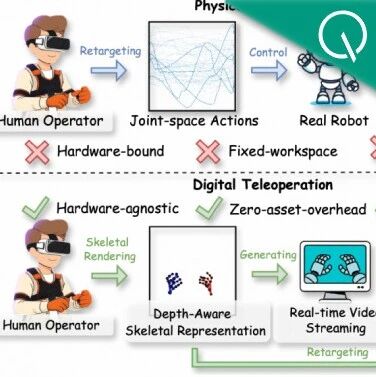
One of embodied AI's biggest bottlenecks is data: real-robot collection is slow, expensive, and dangerous, and it's tightly bound to hardware — switch robots and you have to recollect everything. RynnWorld-Teleop's answer is called "digital teleoperation": use a world model as a "virtual robot" and decouple data collection from real hardware entirely.
Traditional teleoperation vs. digital teleoperation:
| Dimension | Traditional teleoperation | RynnWorld-Teleop |
|---|---|---|
| Hardware dependency | Requires a real robot | No real hardware needed |
| Visual demonstrations | Filmed by real cameras | Videos generated in real time by the world model |
| Action labels | Manual or extra annotation | Automatic joint-level labels |
| Scalability | Limited by hardware count | Effectively unlimited synthesis |
| Cross-platform transfer | Tightly bound to specific robot models | Hardware-agnostic |
The Core Idea: A Gesture-Driven World Model
The full pipeline breaks into three steps:
1. The operator makes gestures (the human-side input)
        ↓
2. The world model (RynnWorld) translates the gestures into actions for a "digital robot,"
   and generates the corresponding visual demonstration video in real time
        ↓
3. Joint-level action labels are output in sync (action labels ready for training)
The key technical piece here is the Action-Conditioned World Model — the model doesn't just generate video; it generates what the next frame should look like given a specific action. Visual demonstrations and action labels produced this way are aligned by construction and can feed directly into downstream policy-model training.
The Problem It Actually Solves
The value of digital teleoperation isn't "yet another way to collect data" — it changes the cost structure of embodied data:
- Hardware-free: collect data without buying or maintaining real robots
- Risk-free: no physical risks like crashes or injuries
- Unlimited scaling: synthesize as much data as you want — the limit is compute, not hardware count
- Automatic annotation: joint-level action labels are a byproduct of the pipeline, eliminating heavy manual labeling costs
- Cross-hardware: in principle, one dataset can train multiple robot morphologies
For early-stage embodied teams, academic labs, and researchers who want to validate policy models quickly, this effectively removes "data collection" from the list of chokepoints.
Where It Sits in DAMO's Embodied Ecosystem
DAMO's embodied stack has three pillars, and RynnWorld-Teleop is one of them:
- RynnBrain: the embodied brain foundation model, handling understanding and decision-making
- RynnWorld-Teleop: the digital teleoperation released this time, handling data collection
- RynnRCP (Robot Context Protocol): the robot context protocol, standardizing context and tool invocation
Together the three cover the full pipeline of "collect data → train the brain → standardize interfaces." RynnWorld-Teleop's position is the data production side — the very upstream of the whole embodied workflow.
Practical Fit and Use Cases
Who It Suits
- Embodied AI research teams: need lots of training data but can't, or don't want to, buy multiple real robots
- Policy model trainers: need paired (vision, action) data with action labels
- Cross-hardware transfer research: want to validate one dataset across different robot morphologies
- Academic experiment reproduction: open source + no real hardware needed makes the bar extremely low — great for paper reproduction and teaching
Trade-Offs to Weigh
- Sim-to-real gap: however realistic the world model's visuals, they still differ from the physical world. Downstream policies may still need a small amount of real data for fine-tuning before deploying on real robots.
- Bias in the world model itself: generation quality directly determines data quality; there's a risk of "off-distribution generated frames," so you need a matching quality-inspection process.
- Ecosystem dependency: works best alongside RynnBrain and RynnRCP; integrating it standalone requires assessing compatibility costs.
How to Get Started
# 1. Pull the code
git clone https://github.com/alibaba-damo-academy/<rynnworld-teleop repo-name>

# 2. Read the paper to understand the architecture
# arXiv: https://arxiv.org/abs/2607.06558
# Paper title: RynnWorld-Teleop: An Action-Conditioned World Model
#          for Digital Teleoperation

# 3. Prepare the world-model inference environment per the repo README
# Note: real-time video generation has GPU compute requirements; see official docs for single-machine inference configs
💡 Tip: The exact repo path is subject to what has actually been published at github.com/alibaba-damo-academy. Before reproducing, read through the paper's implementation details (world model scale, action conditioning approach, training recipe).
Before You Use It
- A supplement to real data, not a replacement: skipping real-data collection entirely still carries sim-to-real risk; the recommended setup is "synthetic as the primary source + a small amount of real data for fine-tuning."
- Mind the world model's quality ceiling: the quality of generated visual demonstrations caps the downstream policy model. If your task involves fine manipulation (soft objects, precision assembly), test generated samples for distribution bias before scaling up.
- Ecosystem coupling: gains are largest when deeply integrated with RynnBrain / RynnRCP; purely standalone use requires evaluating integration costs.
References
- Paper: arXiv 2607.06558 — RynnWorld-Teleop: An Action-Conditioned World Model for Digital Teleoperation
- Open-source repository: github.com/alibaba-damo-academy
- DAMO Academy official announcement (2026-07-17)