
Self-Harness: A Self-Evolving Agent Scaffold That Gains 104% Without Changing Models
Shanghai AI Lab proposes a three-phase self-evolution loop in which agents iterate on their own system prompts and tool orchestration — gains of 33%–60% without switching models.
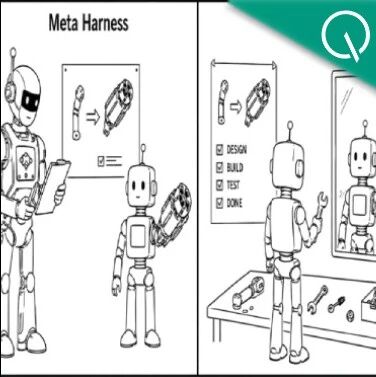
Self-Harness: A Self-Evolving Agent Scaffold That Gains 104% Without Changing Models
Shanghai AI Lab proposes a three-phase self-evolution loop in which agents iterate on their own system prompts and tool orchestration — gains of 33%–60% without switching models.
If you're already using Claude Code, Cursor, or a homegrown agent, you've probably hit the same dilemma: capability plateaus, and the reflex is to "switch to a bigger model." But the cost of switching models rises exponentially, and often the model itself isn't the problem — it's that the "runtime scaffold (harness)" wrapped around the agent hasn't been polished enough.
A 2026 paper from Shanghai AI Lab, Self-Harness: Harnesses That Improve Themselves (arXiv: 2606.09498), offers another path: no new model, no parameter changes — let the agent iterate on its own harness. Across three different model families it delivered 33%–60% relative performance gains, peaking at 104% in some scenarios.
This tutorial breaks down Self-Harness's three-phase self-evolution loop and provides a reusable template you can apply directly.
What a Harness Is, and Why It Matters More Than the Model
Put simply, the harness is the layer of programmable scaffolding you wrap around an LLM: system prompt, tool orchestration, memory mechanisms, verification loops, error-recovery strategies. The same model paired with different harnesses can show a huge capability gap.
Over the past year, the industry's optimization focus has been quietly shifting from the "model layer" to the "harness layer." The reasons are pragmatic:
- The model layer has long iteration cycles and high costs (a single pretraining run routinely runs into the millions of dollars)
- The harness layer consists of programmable, composable, regression-testable structured components, with iteration costs in the tens to hundreds of dollars
- In most real-world scenarios the bottleneck isn't the model's intelligence, but a harness that fails to squeeze out the model's potential
Self-Harness pushes this to its logical extreme: have the agent diagnose the harness's weaknesses and improve it itself.
The Three-Phase Self-Evolution Loop
The core of Self-Harness is an iteration loop driven by the model itself, with three phases running in a cycle.
Phase 1: Weakness Mining
Have the model analyze the current harness's shortcomings during task execution: which tasks failed? At which step? Was it a malformed tool-call format, an ambiguous role definition in the system prompt, or a verification loop that failed to catch the problem?
The output is a structured "weakness list" — specific problems you can locate and fix, not a vague "it performed poorly."
💡 Tip: The key to weakness mining is structuring failure cases. Keep the trace of every task run (tool-call sequence, model output, final result) as raw material for analysis.
Phase 2: Harness Proposal
For each weakness, the model generates a concrete "improvement proposal": it might be revising a description in the system prompt, adding a new tool, reordering tool calls, or introducing a new verification step.
Proposals must be executable and verifiable — meaning they must be testable against regression runs in the next step.
Phase 3: Proposal Validation
Merge the proposal into the harness and re-run the benchmark task set (benchmark / held-out tasks). Only if the pass rate doesn't drop — ideally improves — is the proposal formally merged into the main harness; otherwise it rolls back.
💡 Tip: Regression validation is the "safety lock" of the whole loop. Without this step, "self-evolution" easily degrades into "random tinkering." Make sure you have a stable held-out test set.
Once the loop is running, the harness keeps getting stronger. The paper's measured numbers are persuasive:
| Model | held-out pass rate |
|---|---|
| Model A | 40.5% → 61.9% |
| Model B | 23.8% → 38.1% |
All three different model families posted 33%–60% relative gains, peaking at 104% in some scenarios.
Why This Method Has High ROI
A quick comparison: switching to a bigger model can cost thousands of dollars a month in subscription fees or higher API costs, while one round of the Self-Harness loop comes in at roughly $50–100 per the paper.
The gains you get in return are often the same magnitude, or better. For budget-sensitive teams, this is the more cost-effective optimization path.
Reusable Template: Try It on Your Own Agent
Below is a minimal skeleton for applying the Self-Harness approach to your own agent (pseudocode; the concrete implementation depends on your agent framework):
# 1. Weakness mining
weaknesses = analyze_failures(task_traces, current_harness)
# Output: [{issue: "...", location: "...", evidence: [...]}, ...]

# 2. Improvement proposals
proposals = []
for w in weaknesses:
    proposal = harness_llm.propose_fix(w, current_harness)
    proposals.append(proposal)
# Output: [{change: "Revise the description of X in the system prompt", patch: ...}, ...]

# 3. Regression validation
for p in proposals:
    candidate = apply(current_harness, p)
    score = run_benchmark(candidate, held_out_tasks)
    if score >= baseline_score:
        current_harness = candidate
        baseline_score = score
    # Otherwise roll back and skip this proposal
A few key points for putting it into practice:
- Keep the benchmark set stable: pick 30–100 tasks with clear success criteria as held-out and leave them unchanged long term
- Keep proposals atomic: one proposal changes one thing, making attribution and rollback easier
- Keep traces: the full course of every task execution must be traceable — that's the raw material for weakness mining
FAQ
- How is Self-Harness different from AutoGPT-style "self-iteration"?: AutoGPT-style projects have the model plan at the task level, while Self-Harness iterates at the harness level (system prompt, tool orchestration, verification loops). The former changes "what to do"; the latter changes "how to do it."
- What if there's no public code repository?: The paper is currently public on arXiv, and the community has several reproduction implementations. The recommendation is to build your own minimal loop from the template above first — the priority is getting the three-phase loop working end to end.
Final Thoughts
The lesson Self-Harness offers developers is simple: before upgrading the model, audit and iterate on your agent's runtime framework. System prompt, tool orchestration, verification loops — these programmable structured components are often the highest-ROI optimization points available today.
The paper (with full experiments and ablation analysis) is at:
- arXiv abstract page: https://arxiv.org/abs/2606.09498
- arXiv full text (HTML): https://arxiv.org/html/2606.09498v1
Honesty note: Self-Harness is currently available as an academic paper; the performance figures cited here (33%–60% relative gains, 104% peak, roughly $50–100 in cost) all come from the arXiv paper. If there is no public official code repository, don't trust any "official repo" links — defer to the arXiv paper.