
OpenAI Codex Launches Savings Reset: No More Waiting When Credits Run Out, and Referrals Pay Both Sides
Codex rolls out a Savings Reset feature giving paid users one credit-reset opportunity, with a limited-time referral promo that rewards both sides once each — flexible management of your coding compute.
OpenAI Codex Launches Savings Reset: No More Waiting When Credits Run Out, and Referrals Pay Both Sides
Codex rolls out a Savings Reset feature giving paid users one credit-reset opportunity, with a limited-time referral promo that rewards both sides once each — flexible management of your coding compute.
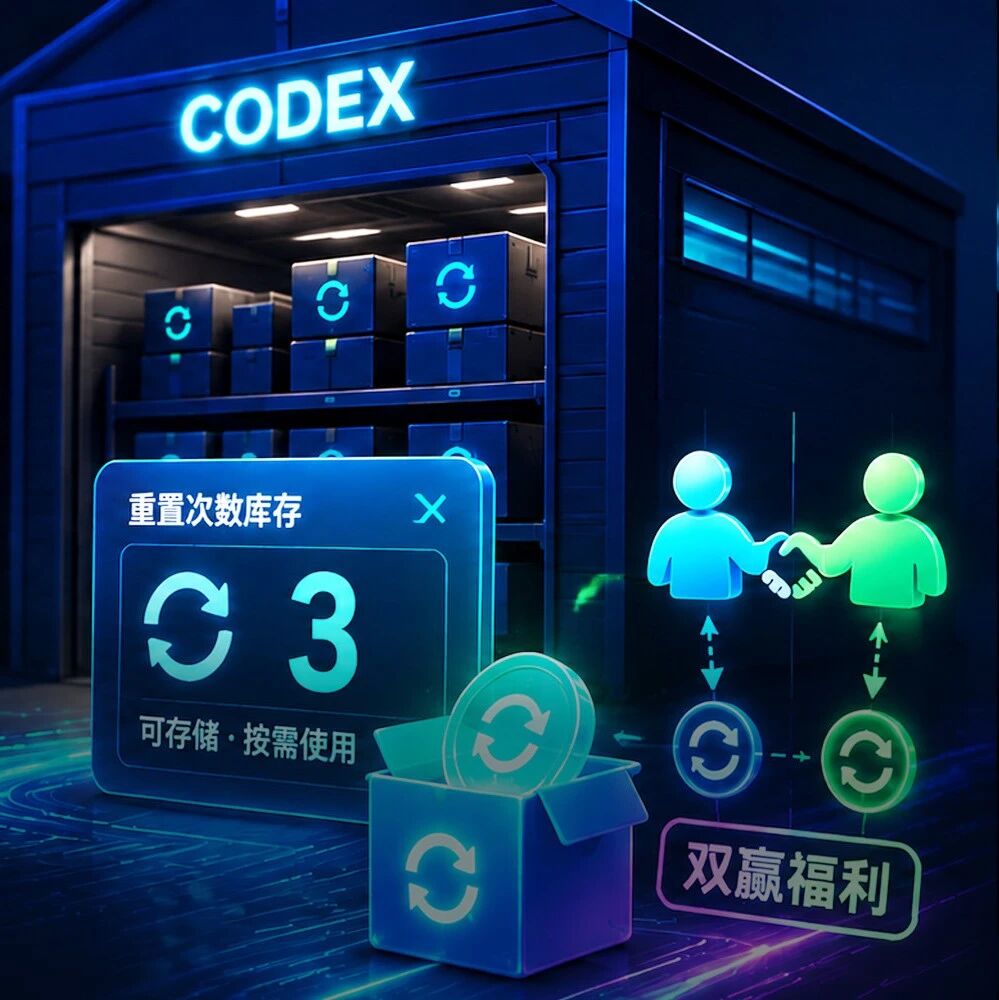
OpenAI's coding agent tool Codex has launched a "Savings Reset" feature. When your credits run out, there's no more idle waiting — a reset sits in your account, and you decide on your own when to zero out the window. Paired with it is a limited-time, two-week referral campaign: bring a friend in to try Codex and both of you earn one reset.
What Is Savings Reset
Codex usage is gated by two thresholds: a rolling 5-hour window and a weekly total quota. Hitting the ceiling meant waiting for natural recovery or buying credits to stay alive.
Once savings arrived, resetting shifted from "waiting for the official drop" to "deciding for yourself when to use it":
- Go, Plus, Pro, and Business paid users all get one Savings Reset for free up front
- After running out of credits, spend one saved reset and your usage window zeroes out instantly — back at full strength
- When to use it, and on which sprint, is entirely up to you
When it shines: You're mid-sprint or halfway through something at 2 a.m. and the credits hit bottom — one saved reset is a whole extra stretch of working time.
Limited-Time Referral Campaign: Both Sides Get One
Plus and Pro users can invite friends to try Codex, with the following rules:
- Up to 3 invites per person
- After your friend sends their first message, both of you receive one Savings Reset
- The campaign runs for a limited two weeks
This resembles the scarcity play Sora 2 pulled with invite codes when it hit iOS last September — except the reward is more tangible: Sora 2 handed out entry tickets, while Codex is handing out real compute.
The Old Reset Mechanism
Before savings existed, resets were entirely in OpenAI's hands:
- April 28: Codex weekly active users passed 3 million, the team lead tweeted "a good week," and all paid users got a round of resets
- Mid-May: a service outage burned users' credits abnormally, and another round of resets came as compensation
- When they dropped, who got them, and which windows were covered — all at the official mood of the day
Someone even built a dedicated website for it, hascodexratelimitreset.today, with exactly one function: watching the official account for you and telling you whether a reset has landed today.
How to Use It
- Open the Codex client
- Check your savings balance on the credits management page
- When your credits run dry, click to spend one Savings Reset and the usage window zeroes out immediately
- To join the referral campaign, find the invite entry in settings and share the link with friends
Tip: The Codex client has also rolled out a one-click "Migrate from Claude Code" import — if you were on Claude Code before, the moving path is already paved.
The Cost Backdrop
OpenAI's help docs once listed a figure: the average Codex user consumes $100 to $200 of compute per month. Every reset given away is real GPU time behind it.
Over the same period, competitors were tightening up: Anthropic announced that automated Claude Code calls would be billed separately, and GitHub Copilot's credit-based billing has taken effect. Codex loosening its limits is, at its core, a fight for developer mindshare.
Is It Worth Grabbing
If you're a paying Codex user, Savings Reset is a genuine perk:
- Pro users: $20/month against an average of $100-200 in compute; one extra reset amounts to several more hours of full-speed working time
- Team collaboration: Business tier gets reset credits too, so teams can allocate flexibly during sprints
- New users: come in through an invite and you get the full compute experience on day one
Note: The referral campaign's two-week window is counted from June 12, so get in early if you're interested.
Related articles

Making Long AI Videos with Image2 + Seedance 2.0: A Brand-Ad Walkthrough
A complete pipeline from asset preparation to edit and assembly, teaching you to produce a 115-second brand-ad long video with an AI toolchain, solving core pain points like face drift and inconsistent scenes.
SenseNova U1: An Open-Source Infographic Generation Model, 8B Parameters, Runs on a Single GPU
SenseTime's open-source 8B-parameter infographic generation model, Apache 2.0 licensed for commercial use, with stable text rendering and precise layout control at roughly one-tenth the cost of closed-source options.

Tencent's "Codename Craft": An AI Platform That Builds Games from Scratch in Natural Language
The AI game-creation platform announced by Tencent Games generates runnable games from natural language, covering 2D/3D, with a full-chain AIGC toolkit and 20,000 free assets built in — complete games, even with zero background.

Claude Opus 4.8 Is Here: More Honest, Less Lazy, Plus Dynamic Workflows
Anthropic releases Claude Opus 4.8 with the code-defect miss rate cut to a quarter of the previous generation, Dynamic Workflows launching alongside it to run hundreds of subagents in parallel, and effort control opened to all users.
The Codex Hands-On Guide: An Open-Source Tutorial from Sign-Up to First Steps
CodexGuide, open-sourced on GitHub, covers complete usage tutorials for the Codex desktop app, CLI, and mobile, including Plus subscription, hands-on cases, and configuration guides.

Skywork Super Agent: A Cloud AI Employee with No Fuss
A deep hands-on with Skywork Super Agent: automated market watching, PPT generation, and deep research — a cloud agent team ready the moment you register.