
Wan-Streamer v0.2: An Omnimodal Real-Time Interaction Model with 550ms End-to-End Latency
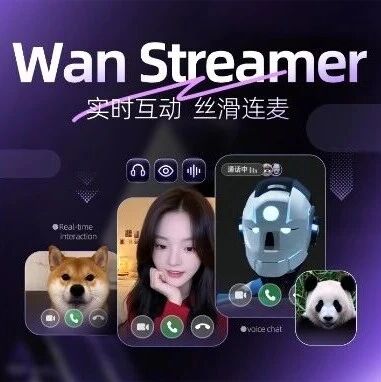
Alibaba Tongyi's Wan-Streamer v0.2 unifies listening, seeing, speaking, and performing in a single Transformer, achieving full-duplex audio-video interaction at roughly 550ms end-to-end latency. This piece breaks down its architecture, key metrics, and use cases.
Wan-Streamer v0.2: An Omnimodal Real-Time Interaction Model with 550ms End-to-End Latency
Alibaba Tongyi's Wan-Streamer v0.2 unifies listening, seeing, speaking, and performing in a single Transformer, achieving full-duplex audio-video interaction at roughly 550ms end-to-end latency. This piece breaks down its architecture, key metrics, and use cases.
On July 17, Alibaba's Tongyi Lab released Wan-Streamer v0.2, an end-to-end omni model built for real-time full-duplex audio-video interaction. In plain terms, it's an AI video call that genuinely works end to end: you speak, and it listens while generating visuals and a spoken response, at roughly 550ms end-to-end latency. The key breakthrough isn't "a bit faster" — it's that for the first time, listening (ASR), seeing (visual understanding), speaking (TTS), and performing (video generation) are unified in a single Transformer, cutting out the multiple standalone modules traditional stacks stitch together. This article covers what it is, its key metrics, the architectural differences, and use cases — aimed at developers building real-time digital humans, AI customer service, and voice-companion products.
What Wan-Streamer Is
Wan-Streamer is Alibaba Tongyi's end-to-end omni understanding-and-generation model, designed for real-time, full-duplex audio-video interaction. "Full duplex" means it can listen and speak simultaneously, like a phone call — not the half-duplex "you finish, then I reply" pattern of traditional dialogue systems.
Key metrics for v0.2:
| Metric | Value | Notes |
|---|---|---|
| End-to-end interaction latency | About 550ms | Includes about 350ms of network transfer |
| Output resolution | 640×368 | v0.2 improved resolution over v0.1 |
| Frame rate | 25 FPS | Video output frame rate |
| Latency change | Flat vs. v0.1 | Resolution went up; latency didn't |
The 550ms figure needs unpacking: about 350ms of it is network transfer, with pure model-side latency in the 200ms range. That means on weak networks, the experience will be dragged down mainly by the network, not the model.
Core Capabilities
1. One Transformer Unifying Four Modalities
This is Wan-Streamer's biggest architectural difference. Traditional real-time digital-human solutions are "stitched together":
[Traditional approach]
Microphone → ASR (speech to text) → LLM → TTS (text to speech) → video generation model → screen
   Every stage is a separate model; latency and error accumulate stage by stage

[Wan-Streamer]
Microphone → [a single streaming causal Transformer] → screen
   Listening / seeing / speaking / performing unified in one model
Cutting out the middle stages pays off directly: lower latency, less information loss between modules, and more natural lip and emotion sync.
2. A Native Streaming Causal Transformer
Wan-Streamer uses a native streaming causal Transformer architecture. "Causal" means the model only sees the past, never the future — a hard requirement for real-time interaction, since it cannot wait for the user to finish a whole sentence before reacting. Paired with a distributed inference topology, per-frame generation latency stays controllable.
3. 640×368 @ 25FPS Video Output
v0.2 improves resolution noticeably over v0.1, holds a steady 25FPS, and keeps latency unchanged. This resolution is enough for:
- Desktop/mobile video-call windows
- Digital-human customer-service windows
- Embedded livestream scenarios
But it still falls short of 1080p HD livestream standards.
Real-World Experience
Strengths
- True full duplex: you can interrupt and add to what it says at any time, without waiting for the AI to finish speaking. This is the biggest experiential gap versus "half-duplex voice assistants."
- Low latency: 550ms is at the usability threshold for everyday video calls; users won't perceive obvious "slowness to react."
- Simpler architecture: one model replaces an entire pipeline, reducing deployment and ops complexity.
Trade-Offs to Weigh
- Resolution ceiling: 640×368 doesn't fit livestream or film/TV scenarios with high image-quality demands.
- Network sensitivity: 350ms of network latency is over 60% of the total; deploy your nodes close enough to users.
- Compute bar: real-time audio-video generation consumes far more compute than text-only dialogue; per-stream concurrency cost needs careful evaluation.
Use Cases
- AI video customer service: real-time face-to-face consultation for e-commerce, finance, and government/enterprise service desks, replacing today's voicebots
- Digital-human companionship / voice assistants: consumer scenarios requiring sustained conversation and emotional sync
- Real-time interpretation / simultaneous translation: full duplex + low latency suits video-capable live translation
- Educational companionship: 1-on-1 real-time explanations and Q&A, where reading student reactions matters
Before You Use It
- Compute cost is the core bar: 25FPS real-time video generation uses far more GPU than text models. Work out per-stream concurrency cost before committing to an end-to-end approach.
- 550ms comes with conditions: the figure assumes nearby deployment + good network conditions. In your target network environment, measure P95 latency yourself rather than trusting the official spec.
- The ecosystem is still early: v0.2 remains a fast-iterating release; APIs and parameters may change. Confirm stability commitments before production integration.
References
- Tongyi Lab official announcement (2026-07-17)
- Wan-Streamer v0.2 technical report and open-source information