
Free AI (not a) Therapist
An AI venting window that admits up front it is not a therapist
Tool details
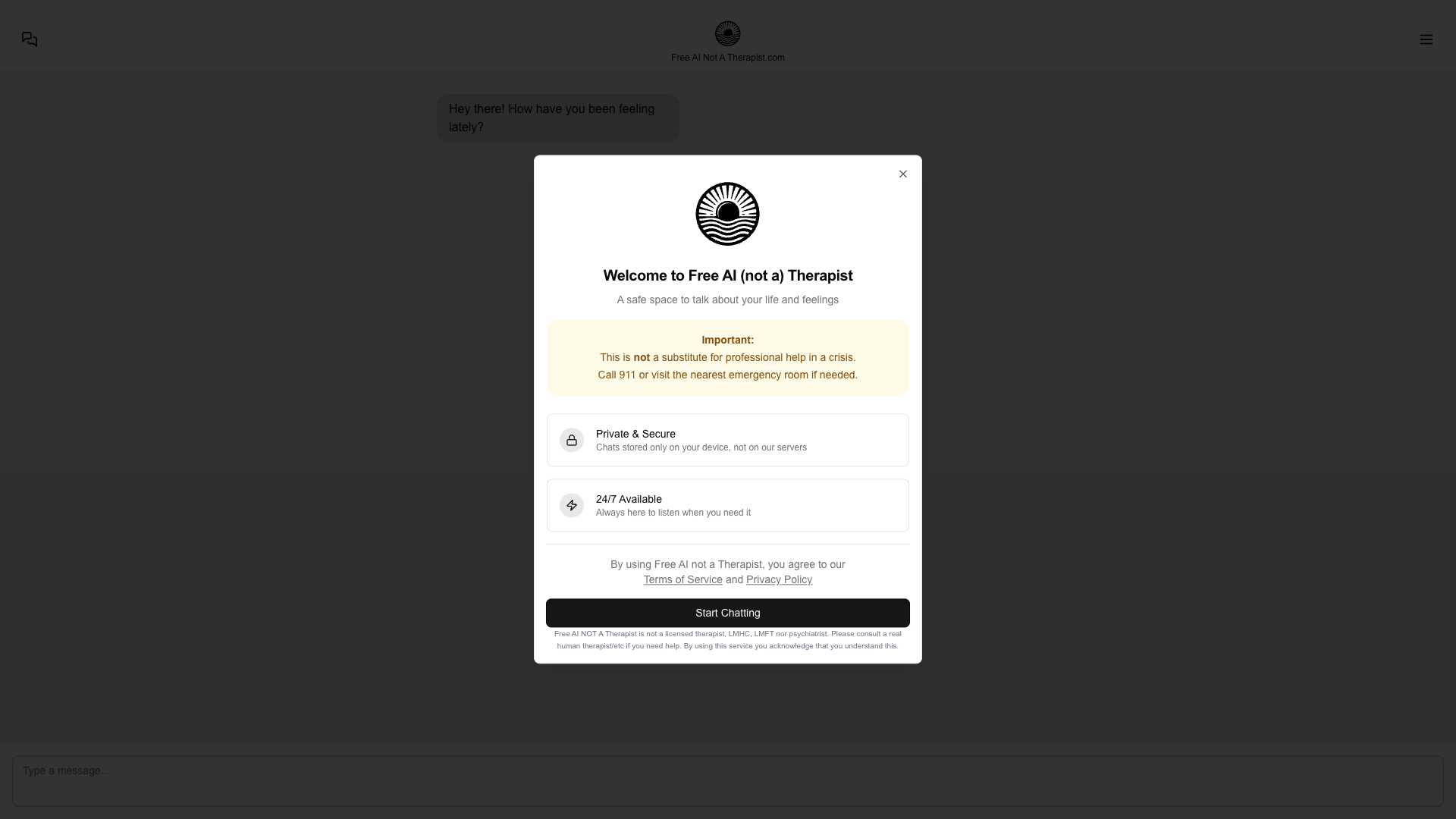
Free AI (not a) Therapist writes the disclaimer straight into its name: the “not a” in parentheses is both its most honest boundary and the starting point of the whole product philosophy. Open it and you get a single chat box — no appointments, no questionnaires, no cloud record — made for people who just want to say a couple of things late at night.
Core capabilities
- Minimal, open-and-chat interface: the home page holds only the chat box and the conversation sidebar, the opening line is hard-coded in the frontend, and there is no onboarding form
- Local-first conversation storage: chats land only in the browser, come with a one-click wipe, and the site can be installed as a desktop app
- Optional profile fields: name, age, family, interests, goals and current struggles can be filled in if you like, so replies fit your situation better
- Purchasing-power-parity billing: prices are converted dynamically according to the purchasing power of your country, with a day pass and a monthly tier, keeping the cost of trying it very low
- Voice playback: paid tiers can turn replies into streamed speech, handy when you would rather not stare at the screen
- Mood check-in prompts: daily or weekly reminders can be switched on, alongside dark mode, to turn it into a steady habit
Where it fits It suits adult English-speaking users whose mood is stable: late-night anxiety you want to untangle, a non-judgemental outlet, and no wish to leave the conversation in the cloud. Acute crisis, a need for structured therapy or a Chinese-language interface — it explicitly does not take those on; people who care about being able to hold the operator accountable should also steer clear.
Distinctive strengths Its difference lies not in capability but in friction: no appointments, no downloads, no questionnaires, and records kept on your own machine — at the cost of abandoning the therapy framework and the safety protocol outright. Another contrast: external directory sites still describe it as “no sign-up, completely free”, while in practice the first message already requires signing in, and monthly subscriptions and day-pass billing have long been in place.
Editorial take The honesty of the name deserves respect; the honesty on the code side does not measure up. The terms solemnly print a crisis hotline, yet no risk-detection logic can be found inside the app — the disclaimer does more work than the intervention. The interface promises that conversations stay on your device, while every message still travels upstream with nine profile fields. The upstream model is not disclosed on the site, the operator is anonymous, and no reputation has formed yet. Among peers, Woebot and Youper had clinical backing and still shut down one after another, which shows how hard this category is to commercialise. As a low-friction place to vent it works; as a mental-health support solution it falls far short.
Pricing
Freemium$0 (free allowance)A fixed number of free messages that resets every twelve-hour window; the official count is not published, and the free tier runs a weaker model than the paid tiers
Unlimited messages for twenty-four hours and a smarter model; the base price is converted dynamically by purchasing power parity
Unlimited messages, a smarter model, and optional AI voice messages unlocked; marked Most Popular on the site
Additional notes
The site has no standalone pricing page; prices exist only inside the subscription dialog that pops up once the allowance is exhausted, and checkout runs through Stripe. Free messages reset every twelve-hour window and the count is not public, and voice messages are available on the monthly plan only.
FAQ
User reviews
User Reviews
No reviews yet
No one has reviewed this tool yet