MONAI
A PyTorch-native open-source framework for medical imaging AI
Tool details
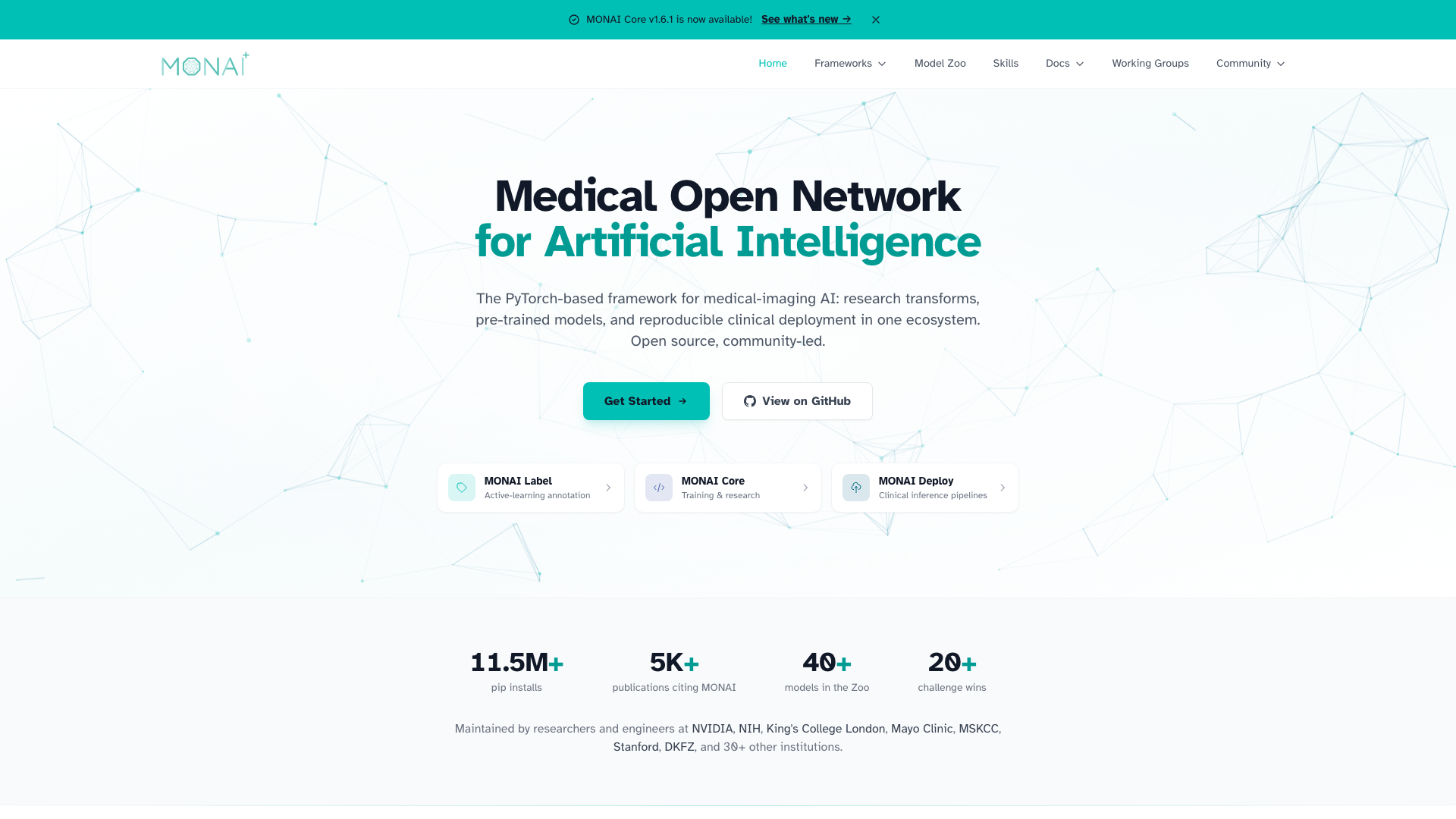
MONAI is an open-source medical imaging AI framework initiated by NVIDIA and King's College London, using native PyTorch operators to connect annotation, training, and deployment into one path. It is built for algorithm teams with a deep learning background: it is neither a no-code tool nor a medical device.
Core capabilities
- Imaging-native I/O: built-in DICOM / NIfTI and 2D-4D read/write, with spacing-aware transforms and dictionary-style synchronization so images and labels stay aligned.
- Segmentation metrics and losses: Dice, Hausdorff, and surface distance are computed in batches on GPU, while DiceCE / Focal address class-imbalanced anatomical structures.
- Three-part pipeline: Label handles active-learning annotation (connected to 3D Slicer), Core handles training, and Deploy packages models into DICOM-reading MAP containers.
- Reference implementation library: MAISI for synthetic 3D CT, UNETR / SwinUNETR backbones, VISTA-3D for general segmentation (127 classes), and Auto3DSeg.
- Bundle delivery specification: weights, configuration, code, and metadata are packed into one reproducible unit; Core produces it, Label consumes it, and Deploy wraps it into a MAP.
Use cases Algorithm teams working on medical image segmentation, classification, and generation, radiomics research, model validation at hospital AI centers, and the engineering side that needs to connect a paper model to PACS.
Unique advantages A general framework can train models but cannot hand over something a hospital can actually run; MONAI turns reproducibility and delivery into a specification, and the reference implementation of Metrics Reloaded lives here. 3D Slicer is the reading desk, SimpleITK does preprocessing, and nnU-Net provides a baseline, while MONAI covers the whole workflow and ships its own delivery format.
Editorial assessment Apache 2.0, 8,843 GitHub stars, 332 contributors, 42 versioned Bundles in the Model Zoo, and joint maintenance by 30+ institutions including NVIDIA, NIH, Mayo Clinic, and DKFZ: the selection argument is almost unnecessary. Two boundaries to remember: PyTorch fundamentals are required, and the framework is not a medical device, so the regulatory pathway is borne by the adopter. Start with Core, add Label for annotation, and land it with Deploy.
Pricing
FreeFreeAll code, documentation, and the Model Zoo catalog for Core / Label / Deploy are released under Apache 2.0 and may be used in commercial products and research; enterprise-grade support requires a separate NVIDIA AI Enterprise purchase (quote not public)
Additional notes
The code is free for commercial use under Apache 2.0; Model Zoo weights carry their own separate licenses, so check each one before commercial use; the GPU and engineering labor costs of 3D training are yours to bear.
FAQ
User reviews
User Reviews
No reviews yet
No one has reviewed this tool yet