
Orbi
A pipeline where one label triggers automatic coding, review, and a versioned release
Tool details
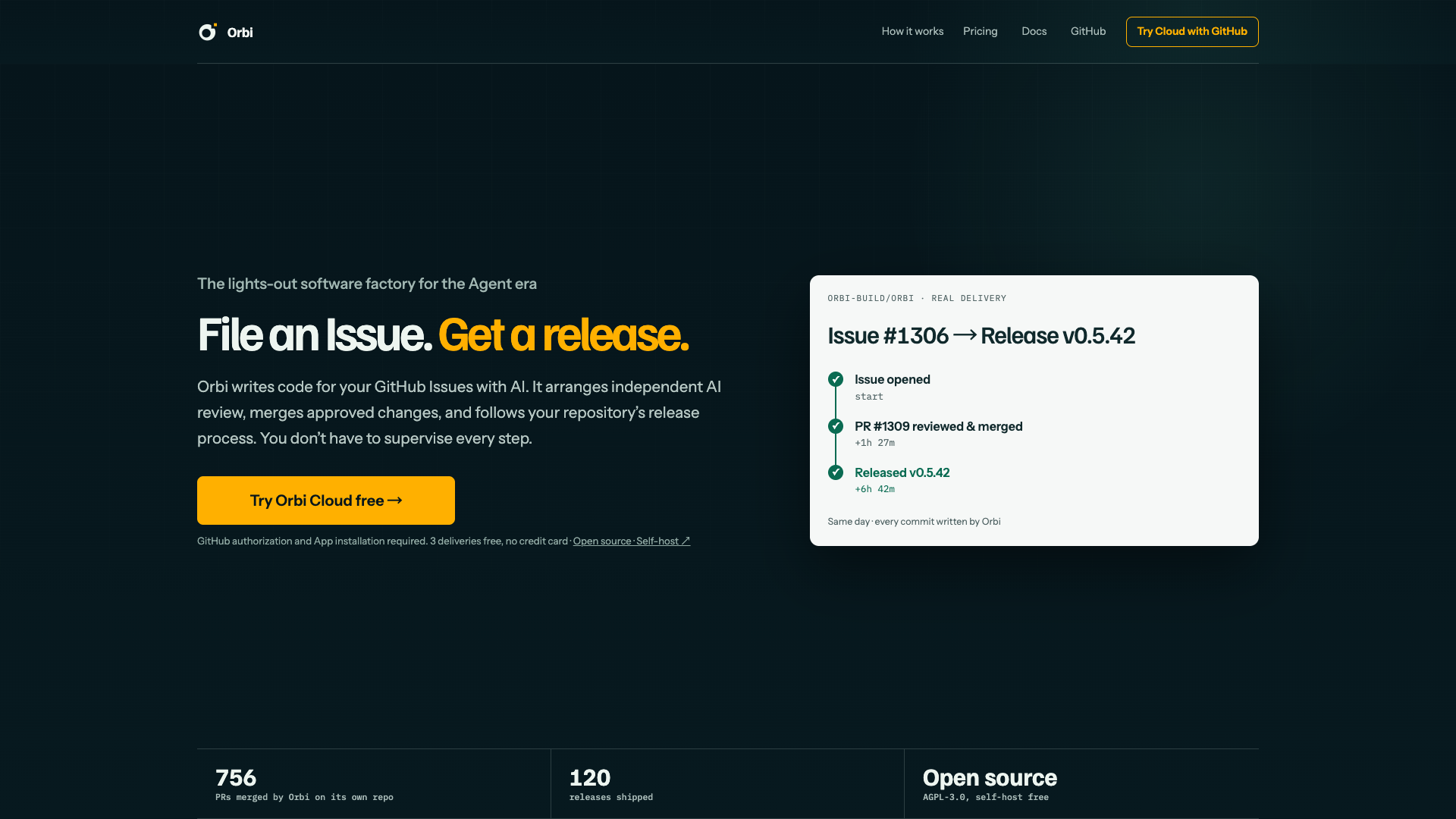
Orbi is a GitHub-native unattended delivery pipeline: label an Issue with ai-ready and it writes code in an isolated worktree, then a second independent session reviews the work against the acceptance criteria and fixes it in place, merges only the single commit that was reviewed, and finally freezes the SHA, tags it, and publishes a GitHub Release. It does not build its own models.
Core capabilities
- The label is the switch: a single
ai-readylabel claims the Issue, and implementation, test runs, and opening the PR all happen automatically - Review can change code: the second session reads the frozen diff plus the acceptance criteria and can edit the code directly and rerun the tests
- Only the reviewed SHA is merged: merging is strictly bound to the head that the review verdict refers to
- Closed loop from PR to Release: after a human adds
ai-release, it freezes the SHA, waits for CI, tags, publishes the release, and closes the milestone - No in-house models: coding runs on the third-party MIT project Pi, and models can be Gemini, GLM, DeepSeek, Grok, local Qwen, and others
- Open source and self-hostable: AGPL-3.0, with repositories and keys staying on your own machine and only upstream model fees to pay
Where it fits GitHub maintainers and small teams that already have a disciplined Issue workflow, CI, and branch protection: backlog bugs, back-office refactors, ops tickets — any work that can be split into a ticket with explicit acceptance criteria. Self-host it when code may not leave your network; run Cloud first if you only want to save the operational effort.
What sets it apart Most competitor documentation stops at the PR; what Orbi fills in is everything after the PR — review, merge, release. Its review session can edit and rerun, not merely hand down a verdict. The limits need to be known too: the vendor itself disclosed that across 183 runs, every run that failed the hidden evaluation had passed Orbi's own review, so bugs that need generalizing from a narrow example slip through; production still runs an older harness that has been shown to be weaker. On top of that it is GitHub-only and does not support Claude subscriptions.
Editorial take For teams whose engineering discipline is already in place, it is worth a trial run on a non-core repository: self-hosting is free, and Cloud's three merged deliveries are enough to judge whether it truly understands your acceptance criteria. It is not expensive, and what it asks of you is the part you are willing to let go — hand over the hours when nobody is at the keyboard, rather than treating it as a day-to-day coding assistant.
Pricing
Freemium$0 (self-hosted open source, free forever; Cloud trial is 3 one-time deliveries)Cloud's one-time trial of 3 merged deliveries, no credit card required, failed deliveries are not countedOne-time trial of 3 merged deliveries, does not reset monthly, failed deliveries are not counted
Annual billing $290 (equivalent to $24/month); 400M tokens/month, 1 repository, about 80–210 deliveries
Annual billing $790 (equivalent to $66/month); 1.2B tokens/month, 5 repositories, about 240–630 deliveries
Additional notes
The self-hosted open-source core is AGPL-3.0, free forever but you pay model API costs yourself; annual billing saves 16.67%; a flat monthly fee with no overage billing, and new deliveries pause once the quota runs out; discount code FOUNDING50 gives a lifetime half price (5 out of ten), limited to 6 people; there is no Enterprise tier.
FAQ
User reviews
User Reviews
No reviews yet
No one has reviewed this tool yet