
RapidAI
AI triage and quantification platform for acute stroke imaging
Tool details
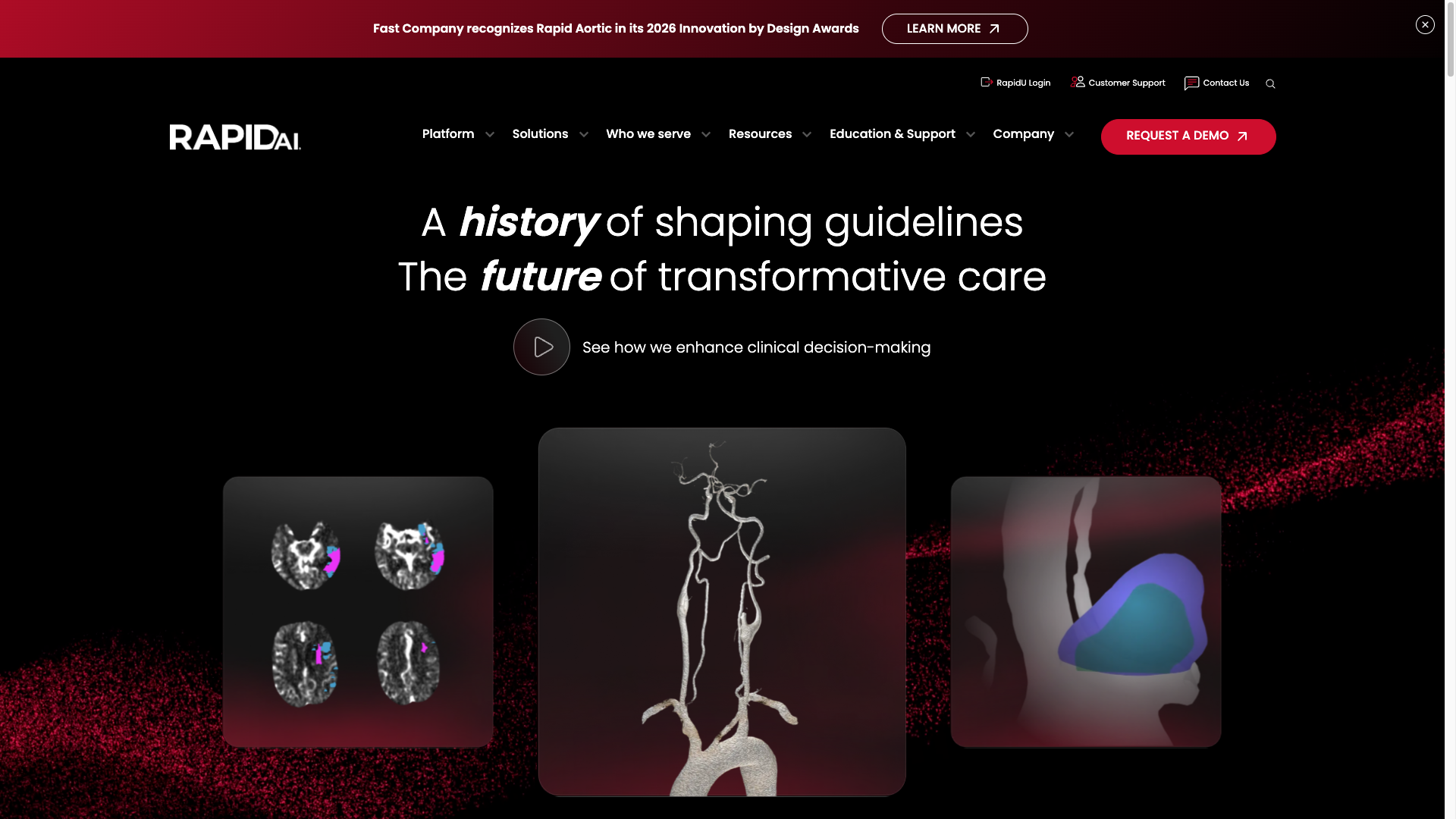
RapidAI (formerly iSchemaView, with roughly one hundred million dollars raised) builds a clinical decision platform for acute stroke and neurovascular imaging, threading CT perfusion, CTA, ASPECTS scoring and large vessel occlusion flags into one emergency workflow. It does not sell "AI that reads scans in place of doctors"; it sells compressing triage, quantification and team notification down to the minute level.
Core capabilities
- Triage and notification: positive cases are pushed to the top of the worklist and to mobile phones, with a compressed preview image attached
- Perfusion and infarct quantification: CT and MR perfusion compute core infarct and penumbra volumes that feed straight into thrombectomy selection
- Automated ASPECTS scoring: the score is computed automatically on non-contrast CT, and this is the only module in the line cleared under an assisted-diagnosis code
- Vessels and aneurysm: localizes large and medium vessel occlusion segments on CTA, and gives triage flags and pre-surgical previews for aneurysms
- Aorta and pulmonary embolism: full-course aortic diameter measurement with follow-up comparison, plus triage notification for pulmonary embolism
- Platform and integration: connects to PACS and the electronic medical record, deploys on-premises, hybrid or cloud, and orchestrates third-party algorithms in one place
Where it fits Stroke centers and regional stroke networks already running or being set up, care alliances that need prehospital notification and transfer decisions, and hospital IT teams that want to pull multi-vendor imaging AI under one governance layer. Vascular surgery with a heavy aortic follow-up load, and emergency departments with a high pulmonary embolism burden, also fit.
Distinctive strengths Clinical evidence is its real moat: trials such as DAWN pushed the thrombectomy window out to twenty-four hours, and Rapid was the imaging selection tool inside them, a track record that is scarce in imaging AI. Viz is strong on mobile coordination and Brainomix on ASPECTS, while RapidAI pushes quantification deep enough to yield numbers that can go straight into a report.
Editorial assessment Its claims need correcting on its behalf: the website says thirty cleared modules, yet checking the regulatory texts one by one turns up only twenty-six certificates, of which only the ASPECTS line is for diagnostic use while most of the rest are assistive triage and localization, and the registration file for the flagship occlusion module still describes traditional algorithms. Technically this is discriminative imaging AI, not generative, and no large-model product is public. The site has no pricing page and no self-serve trial; the only verifiable anchor is roughly twenty thousand pounds per hospital per year in a UK NICE assessment. No registration certificate could be found for mainland China and the compliant procurement path is unclear; neither the trust center nor the compliance page opens, and the certifications are self-declared only. Third-party reviews are close to nonexistent, and end-user complaints cluster on unreliable push notifications and repeated logins.
Pricing
Custom pricingCustomNegotiated by institution and selected modules; the public UK NHS anchor is about £20,000 per hospital per year
Additional notes
There is no pricing page on the official site (/pricing, /plans and /price are all genuine 404s), no self-serve trial, and only enterprise enquiry and contracting; exact amounts must be obtained from sales.
FAQ
User reviews
User Reviews
No reviews yet
No one has reviewed this tool yet