RunPod
Cloud GPU and Serverless inference platform
Tool details
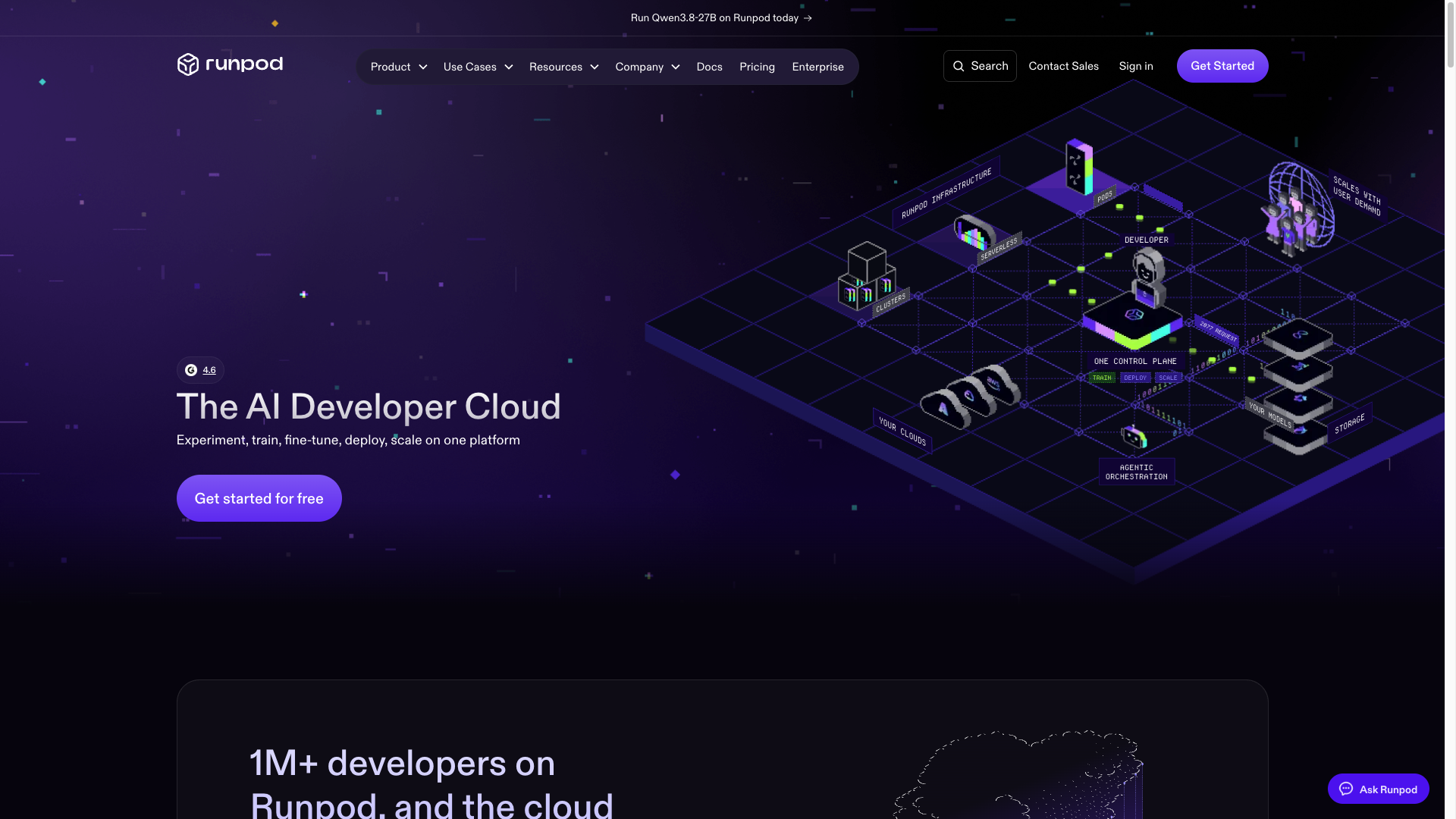
RunPod calls itself "The AI Developer Cloud", giving AI/ML teams on-demand GPU compute and managed Serverless inference so developers can train, fine-tune and deploy in one place. It does not build foundation models itself; it focuses only on the compute substrate and runtime scheduling.
Core capabilities
- Pods (GPU cloud instances): 30+ GPU SKUs, from RTX 4090 up to B300, spread across 31 regions, billed per second
- Serverless: run inference workloads through an API, with scale-to-zero and autoscaling, and FlashBoot cold starts under 200ms
- Clusters: multi-node GPU clusters for distributed training, scalable to 64 GPUs, with InfiniBand/RoCE interconnect
- Hub / Public Endpoints: one-click deployment of open-source models and templates, plus hosted pre-deployed APIs for third-party models
- Two cloud tiers: choose between Secure Cloud (enterprise T3/T4) and Community Cloud (lower price)
- In-house runtime: proprietary Serverless orchestration and queue scheduling, the Flash SDK, Instant Clusters and cross-region failover
Best-fit scenarios Suited to ML engineers, AI researchers, generative AI startups and B2B teams that need elastic GPU compute, especially burst inference, model fine-tuning and multi-node training. Teams that need a zero-ops, fully managed ML platform are not a good fit.
Unique strengths More reliable than Vast.ai and with Serverless built in; more flexible than Lambda Labs and Modal on raw compute and the dual cloud tiers. Per-second billing, no ingress/egress fees, and FlashBoot makes per-request inference production-ready.
Editorial verdict It has secured its place in the GPU cloud race with strong price-performance, per-second billing and full lifecycle coverage, backed by being an OpenAI Model Craft compute partner and by ISO 27001, SOC 2, HIPAA and GDPR credentials. It loses points for Community-tier stability and billing-transparency disputes, and is best seen as a "bare compute substrate" rather than a full-stack ML platform.
Pricing
Subscription$0.16/hour (Community Cloud, RTX A5000 Pod)Billed per second; RTX A5000 24GB from $0.16/hr, RTX 4090 $0.34/hr, A100 $1.19/hr; third-party hosted, cheapest but less stable
T3/T4 enterprise-grade data centers; RTX A5000 from $0.27/hr, H100 PCIe $2.89/hr, B300 $8.99/hr
Usage-billed inference workers; 16GB tier from $0.58/hr, 4090 $1.10/hr, H100 $4.79/hr; supports scale-to-zero and FlashBoot cold starts under 200ms
On-demand multi-node clusters; A100 SXM $2.15/hr, H200 SXM $6.35/hr; L40S/H100 SXM/B200 require Contact sales
Reserved capacity with 1/3/6/12/12+ month commitments; for enterprises at the ten-thousand-GPU scale, includes SLA and discounts, requires contacting sales
Network Storage standard tier >1TB $0.05/GB/month, <1TB $0.07; high performance $0.14; Container/Volume Disk $0.10 (Idle $0.20)
Third-party model APIs billed per request or per second; FLUX.1 [dev] $0.02/megapixel, Nano Banana Pro Edit $0.14/request, SORA 2 Pro I2V (4s) $1.20/request
Additional notes
Pure pay-as-you-go, billed per second, with no monthly subscription tier and no long-term free tier. The one-time signup credit for new users is $5–$500 (sources differ: the official guide says $5; 2026 campaigns offer $5–$500 at random), and it unlocks only after spending $10 and cannot be withdrawn or refunded, so it does not count as a free tier. Billing is split into two tiers: Secure Cloud (enterprise-grade T3/T4 data centers) and Community Cloud (third-party hosted, cheaper); GPU prices float with supply and demand, and the figures in the table are a snapshot of the official pricing page from 2026-10-08. Billing meters cover per-second/per-hour (Pods, Serverless, Clusters) and per GB/month (storage); prices for the same GPU differ between sources because of Secure/Community and on-demand/spot distinctions, so this article uses the official pricing page as the baseline and performs no cross-currency conversion (everything in USD).
FAQ
User reviews
User Reviews
No reviews yet
No one has reviewed this tool yet