
Vizcept
An AI tool that guarantees structurally correct scientific figures through code layout
Tool details
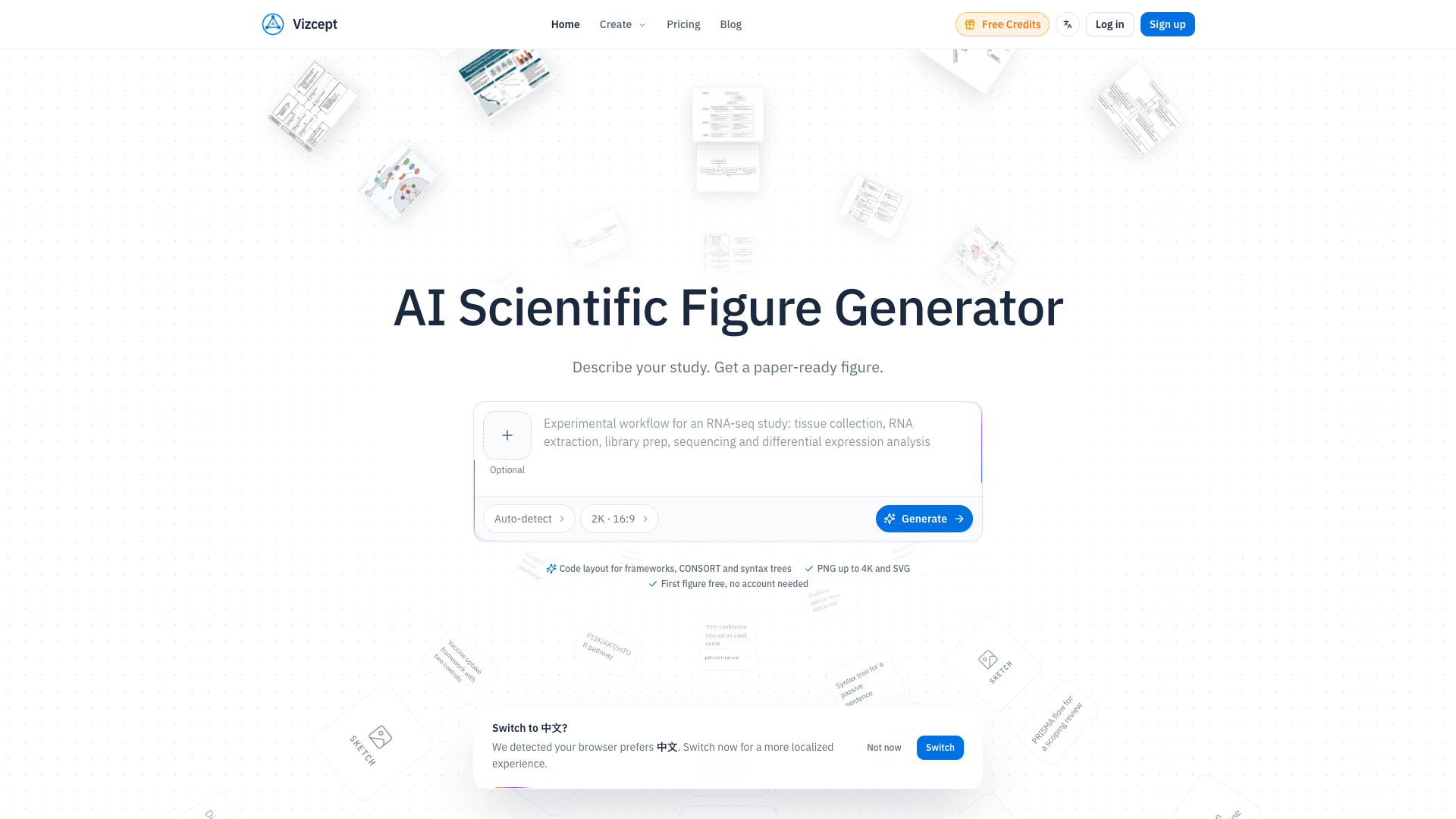
Vizcept is an AI scientific figure tool for theses and journal submissions. It does not ask an image model to draw: a language model outputs only the structure, and code then validates and lays it out. It targets the figures where a single mistake ruins everything, such as a misplaced arrow in a conceptual framework or a drifting count in a CONSORT diagram.
Core capabilities
- Code layout pipeline: The model returns structure only (bracket strings, count mappings), and code checks bracket balance and label completeness before laying out. PNG is rendered from vector outlines; SVG keeps real, editable text.
- Five structural figure types: Conceptual frameworks, CONSORT 2025, PRISMA 2020, syntax trees (including trace and movement arrows) and Reed–Kellogg diagrams are all laid out by code.
- Counts are never guessed: Every n in a flowchart must appear in your own text; when it is missing, the box keeps an empty "(n = )" instead of inferring a number.
- 19 tools plus a compliance layer: Graphical abstracts, signaling pathways and similar figures are drawn by image models, while box, violin and scatter plots are rendered locally in the browser. An AI figure policy table for 11 publishers and disclosure sentence templates are included.
- Version history: Every generation is kept as a version, so you can roll back to the one your supervisor approved (BASIC keeps 30 days; PRO/ULTRA keep everything permanently).
Best for Conceptual framework figures and methods-chapter flowcharts in master's and doctoral theses, journal graphical abstracts and CONSORT 2025 reporting, and syntax trees in linguistics papers. It fits self-funded researchers who revise repeatedly on supervisor feedback and still have to account for their AI use to a journal. It does not do experimental data figures or team collaboration.
Distinctive strengths BioRender and Mind the Graph compete on icon libraries, whereas Vizcept bets on structural determinism: image-generation products cannot verify arrows or counts, while its output can be regression-tested, at an order of magnitude lower cost per figure. The gaps are real too: in Chinese only PRISMA keeps code layout, so writing a conceptual framework or a syntax tree in Chinese falls back to the image model; and there is no PDF/EPS/LaTeX, with the vendor stating plainly that there is no qtree/forest export.
Editorial assessment Pricing is honest, with a code-laid-out figure on PRO annual billing working out to about $0.04. Transparency is unusual as well, since the vendor itself lists the five kinds of mistakes image models make. But neither the team nor the company entity is disclosed, independent reviews are nonexistent, and the 9 testimonials from prestigious universities on the site cannot be verified and contradict one another, so they do not count as reputation. The privacy policy's "improve our AI models" contradicts the terms' "not used for training", so confirm compliance yourself before handling unpublished manuscripts.
Pricing
Subscription$14.90/month (Basic)300 credits per month, 30-day history storage
900 credits per month, permanent version history, 24-hour email response target
2700 credits per month, 12-hour response
One-time purchase with no renewal, valid for 365 days
Additional notes
Subscription credits reset after 30 days; there are two further credit packs, Standard at $19.90/150 credits and Ultra at $99.90/1200 credits, whose per-credit price is roughly 3–9x that of a subscription. All three subscription tiers have identical features (watermark-free, 4K, SVG, commercial license); they differ in credit volume, history storage and support response. Annual billing saves about 40% versus monthly. Students get 40% off and teachers 20% off (12 months). Metering: a code-laid-out figure costs 2 credits, an image-model figure costs 5 credits at 2K and 8 credits at 4K.
FAQ
User reviews
User Reviews
No reviews yet
No one has reviewed this tool yet