
A Hands-On Methodology for AI Content Creation: From Prompts to Workflows
Standards for good content distilled from data on 200+ articles, an 8-point checklist for removing the AI flavor, and the AI content creation progression path from 1.0 to 3.0.

A Hands-On Methodology for AI Content Creation: From Prompts to Workflows
Standards for good content distilled from data on 200+ articles, an 8-point checklist for removing the AI flavor, and the AI content creation progression path from 1.0 to 3.0.
Most of what people write with AI reads as obviously fake at a glance. The problem isn't the AI — it's that you have no standards. This article draws on the hands-on experience of content creator “Binggan Gege”: standards for good content distilled from data on 200+ articles, concrete methods for removing the AI flavor, and the complete path from manual prompting to a systematic workflow.
Who this is for: creators using AI for WeChat official accounts, Xiaohongshu (RED), and marketing content, whose quality is inconsistent.
The Essence of Content Is Argumentative Writing
Content in a business context is, at its core, argumentative writing. The claim is your core proposition, the evidence is data, cases, and stories, and the argumentation is the logic that strings the evidence together.
Many people skip this step and just toss “write me an article about XX” at the AI, getting back 2,000 characters of safe, flavorless filler. The reason is simple: if you haven't figured out who you're persuading and of what, the AI can only give you the average.
Six Quantifiable Standards for Good Content
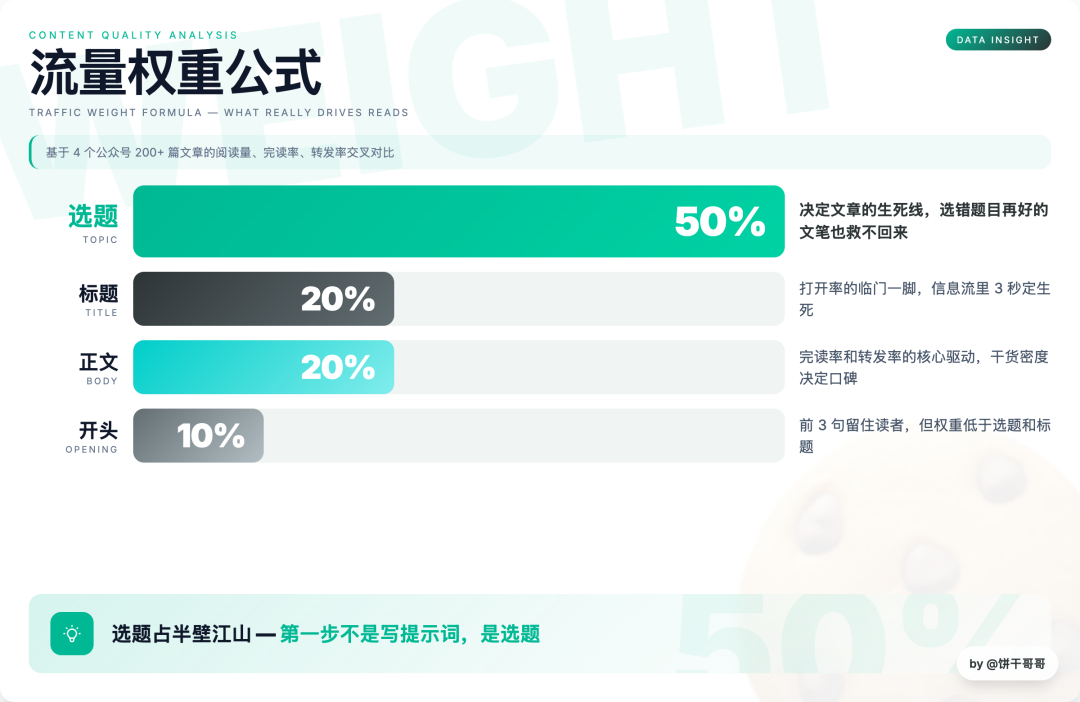
The weighting of each article element: topic selection 50%, headline 20%, opening 10%, body 20%. Topic selection is half the game — the first step isn't writing prompts, it's picking the topic.
Assuming the topic is right, good content meets six standards:
- Logic that builds layer by layer, not flat listing. Every 300-500 characters needs a new point or new question to pull the reader along
- A counterintuitive opening that creates cognitive conflict. Readers decide within the first 3 seconds whether to keep reading
- Sustained reading hooks in the body. New points, questions, suspense
- An ordinary-person feel, a persona, a sense of story. Readers can feel that “a real person is talking”
- Strong personal opinions and the guts to take a stance. Neutrality equals boring
- An ending that isn't an empty summary, but an insight, a quotable line, or a rhetorical question
These six standards are the core constraints you give the AI.
The Three Versions of AI Content Creation
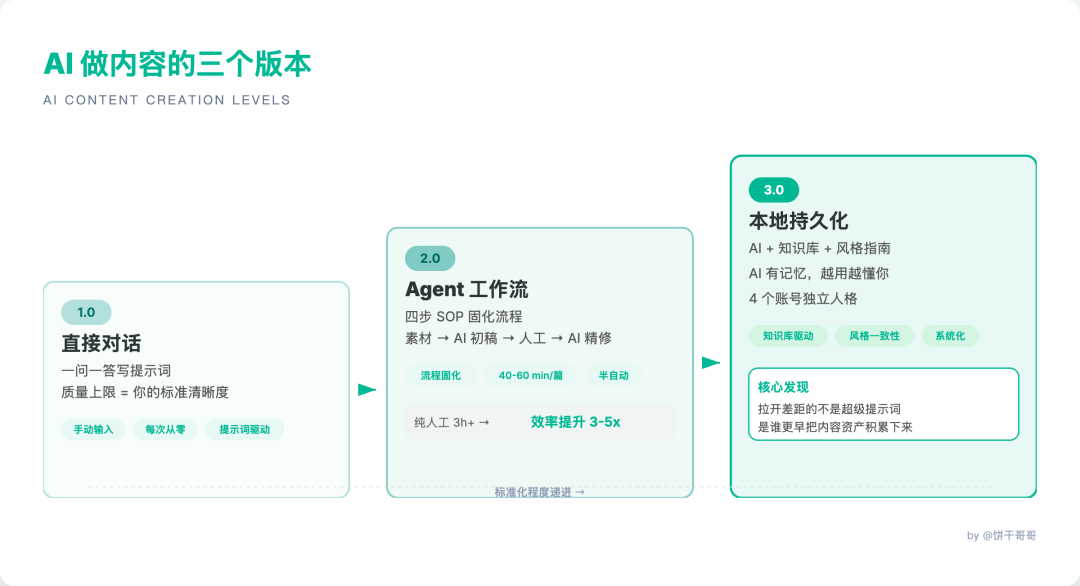
1.0: Prompt-Driven
Most people stay at this stage. The quality ceiling depends entirely on your prompting skills. Five key lessons:
Feed it material before asking for output. Feed in three past high-traffic articles as style references and, on the same topic, 70% of the output is directly usable. Ask the AI to write from nothing and it can only give you the average of its training data.
Give constraints, not freedom. “Write an AI tutorial” is worthless. “First person, 2,000 characters, S-S-L-S sentence rhythm, open with a result, close by elevating with an insight, no summarizing endings” is a real constraint.
Have the AI delete, not add. “Delete every paragraph that contains no new information” is ten times more effective than “make it richer”.
A self-critique loop. After generating a first draft, have the AI in another chat window score it item by item against the six standards and pick it apart. After a few rounds, quality improves at least 10x.
Reverse engineering. Feed in a well-written article and have the AI derive its style rules, structural patterns, and sentence features. Distill writing rules from 50 articles you were happy with, then feed them in as constraints every time you write.
Prompt template built on the six standards:
Content logic builds layer by layer, no flat listing
Open counterintuitively and create cognitive conflict
Keep throwing out new points or new questions in the body as reading hooks
Give the piece an ordinary-person feel, a persona, and a sense of story
Use strong personal opinions as subheadings
No metaphors, no double quotes, no summarizing endings
2.0: A Four-Step Workflow SOP
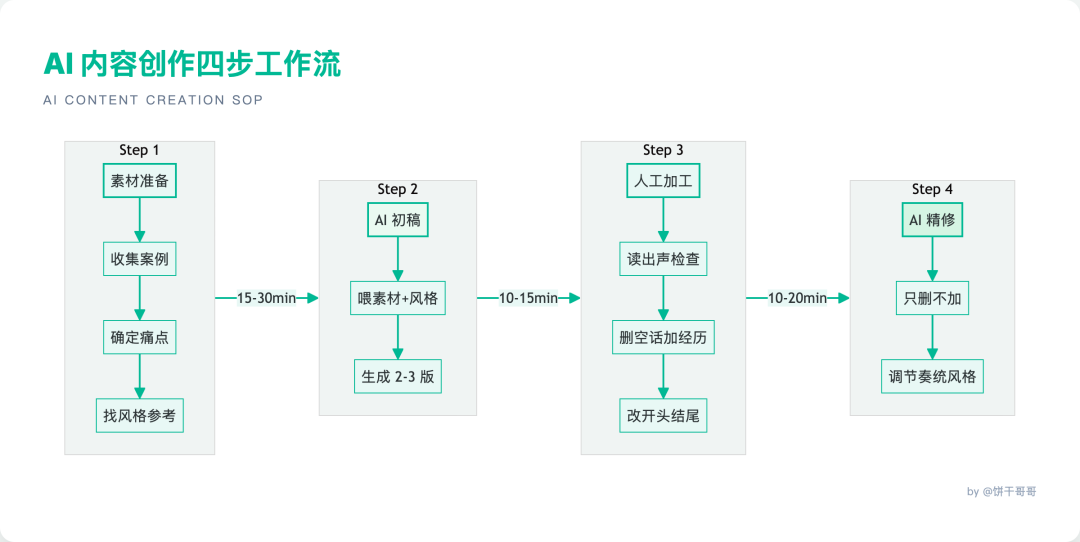
- Step 1 Material prep: collect cases, pin down pain points, find style references. Material comes from three directions — sales collects the questions customers ask most, delivery distills the product's real advantages, and operations reuses proven hit topics
- Step 2 AI first draft: feed the material + style samples + constraints to the AI and generate 2-3 versions
- Step 3 Human refinement: read it aloud to check. The opening, the ending, and key judgment sentences must be gated by a human
- Step 4 AI polish: have the AI only subtract — cut redundancy, adjust rhythm, unify the style. Be explicit: “delete only, add nothing”
The core idea: AI handles the draft and the skeleton; humans handle the perspective and the judgment.
3.0: Giving the AI Memory
Version 2.0 still starts from zero every time. What 3.0 solves is giving the AI long-term memory.
The method: use Claude Code to operate a local knowledge base, where each account gets its own style guide file (persona, tone, sentence rhythm, banned words, high-performing topic patterns), plus 5-10 benchmark articles injected as style references. Multiple accounts share the research knowledge base, but each keeps its own persona.
Key finding: what separates the winners isn't who can write super-prompts, but who accumulates content assets sooner.
The 8-Point De-AI-Flavor Checklist
The real problem with AI-flavored writing isn't word choice (“it's worth noting that” is just a surface symptom) — it's patterns: every paragraph neatly in three parts, no opinions or stances, identical structure throughout.
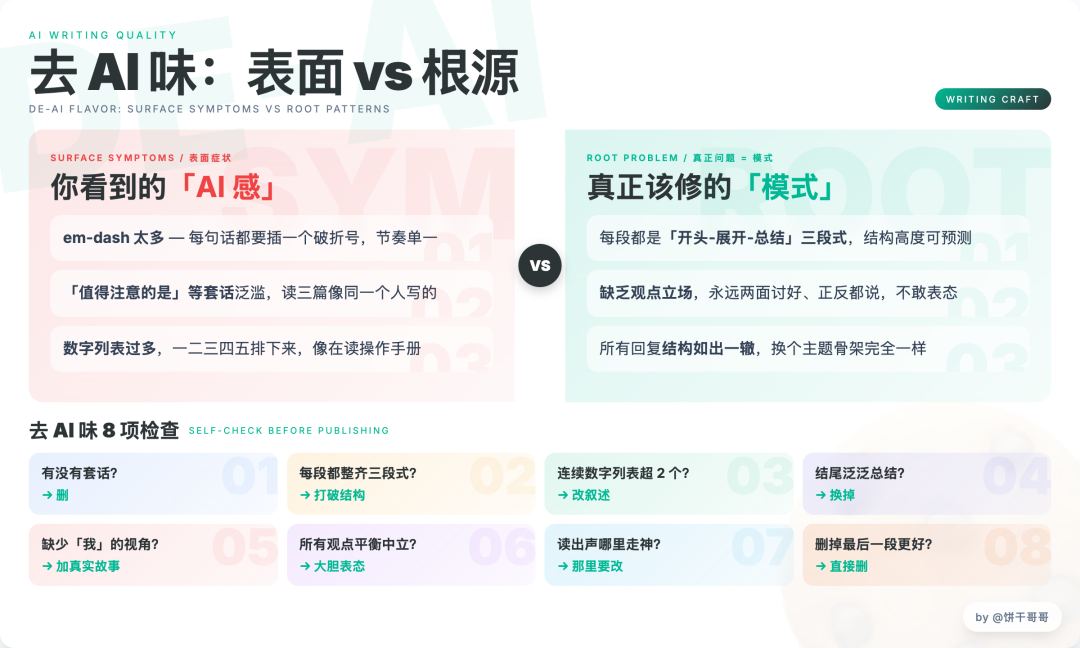
Run every article through this before publishing:
De-AI-flavor 8-point check:

[ ] Filler phrases like “it's worth noting that”, “in summary”, “moreover”? → delete
[ ] Does every paragraph follow a neat “open-develop-summarize” pattern? → break the structure
[ ] More than 2 consecutive numbered lists? → turn them into narrative
[ ] A vague summary or outlook at the end? → replace it
[ ] Missing the “I” perspective? → add a real story
[ ] Every viewpoint balanced and neutral? → take a bold stance
[ ] Read it aloud — where did you drift off? → fix that part
[ ] Does the article read better with the last paragraph deleted? → delete it
The last one is a quick test: in an AI-written article, just delete the final summary paragraph — the second-to-last paragraph usually lands harder.
Batch-Generating Openings and Endings
High-conversion openings come in four types: say-what-I-feel resonance, counterintuitive, personal story, and data shock.
Batch-generation prompt:
Write me 10 openings for this topic:
First 5, use different emotional triggers (curiosity/fear/surprise/resonance/provocation)
Next 5, use different structures (number/question/story/counterintuitive/suspense)
Each one no longer than 15 characters
Banned: “did you know”, “most people don't know”, “today I'm sharing”
Topic: [fill in your topic]
For endings, explicitly ban the AI's default behaviors (summarizing, looking ahead, encouraging) and specify the ending type: echo the opening, a personal stance, or close with data.
Toolin Editorial Team
Categories
Related articles

The caveman Plugin: Making Claude Code Cut the Fluff and Save Tokens
The caveman plugin that blew up on GitHub with 20K stars saves tokens by streamlining AI output style. It supports Claude Code and Codex, with three compression levels to switch between as needed.
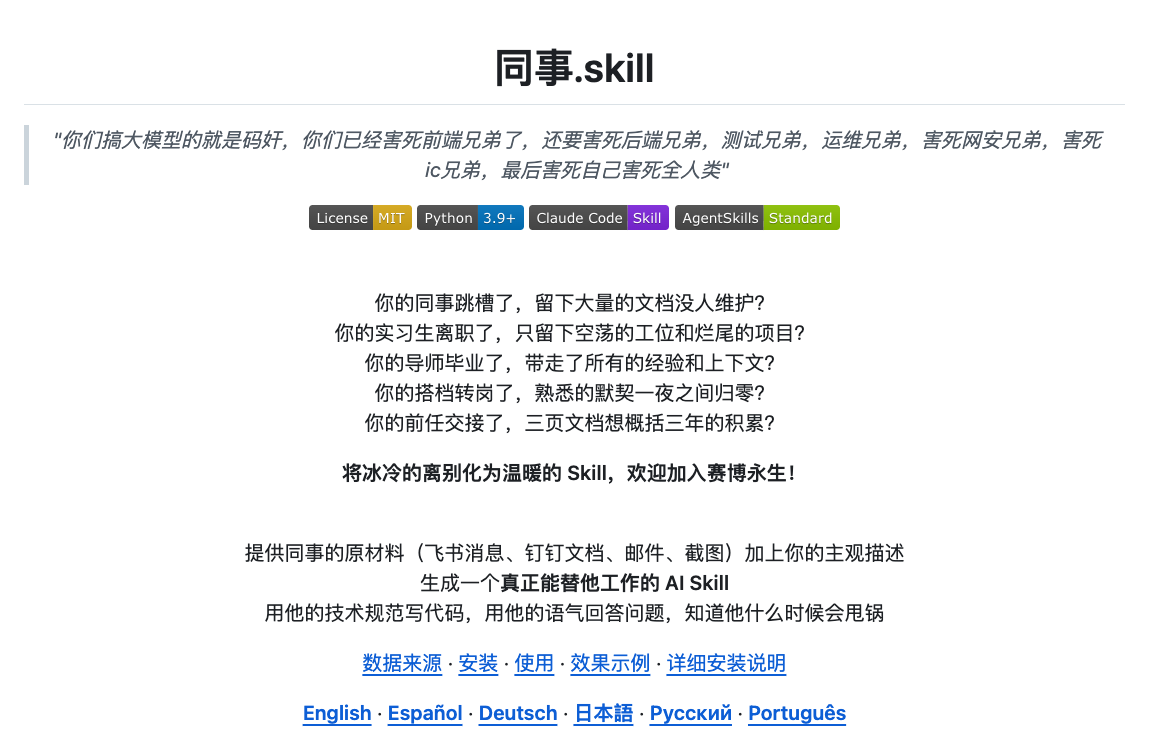
Colleague.Skill Explained: How Do You Actually Turn a Person's Capabilities into an AI?
Colleague.Skill, the project that went viral on GitHub, feeds chat logs and work documents into an AI to generate a reusable work Skill. This article breaks down its technical architecture and the core strategy of distilling yourself proactively versus being distilled by others.