
Claude Code Artifacts: Turning Terminal Development into a Shareable Web Dashboard
Anthropic brings Artifacts to Claude Code, generating shareable web pages in real time as you develop — team collaboration no longer relies on retelling things by hand.

Claude Code Artifacts: Turning Terminal Development into a Shareable Web Dashboard
Anthropic brings Artifacts to Claude Code, generating shareable web pages in real time as you develop — team collaboration no longer relies on retelling things by hand.
Claude Code's output is finally more than text in a terminal. During the Dragon Boat Festival holiday, Anthropic launched the Artifacts feature for Claude Code, publishing the entire progress of a development session — code diffs, conversations, debugging timelines, monitoring data — in real time as a shareable, interactive web page. This marks the first time an AI coding tool has captured the "work process" in a form the whole team can see.
This article gives you a quick tour of what the feature is, how to use it, who it's for, and the product logic behind it.
What Are Artifacts
Simply put: once Artifacts is enabled, Claude Code can generate a real-time, shareable, interactive web page in the middle of any development conversation.
That page can be a PR code walkthrough, a system architecture explainer, a debugging timeline, a data dashboard, or a launch checklist.
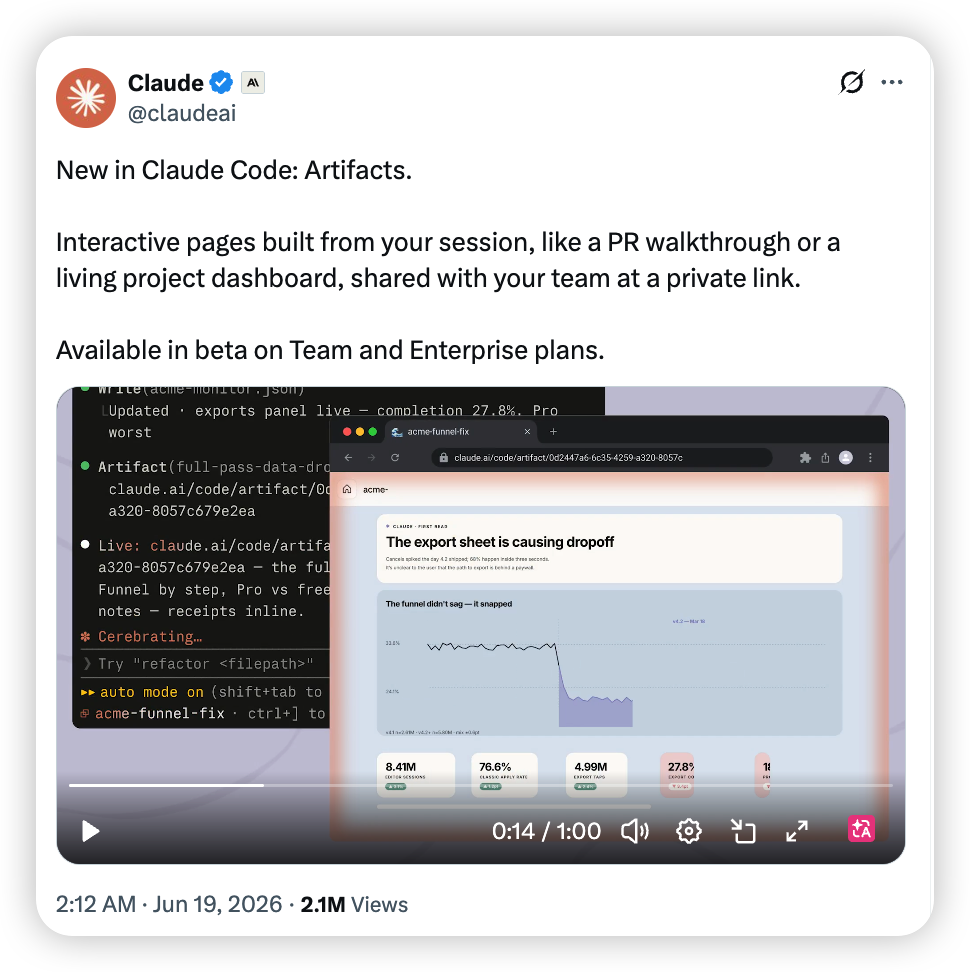
These are not the Artifacts of 2024's Claude 3.5 Sonnet era inside the Claude.ai chat interface. The emphasis this time is on real-time updates: the full context of a Claude Code development session (the current codebase, conversations, investigation process, connector data, logs, monitoring, test results, function call chains, diffs, and more) gets published as a "browsable workbench."
Every publish is a new version under the same link, with version history and rollback support. When you update code in Claude Code, the open web page refreshes in place, and teammates immediately see the latest content — no extra data sources required.
How to Trigger an Artifact
Invoking it is simple — two paths:
- Directly ask it to create an artifact in the session
- Make a request that clearly calls for visualization, and Claude Code will detect it and generate one automatically
Tip: Artifacts is in Beta and currently open only to Team and Enterprise users — individual Pro/Max plans don't have access yet. That fits Anthropic's usual B2B-first strategy — roughly 80% of its revenue comes from enterprise and developer API calls.
The Nine Official Use Cases
Claude Code's official list of nine scenarios nicely shatters the stereotype that "CC is for programmers only."
Inside Engineering: A Productivity Multiplier
- Software engineers: make an artifact walking through this PR — the diff, the reasoning, what was tested
- Senior engineers/architects: turn the payment service's architecture into an artifact drawn from the code itself — a real service topology generated from import relationships, no more whiteboard sketches from memory
- Designers/frontend engineers: generate 5 UX options for a signup form based on the component library
- SREs/on-call engineers: turn an incident into an artifact — timeline, suspicious commits, monitoring error spikes — republished as the investigation continues; the incident page keeps growing and becomes the postmortem doc when you're done
- Engineering managers: generate a "PRs merged this week, grouped by project" page
Non-Programmers: The Group It Really Wants to Reach
The most telling signal is in the last four roles — people who would never normally open a terminal to write code:
- Legal/open source compliance: list all third-party dependencies and licenses, flagging copyleft risks
- Privacy teams: track everywhere personal data is involved, packaged as an artifact for privacy review
- Security teams: turn audit findings on authentication into an artifact, each item linked to the corresponding code
- FinOps/platform finance: map cloud resources in Terraform into an artifact, grouped by service, showing where the big costs are
Why This Feature Matters
Filling the Last Gap in Team Collaboration
The most awkward thing about AI coding tools until now: the agent does a ton of work — reading code, running tests, locating bugs — but nearly all of it happens inside one person's terminal. When it's time to collaborate, the engineer has to retell the whole story: which logs it looked at, which commit it suspected, why it believed this was the root cause. A good chunk of the time AI saved you gets eaten right back up by "manually narrating the AI's work."
Now, engineers don't need to repeat themselves until hoarse — just drop the link into the team chat, and everyone sees the same view, the same context, the same continuously updating work in progress.
The Codebase Becomes a "Source of Truth"
From this move you can see that the group Claude Code really wants to reach is precisely these non-programmers with professional skills and specific work scenarios. The codebase will become a source of truth for more and more functions inside a company, and Claude Code is trying to translate it into an interface that teams can more easily consume.
This isn't just a grab at Cursor's and Codex's cake — it may also squeeze the market space of collaboration tools like Notion, Confluence, and Jira.
Use Cases
Artifacts is best suited for:
- Internal engineering collaboration: PR review, incident retrospectives, auto-generated architecture docs
- Cross-functional communication: let legal, security, and finance consume codebase information directly, without an engineer translating
- Remote teams: share development progress asynchronously, no sync meetings needed
- Client/management reporting: present technical progress as a visual web page
If you're a Claude Code Team or Enterprise user, the next time you do a PR or an incident retrospective, try saying in the session "turn this work into an artifact" — your teammates will thank you.
Toolin Editorial Team
Categories
Related articles
Two Open-Source Skills: Have Codex/Claude Code Make Your Illustrations and Web Designs
The open-source guizang-material-illustration article-illustration skill and web-design-taste web design skill install into Codex with one command — goodbye to AI-flavored illustrations and cookie-cutter web pages.

Tencent Hunyuan Hy3 Official Release: A Homegrown Coding Agent Model Matching GLM-5.2
The official Tencent Hunyuan Hy3 is live: 295B MoE architecture, agent task success rate up to 90%, API price of ¥1 per million tokens, with a limited-time free trial inside WorkBuddy.

Vidu S1: The Open-Class Interactive Video Model That Lets Digital Humans Talk in Real Time
Shengshu Technology's Vidu S1 achieves real-time voice-driven video generation at 540P/25FPS, runs on consumer GPUs, and turns a single image into a conversable digital human.

A Guide to Codex's Three Computer-Control Modes
Codex's three control modes — Computer Use, the Chrome extension, and the in-app browser — each fit different scenarios. This piece breaks down the permission hierarchy and offers best practices.
Codex Open-Source Mode: Plug In Local Models with One Line of Config
OpenAI's Codex adds an OSS mode: a model_providers config connects Ollama, LM Studio, and other local model services, with switchable models to cut costs.

Alibaba HappyHorse 1.1: Video Generation Upgraded Across Five Dimensions
Alibaba's HappyHorse 1.1 video generation model improves five dimensions including motion expressiveness and subject consistency, cuts 1080P pricing by 25%, and is now live on the Bailian platform.