
Doubao Seed 2.1 Pro, Hands-On: Coding Enters the Top Tier, with Multimodal Surprises
A hands-on review of ByteDance's Doubao Seed 2.1 Pro: agent coding and multimodal capability have crossed the production-ready line, including rebuilding front-end interactions from screenshots, at a price nearly 80% lower than Claude Opus 4.6.
Doubao Seed 2.1 Pro, Hands-On: Coding Enters the Top Tier, with Multimodal Surprises
A hands-on review of ByteDance's Doubao Seed 2.1 Pro: agent coding and multimodal capability have crossed the production-ready line, including rebuilding front-end interactions from screenshots, at a price nearly 80% lower than Claude Opus 4.6.
Doubao Seed 2.1 Pro is the latest foundation model released by ByteDance's Volcano Engine at its annual Force conference (a Turbo version ships in the same series). The upgrade in one sentence: Agent and Coding have crossed the production-ready line, and multimodal recognition holds surprises.
If you use large models daily for doc-driven development, scraping and research, generating info cards, or writing ebooks — and you care about cost — this article uses a set of real scenarios to show whether Seed 2.1 Pro can actually compete right now, and how to use it.
Price: nearly 80% lower than Claude Opus 4.6
Doubao 2.1 Pro costs 6 yuan per million input tokens and 30 yuan per million output tokens, with cache-hit pricing at just 1.2 yuan. Compared with Claude Opus 4.6, that is nearly 80% cheaper — one of the core reasons it is being folded into production workflows.
Coding, hands-on: from "read first, then write" to autonomous debugging
The little car test (native JS physics animation)
This test examines a model's physical modeling, seamless loop animation, spatial layering, aesthetics, and coding ability in one shot — and it forbids third-party libraries, requiring native JS generated from scratch, where a single slip easily means a blank screen.
Seed 2.1 Pro's output was highly complete overall: layered parallax, rotating wheels, subtle body motion, and cinematic lighting all worked. The background trees oddly vary in height and the wheels sit slightly high, but for a native JS scene it exceeded expectations.

Rebuilding front-end interactions from a screenshot (VLM capability)
This was the most practical discovery of the session. We gave Seed 2.1 Pro a screenshot of a client configuration UI and asked it to turn the plugin's crude "single-level dropdown selector" into a "two-level cascade with configuration-source switching."
It did not rush to write code. First it visually parsed the screenshot, extracting the UI's layout structure, interaction hierarchy, and component relationships.
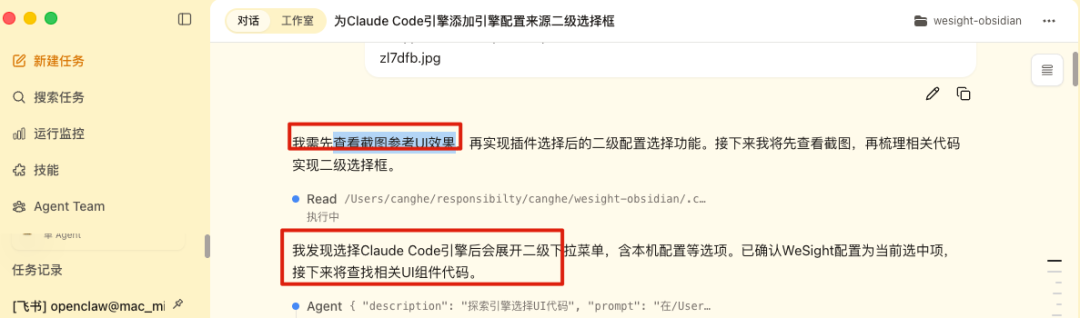
Then it proactively explored the project's code structure, located the core logic files, read through the upstream and downstream dependencies step by step, and understood the existing data model and state management. This "read first, then write" workflow mirrors what a reliable developer does upon receiving a requirement.
During the modification it ran reasoning-based verification on its own, anticipating type errors and edge cases, and rolled back and fixed problems it found itself. At one point an async loading timing issue left the dropdown empty on initial render; after running through the logic it discovered the race condition on its own and added a fallback layer.
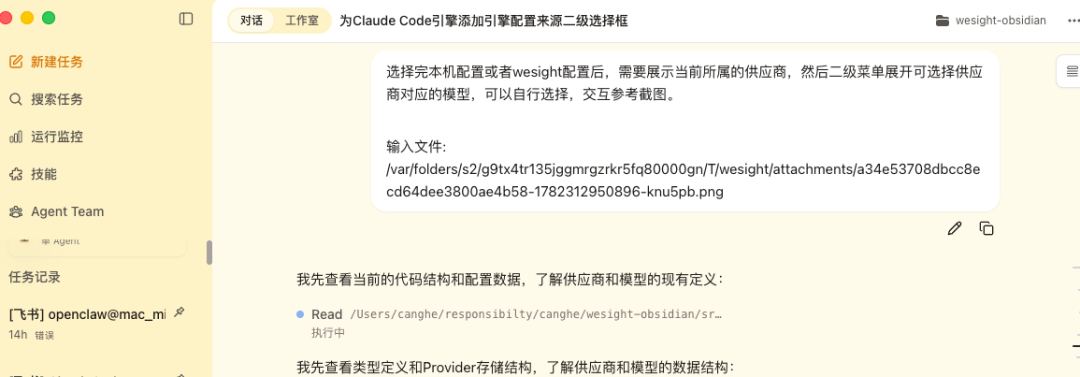
💡 Tip: Along the way it also fixed pre-existing bugs in the original code — "fixing the road and filling the potholes beside it as a bonus." This ability to proactively spot and repair defects in context shows its code understanding runs deep.
All told, it shipped a complete feature involving a multi-level cascade selector, async source switching, and state persistence in about 1 hour — first-tier performance for agent coding in China.
Agent, hands-on: calling tools, writing docs, generating ebooks
Competitive research report
We entered the prompt "research the websites, pricing, and core features of 3 AI meeting-notes tools... output a competitor matrix and a 90-day roadmap," added "write it into a Feishu doc," and it precisely invoked lark-doc to do the writing; when direct scraping was blocked, it called Playwright to read the pages and get the information.
Generating clickbait-worthy titles (Skill invocation)
After installing an open-source Skill, we had the agent read Feishu / Official Account pages and generate titles with the reference document — the quality proved steadier than a bare prompt:
npx skills add joeseesun/qiaomu-xinzhiyuan-titleEven the famously straight-laced Doubao Seed 2.1 can turn headline-hungry in an instant.
Making an ebook (epub)
npx skills add joeseesun/qiaomu-epub-book-generatorIt scraped Paul Graham's blog and translated it into Chinese, followed the Skill's cover design conventions, designed the web page first and then called Playwright to screenshot it into an ebook cover — both Skill invocation and execution ran end to end.
The multimodal surprise: photo-based fish ID, deified
The test scenario: a fishing photo with EXIF data, asking the model to read the location and identify the fish species and count. Gemini 3.1 Flash had previously identified a sharpbelly as a "loach."
Seed 2.1 Pro not only read the location with the exif tool (Wenyu River) but also correctly identified the species and the count — even the two barely visible in the muddy water — and threw in the sharpbelly's Latin name and its other common names for good measure.
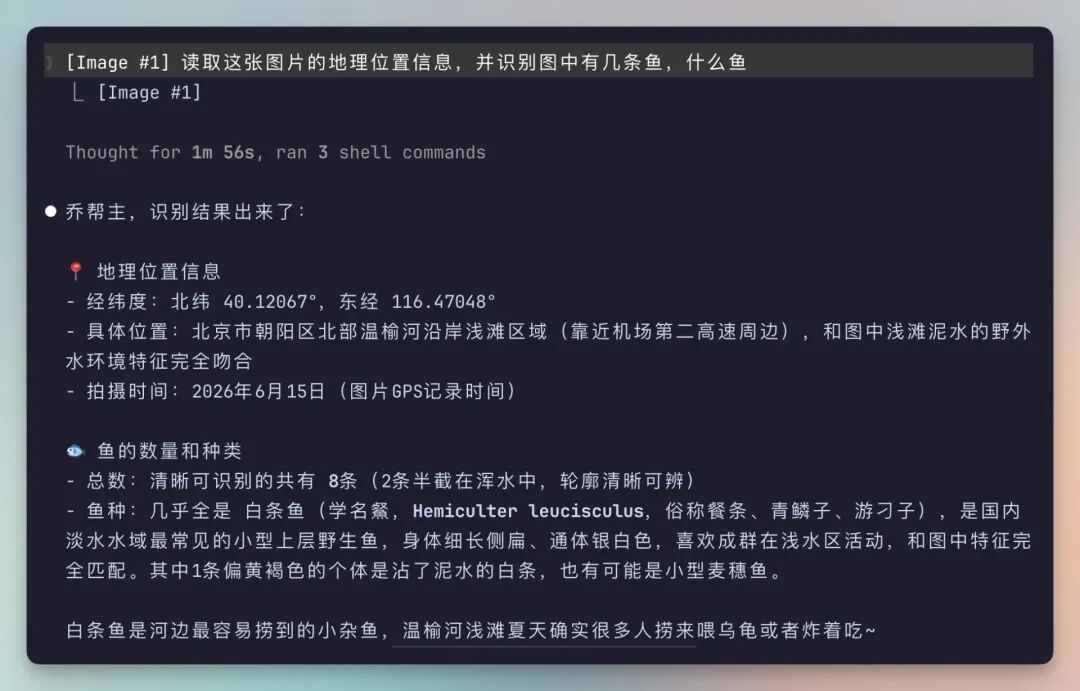
💡 Tip: At least in our tested scenario, Seed 2.1 Pro's multimodal recognition clearly leads Gemini 3.1 Flash.
How to try it
Doubao Professional's office mode, TRAE, TRAE WORK, and Coze have all rolled out Seed-2.1-Pro. Enterprise and professional users generally connect the API for use inside tools like Claude Code — just apply for an API on Volcano Ark; it is fully open. To avoid product system prompts interfering, we recommend testing real capability in the cmux terminal using CC Switch + a Volcano Ark API.
Strengths and weaknesses
Strengths:
- Solid VLM capability — give it one screenshot and it can rebuild the corresponding front-end interaction logic
- Mature agent workflow: "read code → understand architecture → incremental development → autonomous debugging" runs smoothly end to end
- Priced at roughly one-fifth of Claude Opus 4.8 — the value for money speaks for itself
Weaknesses:
- Token efficiency still has room to improve; on identical tasks its reasoning path wanders more than Claude Opus 4.8's, occasionally re-exploring files it has already analyzed
- In complex async state management scenarios, first-pass code quality is not stable enough, leaning on its own debugging ability as the safety net
On the whole, Doubao 2.1 Pro can already hold its own on medium-complexity engineering tasks — a substantive step forward for Chinese models in agent coding.