
Hyper3D Rodin Gen-2.5: A Million Polygons in 4 Seconds as Thinking Comes to 3D Generation
Deemos has released Hyper3D Rodin Gen-2.5, the first to bring an LLM-like Thinking mechanism to 3D generation — million-polygon models in 4 seconds, 10-million-polygon precision, and native 12K texturing.
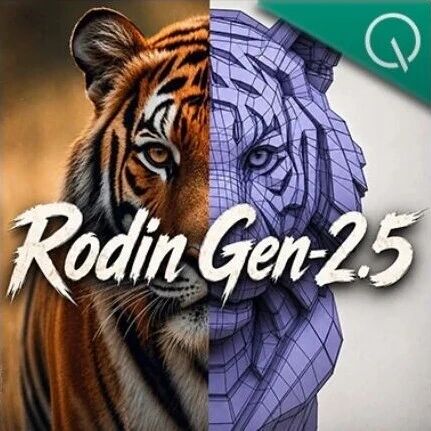
Hyper3D Rodin Gen-2.5: A Million Polygons in 4 Seconds as Thinking Comes to 3D Generation
Deemos has released Hyper3D Rodin Gen-2.5, the first to bring an LLM-like Thinking mechanism to 3D generation — million-polygon models in 4 seconds, 10-million-polygon precision, and native 12K texturing.
Hyper3D Rodin Gen-2.5 is the latest 3D generation model from Deemos. It is the first in the 3D generation field to introduce an LLM-like Thinking mechanism, letting the model adaptively decide the complexity of its output based on the compute budget — a million-polygon model in 4 seconds, and 10-million-polygon precision within 80 seconds.
It is also the world's first 3D generation model to break the 10-million-polygon precision ceiling, and paired with the first native 12K 3D texture model released alongside it, it can faithfully reproduce skin detail down to the pore level. If you work in game art, film and TV digital humans, industrial modeling, or e-commerce assets, you can treat Rodin as a controllable, editable master generator.
Core Upgrades: Three Major Changes
10-Million-Polygon Geometry Precision
Ten million polygons is like shooting photos in RAW: the files are large, but the information is complete and post-editing is unconstrained. Game artists can nail every detail on the high-poly master first, then bake it into a lightweight version for the game; film and high-precision industrial modeling likewise produce a master first and derive per-scene versions from it. More polygons mean more freedom downstream.
An LLM-like Thinking Mechanism
Speed and precision look contradictory, and Rodin Gen-2.5's answer is "think first, then build." The model thinks before generating, with thinking time controllable from 4 to 80 seconds across five tiers (4s / 9s / 20s / 40s / 80s).
- Rushing a draft out the door → the 4-second speed mode
- A sculpture-grade final product → let the 80-second mode grind away
The core philosophy is not making decisions for the user — the choice goes back to the user.
Native 12K Texturing
"Native" here means the colors and materials on the model surface are not painted on afterward; they "grow" naturally out of the model itself. Coverage is seamless across all 360 degrees, standard PBR materials are supported, and visual detail is preserved precisely, avoiding blurry, broken, or distorted textures.
Hands-On Experience
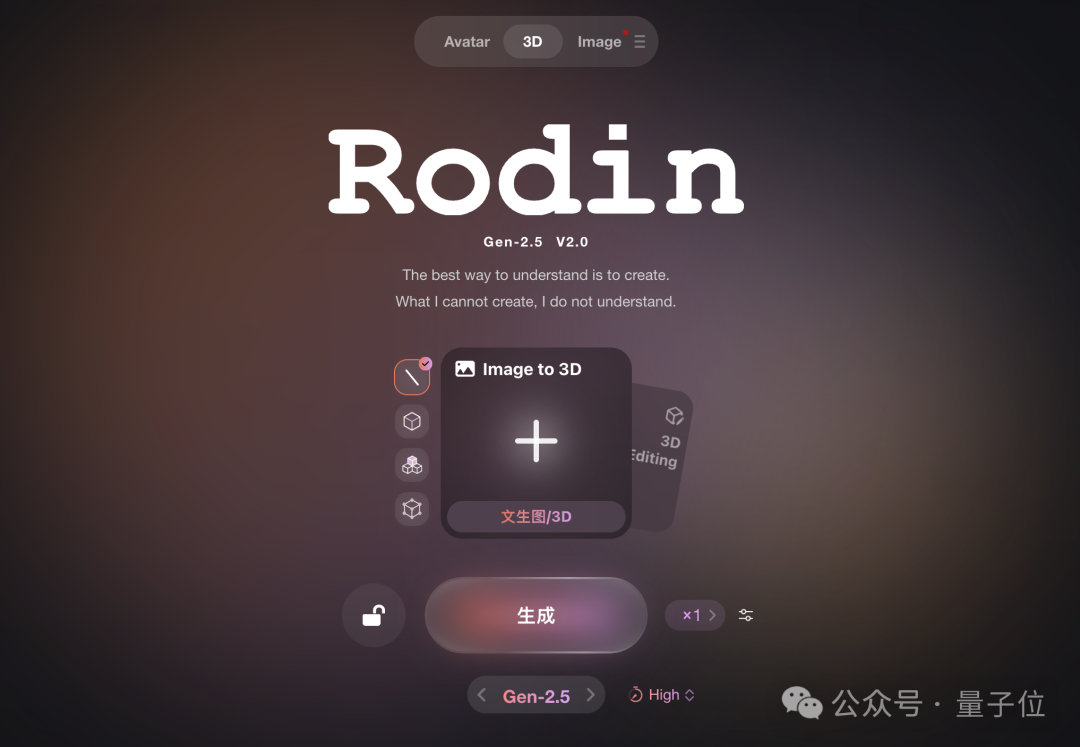
Head to the official site hyper3d.ai and switch the product mode to 3D to try Rodin Gen-2.5, which supports two ways to play: direct generation and further editing. The generation model offers five modes from Extreme-Low to Extreme-High; professional users can also opt for 3D ControlNet shape control (bounding box, voxel, point cloud).
I casually tossed in an AI-generated photo of a little monster with 4 seconds of thinking time, and Extreme-Low mode produced a base asset almost instantly, generating rich plush texture directly at the model level — well suited to quickly building simple assets, batch testing, and UGC play.

With thinking time turned up to 80 seconds, Extreme-High mode reproduces texture detail noticeably more accurately: distinct fur flow, fluffiness generated directly, full 360-degree coverage. Once materials are applied, every strand of hair is clearly visible, and the eye detail is strikingly lifelike.

For portraits, Rodin Gen-2.5 renders crow's-feet, facial creases, and skin texture with fine, natural detail — no harsh smoothing or detail loss — preserving each person's unique facial texture and freeing 3D portraits from the "cookie-cutter plastic look."
💡 Tip: Fast, accurate, and economical — that is the most immediate impression this generation of Rodin leaves. Because the team understands the underlying algorithm architecture deeply, the model's generation and inference efficiency sits far above the industry average.
Use Cases
- Game art: nail detail on the high-poly master → bake into a lightweight version for the game
- Film and digital humans: photoreal human likenesses, film-grade digital portraits
- Industrial and spatial computing: high-precision masters, with versions of varying precision derived per scene
- E-commerce assets: rapid batch generation and further editing
Revenue from Deemos' business clients already exceeds the sum of every other company in its category, with roughly 80% of income coming from overseas and customers spanning games, e-commerce, embodied AI, spatial computing, and other high-value scenarios. Toolchains and design platforms such as Unity AI Beta, OctaneRender, Canva, and Figma have also integrated its capabilities.
Pricing and Access
Official site: https://hyper3d.ai, subscription-based. In the model's first month online, Deemos' subscriber count and annual recurring revenue (ARR) growth rate expanded by 400% month over month.
Final Thoughts
Deemos did not take the opportunistic shortcut of lifting 2D into 3D; it started from native 3D and built strong controllability into pretraining — from the early 3D ControlNet and the recursive part-decomposition technique Bang to Parts, to 3D Editing that modifies models directly with natural language. Every generation has hammered away at controllable, editable, applicable. That is why, to this day, they are the only team in the industry that has delivered this capability set.