
Meshy: Turning Text and Images into Usable 3D Models in 20 Seconds
AI text/image-to-3D tool with a two-step workflow and FBX/OBJ/GLB/STL export, plus an official API and platform plugins.
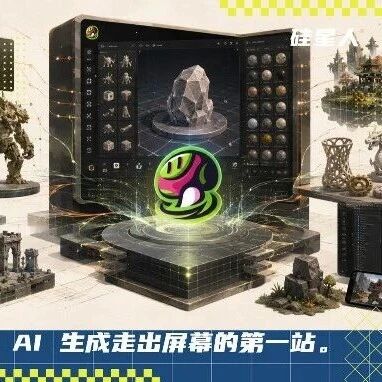
Meshy: Turning Text and Images into Usable 3D Models in 20 Seconds
AI text/image-to-3D tool with a two-step workflow and FBX/OBJ/GLB/STL export, plus an official API and platform plugins.
Meshy has just closed a Series B of nearly $400 million at a post-money valuation above RMB 10 billion, setting the record for the largest single financing round to date in AI 3D. But what should matter more to creators and developers than the raise: it turns a piece of text or a single image into a production-ready 3D model in 20-30 seconds, exports directly to FBX, OBJ, GLB, and STL, and plugs into your own workflow through the official API. If you work in games, 3D printing, product design, or VR/AR, this piece gets you quickly across what Meshy can do and how to use it.
What Meshy Is
Meshy is an AI 3D model generator whose core capability is converting text and images into production-ready 3D models. It launched in 2023 as the world's first publicly accessible 3D generative AI product. Founder Yuanming Hu — a Tsinghua Yao Class undergraduate and MIT PhD — led the development of the Taichi programming language (28,000+ GitHub stars) during his doctoral studies, and the team carries both large-model training and computer graphics capabilities in-house.
A few key numbers (per official disclosures):
- Over 12 million registered users, and more than 100 million models generated in total.
- Annual recurring revenue grew roughly 12x within one year, with month-over-month growth sustained at 20%-30%.
- Release cadence: from the first version in 2023 to Meshy 6 in early 2026, major updates landed more often than once every six months on average.
Why 3D Generation Is Harder Than Image Generation
To understand Meshy's value, start with the three barriers of AI 3D:
- No single standard representation: meshes, point clouds, voxels, implicit functions — each has trade-offs, and none converts losslessly to another.
- Complex supervision signals: a 3D model must look right from every viewpoint; geometry must be closed, topology sensible, and UV unwraps must be able to carry textures — and these constraints often conflict with one another.
- Scarce data: images number in the tens of billions and videos in the billions, while high-quality 3D data sits at only the tens of millions and is distributed very unevenly.
Meshy feeds the 100 million generations produced by its 12 million users back in as preference data — a structural moat in a field where 3D data is naturally scarce, and one latecomers will find extremely hard to replicate.
Core Features
Text-to-3D / Image-to-3D: A Two-Step Workflow
Meshy's text-to-3D API uses a clean two-step workflow:
- A preview task (
mode: "preview"): first quickly generates an untextured 3D mesh, used to judge whether the shape is on the right track. - A refine task (
mode: "refine"): pass in the finished preview task's ID to add textures to the mesh and get the complete final model.
This "shape first, texture later" flow avoids spending compute in the wrong direction from the start.
All the Mainstream Formats
Generated results export to FBX, OBJ, GLB, STL, USDZ, and 3MF, importing directly into mainstream toolchains like Unity, Unreal, and Blender. Slicing success rates for 3D printing reach 97% per official figures.
The Latest Generation's Capabilities
- Smart Topology: generates a 3D model with native parts in about 10 seconds, with precisely controllable face counts (100 to 15000) — no manual decimation or retopology needed, ready for real-time rendering.
- 8K Texture: pushes AI texture resolution and quality to a new level, with significant gains in detail retention, color fidelity, and clean de-lighting.
- Auto Split: aimed at 3D printing users, compressing the most time-consuming part-splitting step into one click. In testing it identified an astronaut model as 19 separate parts; in assembly mode each part reassembles into the complete figure and can go straight into slicers like Bambu Studio.
- 3D Agent: the world's first conversational 3D creation agent, now open to all registered users. No 3D experience required — through conversation, text, photos, or sketches, you go from idea divergence to a finished 3D asset in a single conversation, importable into Unity/Unreal/Blender with rigging and animation.
💡 Tip: 3D printing users, pay special attention: thin walls, holes, or self-intersecting faces — any one of these will sink a print on its own. Meshy's Auto Split plus solid exports significantly reduces these risks, but it is still worth running one more model check in your slicer before printing.
How to Use It: Key API Parameters
The parameters below come from Meshy's official documentation (https://docs.meshy.ai/zh/api/text-to-3d) — a useful reference if you are integrating it yourself.
Task parameters:
prompt: describes the object type, up to 600 characters.model_type:standard(high detail) /lowpoly(low face count).ai_model:meshy-5/meshy-6/latest(that is, Meshy 6).should_remesh: whether to rebuild the mesh.symmetry_mode: symmetry modeoff/auto/on.pose_mode:a-pose/t-pose.target_formats: specifyglb/obj/fbx/stl/usdz/3mf.enable_pbr: generate PBR maps (metallic/roughness/normal).hd_texture: 4K base color map.texture_prompt/texture_image_url: extra texture guidance.auto_size: AI vision estimates the real-world height automatically.
Task state machine: PENDING → IN_PROGRESS → SUCCEEDED / FAILED / CANCELED, with SSE streaming for progress. Billing is per task, and credits for failed tasks are refunded.
For specific pricing tiers, defer to Meshy's official subscription page.
Platform Plugins and the Enterprise Edition
Meshy offers a REST API plus native plugins for a set of 3D platforms: Blender, Unity, 3ds Max, Maya, Godot, and Unreal Engine, along with mainstream 3D printing slicers. The enterprise edition additionally provides SSO, SOC2/ISO27001/GDPR certifications, and perpetual asset retention.
Use Cases
- Game development: controllable face counts, clean topology, correct rigging — imports straight into Unity/Unreal. Publicly announced partners include Nexon, NetEase Games, and 37 Interactive Entertainment.
- Consumer 3D printing: upload a single image and get a file ready to slice, integrated with Bambu Lab's MakerLab and the Creality ecosystem.
- Film production, product design, VR/AR, interior design, education: fast concept prototypes and teaching materials.
Final Thoughts
A near-$400 million Series B clearly is not pricing a tool market. Meshy defines its next phase as "real-time interactive multimodal content experiences" and has founded Meshy Game Studio, whose first AI game demo, Black Box: Infinite Constructs, lets players drive weapon generation in real time with natural language. When AI-generated 3D content becomes good enough, fast enough, and cheap enough, games, education, design, manufacturing, and spatial computing each unfold into an independent market.
If you happen to be working on game assets, 3D printing, or product prototypes, register an account at https://www.meshy.ai/zh and run one preview→refine two-step — more direct than reading ten reviews.
Official resources:
- Website: https://www.meshy.ai/zh
- API docs: https://docs.meshy.ai/zh/api/text-to-3d