
OpenSquilla 3.0: Auto-Orchestrating AI Skill Flows with MetaSkill
The open-source AI Agent framework OpenSquilla 3.0 introduces MetaSkill, which synthesizes multi-step workflows from natural language, paired with intelligent model routing to cut usage costs.
OpenSquilla 3.0: Auto-Orchestrating AI Skill Flows with MetaSkill
The open-source AI Agent framework OpenSquilla 3.0 introduces MetaSkill, which synthesizes multi-step workflows from natural language, paired with intelligent model routing to cut usage costs.
Once you've stockpiled dozens or even a hundred-plus AI skills, the real headache arrives: how do you get the Agent to chain them into a workflow that actually runs? Hand-orchestrating every step is no different from hardcoding a script. MetaSkill in OpenSquilla 3.0 came to be precisely to solve this problem.
What Is OpenSquilla
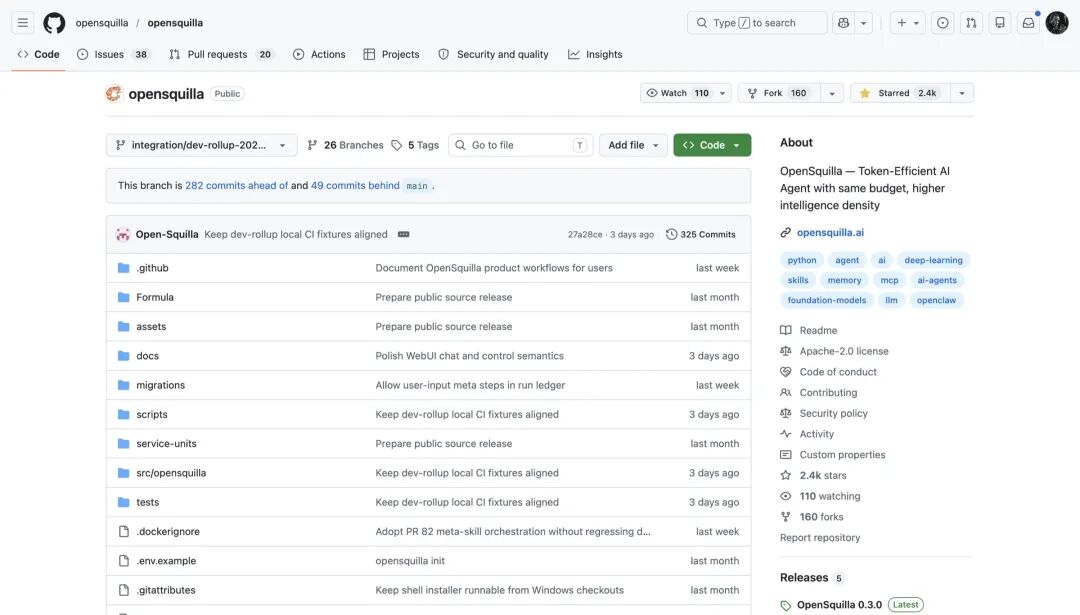
OpenSquilla is an open-source AI Agent that can run locally, written in Python. It's in the same open-source Agent lane as OpenClaw and Hermes Agent, but it has two differentiating capabilities:
- Intelligent model routing: automatically gauges each turn's task difficulty and picks the best fit from among dozens of models — cheap models for easy jobs, flagships only for hard ones
- MetaSkill: describe the goal in natural language, and the Agent automatically organizes existing skills into an executable workflow
Its core philosophy is "don't compete on the model, compete on the Harness" (the Harness is the layer of "shell" around the model, covering routing, skill management, and orchestration).
Core Capability: MetaSkill Auto-Orchestration
Picks Up Your Existing Skill Library on First Launch
The first time you open the skill list after installing, OpenSquilla automatically scans your local skill files. Personal skills from Claude Code — the full Feishu suite, browser automation, custom writing tools, and so on — are all recognized as-is and appear in the list, with no manual import needed.

One Sentence Generates a New Skill
MetaSkill Creator lets you describe what you need in a single sentence, and it automatically synthesizes a multi-step skill. For example, enter:
"First fact-check a Chinese draft, then rewrite it into a more colloquial version with the AI flavor removed, and finally output a revision list."
It generates a complete flowchart-style skill file:
fact_check (fact check)
  -> rewrite (de-AI-flavor rewrite)
    -> modlist (generate revision list)
Which skill each step uses, which earlier step it depends on, who the results go to — all filled in automatically.
Not Letting the Agent Run Wild
Once the generated flow is handed to the runtime, dependency order, tool whitelists, risk levels, and template safety are all mandatorily validated. Which step may read files and which step may run commands all have to be declared in advance.
Intelligent Model Routing: The Key to Saving Money
OpenSquilla ships with multi-tier model routing built in:
- Single-vendor routing: say, Doubao on Volcano Ark — from the cheapest mini tier to the strongest code tier, the router picks automatically by task difficulty
- Cross-vendor routing: through OpenRouter, it can pick across models from dozens of providers. Easy questions go to DeepSeek Flash, complex reasoning goes up to Claude Opus
- Local judgment: difficulty assessment happens locally, with no need to send the question to an external model for scoring
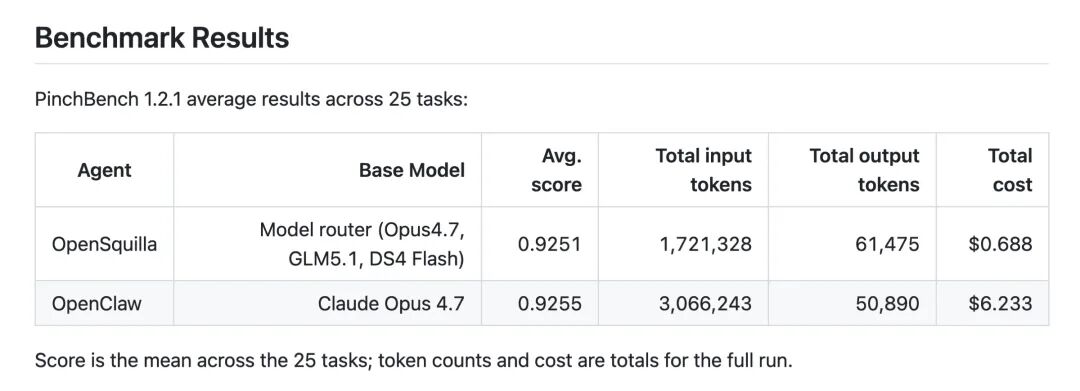
A benchmark comparison across 25 real tasks: the routing plan scored nearly the same as Opus alone, while costing an order of magnitude less.
Use Cases
- Skill-heavy users: people holding a large stock of personal Skills who need them auto-organized into pipelines
- Cost-sensitive teams: teams that want intelligent routing to push AI call costs down
- Workflow standardization: abstracting repetitive multi-step operations into reusable skill combinations
How to Get It
Search for OpenSquilla on GitHub and you'll find it — open source and free, with local deployment supported.