
WeRead AI Skill: Let AI Understand Your Reading Profile
The official WeRead AI skill opens 6 data query capabilities, while the open-source enhancement huashu-weread cross-analyzes your bookshelf and notes to deliver personalized recommendations and reading-theme evolution tracking.

WeRead AI Skill: Let AI Understand Your Reading Profile
The official WeRead AI skill opens 6 data query capabilities, while the open-source enhancement huashu-weread cross-analyzes your bookshelf and notes to deliver personalized recommendations and reading-theme evolution tracking.
A few days ago, WeRead quietly launched an official AI skill that opens your bookshelf, notes, reading stats, and other data to AI. It is a leading move in China's e-book market -- almost no domestic platform truly opens account data to AI. At the same time, a developer built an open-source enhanced edition, huashu-weread, which adds intelligent workflows on top of the official capabilities, so your reading data is no longer cold numbers but a conversational, living reader profile.
The Official Skill: 6 Data Query Capabilities
The official WeRead skill opens up the following 6 capabilities:
- Browse the bookshelf: see the books you are reading, want to read, and have finished
- Book search: search the WeRead bookstore
- Reading stats: cumulative reading time, days, and book counts
- Book details: progress and chapter information for a given book
- Notes and highlights: every highlight and thought you have recorded in books
- Recommend good books: book recommendations based on bookstore data

Installation (Two Steps, 1 Minute)
- Open https://weread.qq.com/r/weread-skills
- Click the "Quick Setup" button on the homepage, copy the instructions on the left, and send them to your AI assistant (Claude Code or a compatible client); on the right, click "Log in to WeRead" to get an API Key and configure it as an environment variable
Once installed, you can ask anything in plain language:
- "How long have I read this year?"
- "Which chapter of The Three-Body Problem am I on?"
- "Which line in Sapiens do people highlight the most?"
Limits of the Official Skill
The official skill provides a "list of capabilities", but there is a lack of "intelligence" between them. Ask it to recommend product management books, for instance, and it hands you a generic reading list from the search interface without checking which titles are already on your bookshelf or which books your notes show you have finished. It is just a search interface wrapped in natural language.
Enhanced huashu-weread: Adding Intelligent Workflows
huashu-weread is an open-source enhanced skill that adds a layer of "reading-advisor workflow" on top of the official capabilities. Its core methodology: the bookshelf and the notes are two data sources and must be cross-analyzed.
The bookshelf reveals the interests you "actively categorized"; your notes reveal the books you "actually read". Plenty of books sit untouched on the shelf, and plenty of books you have read deeply never made it there. Looking only at the bookshelf misses signals; looking only at the notes misses where your interests are heading.
4 Workflows
| Name | Function |
|---|---|
| advisor | Recommends what to read next: digs through the bookshelf + cross-references notes, finds the gaps in the puzzle, and checks whether WeRead carries the book |
| path | Want to master a field: first gauges your level, then builds a ladder of books from introductory to frontier |
| alchemy | Organizes your notes: distills scattered highlights and thoughts into structured reading notes |
| review | Writes reading retrospectives: outputs recap articles ready to post to WeChat Moments, Official Accounts, or Xiaohongshu |
Recommendation Quality Compared
Same question, "recommend product management books":
Bare weread (the official skill) recommended 14 books, 3 of which the user had already finished (68 notes on Yu Jun's Product Methodology, Behind the Product sitting on the bookshelf, 34 notes on Silicon Valley Growth Hacker) — in essence a generic PM reading list.
huashu-weread recommended 5 books, each with an explanation of why it was picked:
- Transformed, by Marty Cagan: you have read the Chinese PM classics of the Yu Jun and Su Jie lineage but never touched Cagan
- The Design of Everyday Things, by Don Norman: you have a pile of methodology books but no UX foundation
- The AI Product Manager's Handbook: you are building AI products, yet your AI PM shelf is empty
- Rework, by Jason Fried: you are an independent developer, yet most PM books you read take a big-company perspective
- Rework 3: you added Small and Beautiful earlier but never finished it; a more systematic pick from the same lineage
Reading Theme Evolution Analysis
The alchemy workflow has one more impressive feature. It takes all your highlights, tokenizes them, runs TF-IDF, clusters them into themes, and plots each theme's share by year.
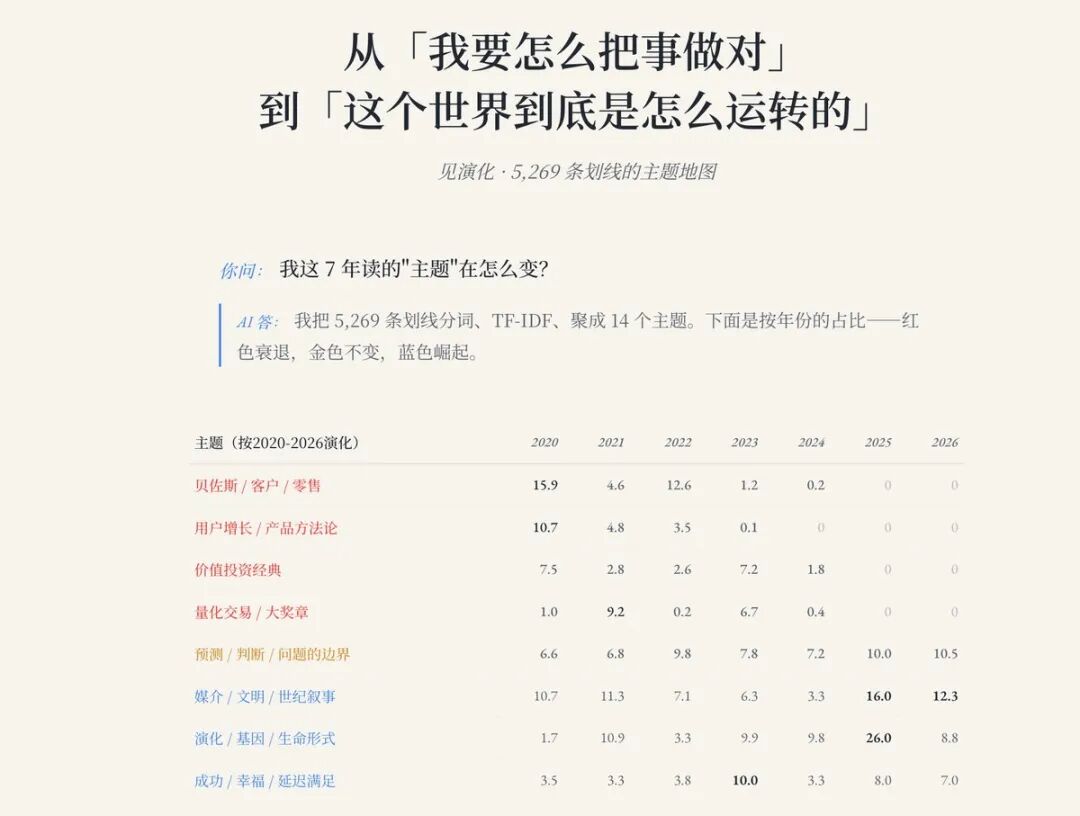
For example, the analysis of a 10-year WeRead user showed: business/customer/retail themes slid from a 15.9% share in 2020 all the way to 1.2% in 2023, while evolution/life-form themes rose from 3.9% to 26%. This is not just "the books changed" — it is "the questions changed".
How to Install
Option 1: Claude Code
Step 1, install the official weread skill:
Visit https://weread.qq.com/r/weread-skills and follow the guide to finish setup
Step 2, install the enhanced huashu-weread:
Visit https://github.com/alchaincyf/huashu-weread and install it following the instructions. Once installed, the original weread skill still runs underneath while huashu-weread orchestrates workflows on top; the two do not conflict.
Step 3, just speak plainly:
- "Recommend what I read next" -- automatically routed to advisor
- "I want to understand neuroscience" -- automatically routed to path
- "Organize my notes from Atomic Habits" -- automatically routed to alchemy
- "Write my reading retrospective for this year" -- automatically routed to review
Option 2: CLI
WeRead also provides an official CLI tool:
# Install the CLI
npm install -g weread-agent-cli

# Configure the API Key
weread config set-key "wrk-..."
Once the skill is installed, the agent knows how to call it — you can simply ask "which books have I read lately".
Who It's For
- Heavy readers who have used WeRead for years and want AI to review and organize their reading history
- Anyone who wants personalized book recommendations instead of cookie-cutter bestseller lists
- Anyone who wants to track how their reading interests and knowledge structure evolve
- Users of Claude Code or other AI Agent tools
Toolin Editorial Team
Categories
Related articles

CapCut AI Assistant Hands-On: Editing Video with Natural Language
CapCut has launched an AI Assistant feature. Batch editing, BGM addition, watermark removal, copywriting, and more can all be done through natural language, dramatically lowering the barrier to video creation.

Xingliu Image-2: An AI Design Whiteboard You Can Use Directly in China
Xingliu's Smart Image V2 supports batch asset generation, Edit Elements decomposition, text editing, HD upscaling, and more — think of it as a Chinese version of Lovart, usable directly in China.

329 GPT-Image-2 Prompt Templates: An Industrial-Grade Image Generation Engine
The open-source project awesome-gpt-image-2 reverse-engineered 329 GPT-Image-2 prompts into JSON/YAML structured templates, letting agents batch-generate images with zero hallucination.