
Corti
Voice and coding AI infrastructure for healthcare enterprises
Tool details
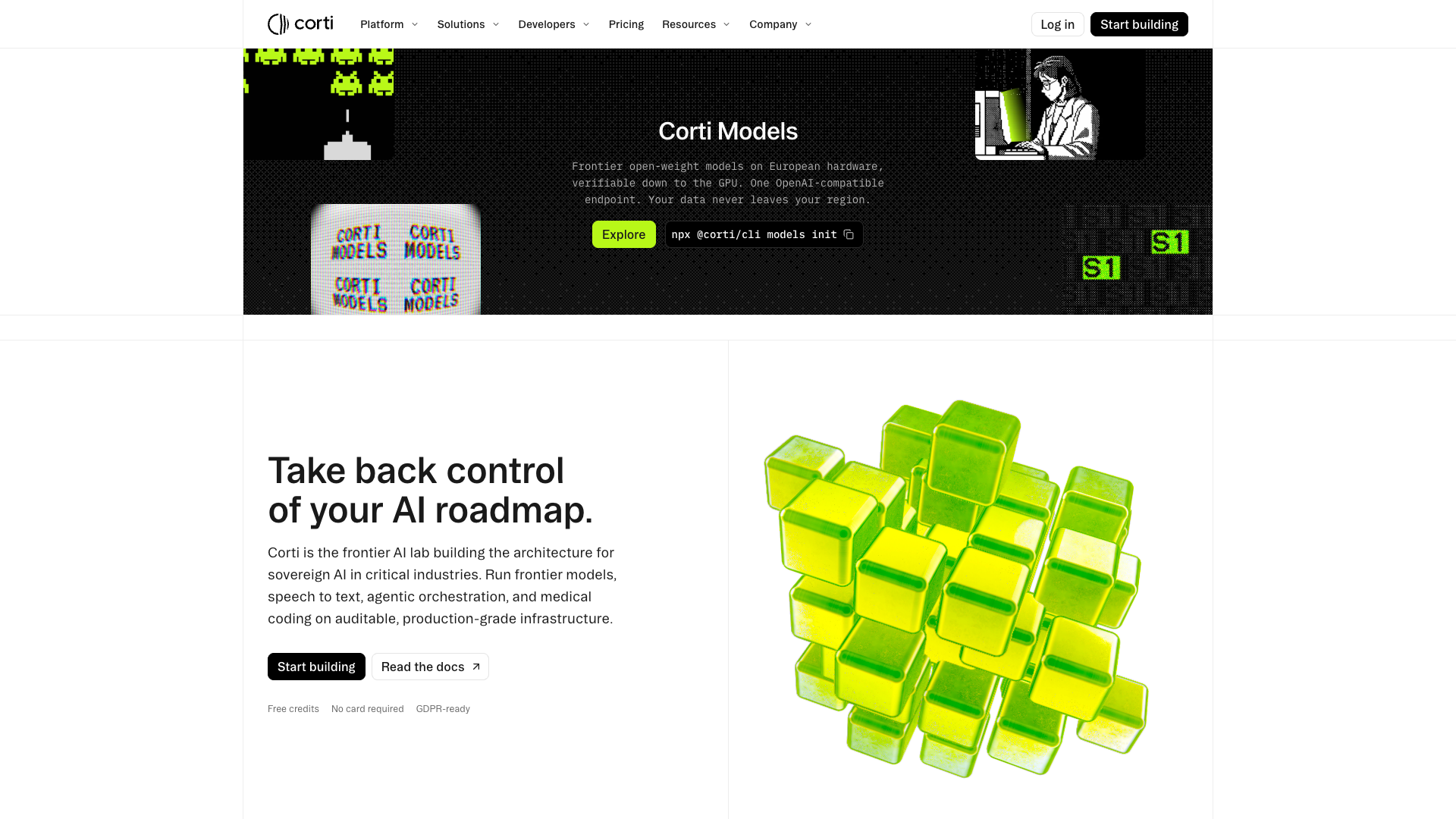
Corti is a next-generation vertical AI infrastructure for healthcare, built by a Danish team that packs speech transcription, clinical note generation, medical coding and agent orchestration into one set of APIs you can call directly. It does not sell a ready-made physician assistant; what it sells is the model and inference layer that EHR vendors and health-tech teams build their own products on, with unit prices you can budget for in advance.
Core capabilities
- Speech transcription: the same price for real-time and batch, suited to consultation recordings, call centers and dictation.
- Clinical note generation: templated long-form output plus a fact-alignment mechanism that compresses a conversation into a structured clinical record.
- Medical coding: outputs ICD-10, CPT and SNOMED codes with an evidence chain that traces back to the original sentence.
- Model API: OpenAI-compatible; corti-s1 supports million-token-scale context and image input, so migrating is mostly a matter of switching the endpoint.
- Agent orchestration: more than twenty prebuilt blueprints (triage, CDI, prior authorization), and you can also build your own orchestration layer.
Where it fits Aimed at EHR, virtual care and clinic management system vendors in Europe, and at public healthcare teams that need "data does not leave the region, unit prices can be budgeted" to appear in their procurement rationale. It is a poor fit for individual physicians who want an out-of-the-box scribe - the standalone entry point was folded into partner products long ago.
Distinctive strengths Self-serve signup is real, but the entry point is console.corti.app rather than the main domain, and once you hold a key you can get a call working end to end. Price transparency sits at the upper end of healthcare AI: minute pricing and token pricing are all public, and you can verify them yourself through unauthenticated endpoints. The research base is not thin either: the GIM method is open sourced, and its stroke-detection paper appeared in npj Digital Medicine.
Editorial take The website calls itself a "frontier AI lab", yet the official documentation discloses that corti-s1 is built on GLM weights and s1-mini on Qwen weights, that US-region traffic is actually served by OpenAI models hosted on Azure, and that the same model ID is not the same model across the two regions - this is its biggest gap between claims and evidence. Compliance follows the same pattern: MDR is a Class I self-declaration, with a UDI-DI but no notified body and no CE certificate number. Independent reputation is close to nonexistent as well: zero reviews on G2, and the only high score comes from a small-sample first review on KLAS. As an engineering and procurement choice it deserves four stars; as a "frontier lab" it earns only three.
Pricing
Subscription$0.0065/min (speech to text)free trial credits (amount not disclosed)same price for real-time streaming and batch
templated note generation with fact alignment
includes evidence-chain traceback for codes
million-token-scale context, cached input $0.20/M
dedicated capacity, custom limits and SLA; sales contact required
Additional notes
Neither the free-credit amount nor enterprise pricing is published on the website, so sales must be contacted; the free-credit figure from the old page has been withdrawn and should not be used for budgeting.
FAQ
User reviews
User Reviews
No reviews yet
No one has reviewed this tool yet