

Dust
Enterprise multi-agent human-AI collaboration platform
Tool details
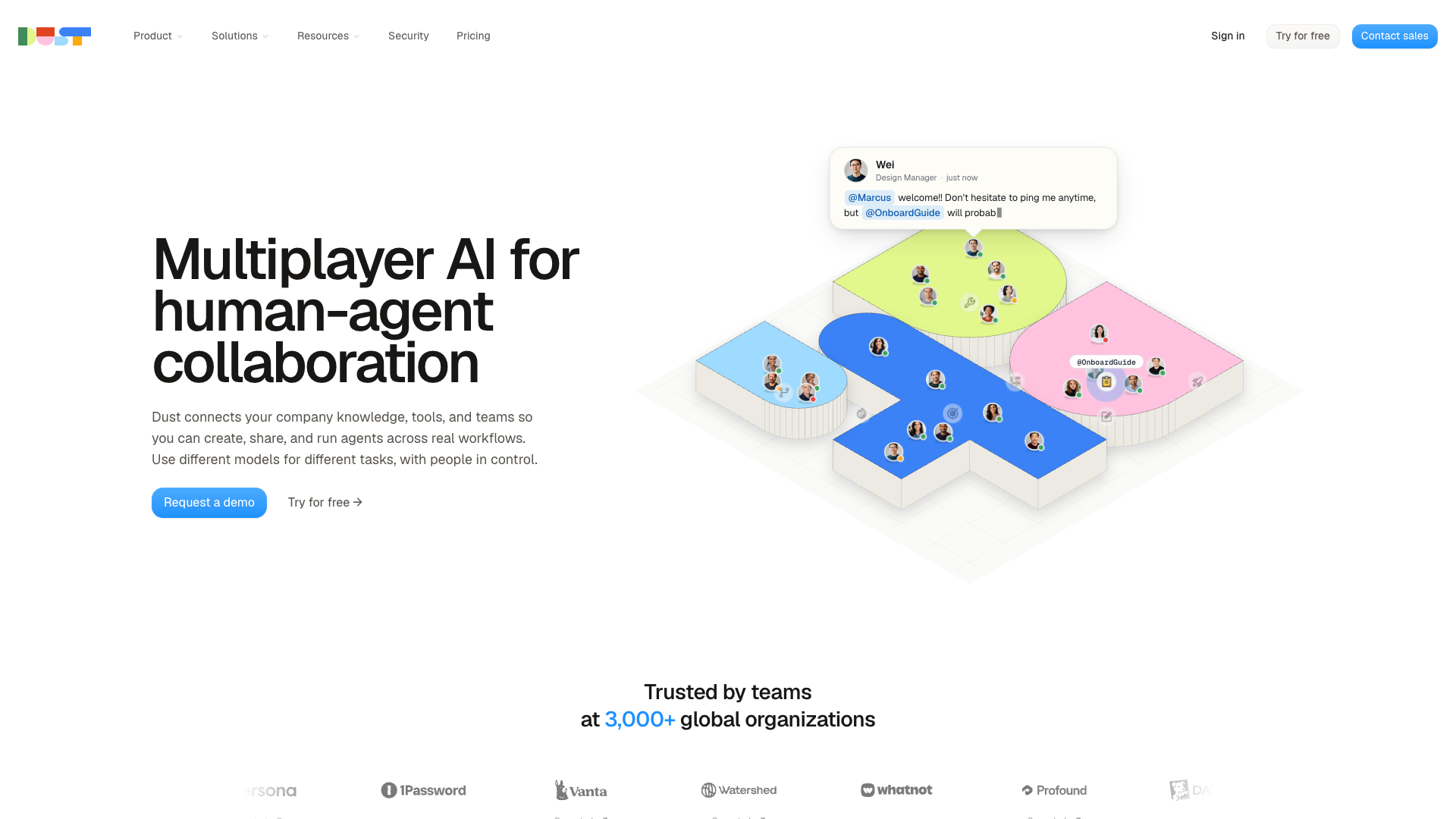
Dust is an enterprise multi-agent collaboration platform built by the Paris-based team Permutation Labs, centred on "Multiplayer AI": it puts people, Agents, company knowledge and tools into one governable shared workspace. It targets mid-size and large enterprises, letting Agents be grounded in company data, shareable and auditable, rather than acting as a single-point chat assistant. It is unrelated to the game, novel, messaging app and Web3 projects that share its name.
Core capabilities
- No-code Agent building: natural language + data sources + tools, published in minutes and shared across the team
- Multi-agent orchestration: schedule/event/Webhook triggers, with Agent outputs chained together
- Model neutrality + MCP: connects to 20+ frontier and open-source models, and tools can be integrated through MCP servers
- Collaboration primitives: Pods shared spaces, interactive Frames output, self-improving Skills/Memory
- Enterprise governance: permissions, audit logs, cost analytics, and replayable run inspection for debugging
- 70+ connectors: Slack, Notion, Google Drive, Salesforce and more (figures vary)
Where it fits Suited to Ops/Support/Sales/Marketing/Data teams building a grounded, shareable and governable Agent layer over internal knowledge; mid-size and large companies with roughly 5-500+ seats fit best. Individual users, or small teams that only need flat-rate billing, will find it heavy and expensive.
Differentiators Compared with Glean's company-wide search or Copilot's Microsoft stack, Dust's moat is multiplayer (shared human-Agent context) + model neutrality + MCP + European data residency and governance. It is not enterprise search - it has fewer connectors and replaces source-system ACLs with its own Space permission model.
Editorial take A distinctive position with strong compliance backing (Sequoia-led funding, SOC 2 Type II, GDPR), suited to a cross-departmental Agent layer in mid-size and large enterprises. Buyers should verify for themselves: dual credit + per-seat billing makes TCO hard to predict, the self-service tier has many limits, and the learning curve is steep; review samples are thin and the shared brand name adds noise, so we draw no conclusion about "concentrated praise or criticism".
Pricing
Freemium$0Official documentation states a 14-day free trial (a 15-day figure also appears). Cancelling during the trial immediately ends access; cancelling on a paid plan keeps access until the end of the current period and then downgrades to Free - all members except 1 admin are removed, and connections and synced data are deleted.500 one-time credits (no reset), up to 5 users / 3 connectors / 5 Spaces, no credit card required
8,000 credits/seat/month; discount sites also show a €24 figure (no cross-currency conversion)
8,000 credits/seat/month
40,000 credits/seat/month; discount sites also show a €120 figure
40,000 credits/seat/month
Pooled credits + volume tiers; SCIM / audit logs / single-tenant only on this plan
Additional notes
Currency is mixed USD/EUR: the official pricing page shows only the bare numbers 24/120 with no symbol; an older €29/seat/month flat system (unlimited fair use) and directory sites' "from $29" figures also exist, and no cross-currency conversion is applied. Credits reset monthly and do not roll over, and workflows stop outright beyond the overage cap; API usage is $0.01/credit; prices are Excluding VAT and annual billing saves about 20%. Connector counts are inconsistent (70+ / 100+ / 20+ / 50+ / 12).
FAQ
User reviews
User Reviews
No reviews yet
No one has reviewed this tool yet