
Aholo Viewer: A Browser for 3D Scenes with 1 Billion Gaussian Points
Manycore Tech open-sources Aholo Viewer, a 3D Gaussian browser with half the memory and 3x faster rendering, letting any device's browser smoothly load massive 3D scenes with 1 billion+ points.

Aholo Viewer: A Browser for 3D Scenes with 1 Billion Gaussian Points
Manycore Tech open-sources Aholo Viewer, a 3D Gaussian browser with half the memory and 3x faster rendering, letting any device's browser smoothly load massive 3D scenes with 1 billion+ points.
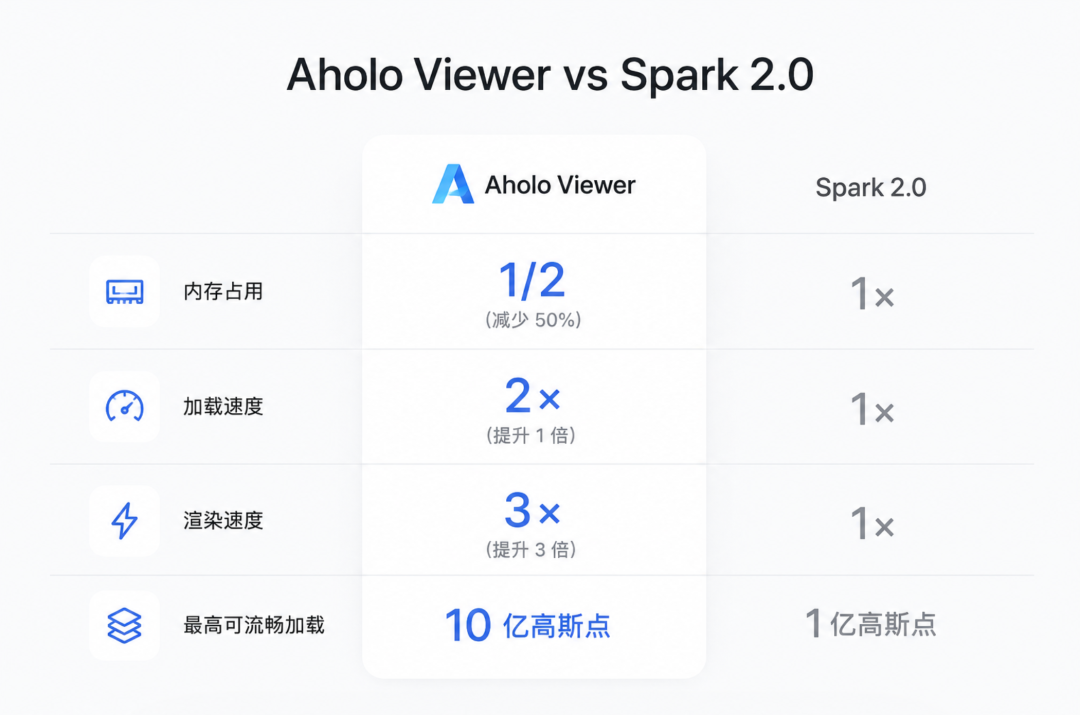
Manycore Tech has open-sourced the 3D Gaussian browser Aholo Viewer, which lets any device's browser smoothly load massive 3D scenes with 1 billion+ Gaussian particles. In performance tests, it uses only half the memory of Fei-Fei Li's team's Spark 2.0, renders 3x faster, and has a 10x higher capacity ceiling.
In plain terms: you can browse enormous 3D worlds in your browser as smoothly as scrolling videos.
- Homepage: https://aholojs.dev/zh-CN/
- GitHub: https://github.com/manycoretech/aholo-viewer
What Is Aholo Viewer
3D Gaussian Splatting (3DGS) is a major breakthrough in 3D vision in recent years: it reconstructs real scenes as billions of learnable 3D Gaussian ellipsoids for real-time rendering. But the problem has always been stuck at the "last hundred meters": how do you let ordinary people view them smoothly in a browser?
Aholo Viewer solves exactly this problem. It's a pure-Web 3DGS rendering engine — no software to install; open a browser and you can load and roam massive 3D scenes.
Core Performance Numbers
For a scene with 300 million Gaussian points, Aholo Viewer's desktop test data:
| Metric | Aholo Viewer | Spark 2.0 | Improvement |
|---|---|---|---|
| Memory usage | baseline | 2x | half the memory |
| Loading speed | baseline | 0.5x | 1x faster |
| Rendering speed | baseline | 0.33x | 3x faster |
| Max Gaussian points | 1 billion+ | 100 million | 10x higher ceiling |
Technical Approach Comparison
There are currently two mainstream LOD (Level of Detail) organizations for Web 3DGS rendering:
Spark 2.0 uses a Splat-based LOD Tree: merging bottom-up from the granularity of individual Gaussian splats. The upside is layer-by-layer detail loading; the downsides are heavy memory and VRAM overhead and weaker scalability.
Aholo Viewer uses a Chunk-based LOD Tree: the raw data is first cut into N chunks (data blocks), LODs at different levels are then generated per chunk, and level switching happens at chunk granularity at runtime.
The Chunk-based approach's two key advantages:
- More controllable overhead: level switching happens per chunk, so memory scheduling works at a coarser granularity with better cache hits
- Better scalability: chunks are clean data boundaries, making it easier to scale up to city-scale and block-scale scenes in the future
Rendering Pipeline Optimizations
Aholo Viewer applies multiple optimizations at the rendering-pipeline level:
- Multi-precision data structures reduce VRAM usage
- Cache pre-computation and on-demand passes compress per-frame GPU overhead
- Morton Sort and detail culling improve data access efficiency
Stack these optimizations together and they land on a set of numbers users can feel: half the memory, loading 1x faster, rendering 3x faster, and a capacity ceiling 10x higher.
Quick Start
Aholo Viewer is an open-source project and simple to use:
- Visit the GitHub repository to get the code
- Deploy locally or to a server following the README
- Import your 3DGS scene data (.ply / .splat formats supported)
- Open it in a browser and start exploring
You can also visit the online demo page directly to try it out.
Application Scenarios
- E-commerce product display: products go from static images to rotatable 3D scenes
- Online home and car tours: users roam real spaces right in the browser
- Online museum exhibitions: 3D interactive experiences blend into everyday browsing
- Digital twins: city-scale and building-scale 3D scenes rendered in real time in the browser
- UGC 3D content: ordinary users can shoot with a phone and generate shareable 3D scenes
License
Aholo Viewer is open-sourced on GitHub; see the repository for the specific license information. The project and Spark 2.0 (from Fei-Fei Li's World Labs) take different technical routes, together pushing 3D content toward the Web.