MiniMax M3: In the Front Rank of Chinese Open-Source Models
MiniMax M3 is the first Chinese open-source model to support 1M context, native multimodality, and coding at the same time, scoring 59% on SWE-Bench Pro with standout results in real testing.
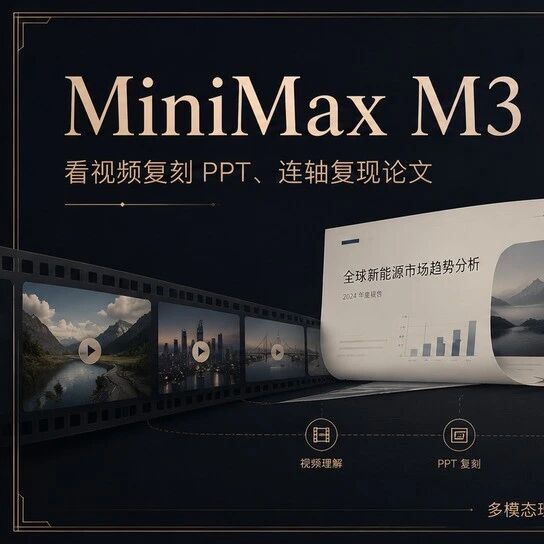
MiniMax M3: In the Front Rank of Chinese Open-Source Models
MiniMax M3 is the first Chinese open-source model to support 1M context, native multimodality, and coding at the same time, scoring 59% on SWE-Bench Pro with standout results in real testing.
MiniMax M3 is the first open-source model in China to do three things at once: 1M context, native multimodality, and Coding Agent. Before it, the only models that could run all three were the latest flagships from GPT, Claude, and Gemini — every one of them closed source. M3 cracked that open.
What Is M3
MiniMax M3 is the flagship open-source model from MiniMax, supporting:
- 1M context window: processes documents, code, and conversations of a million tokens in one pass
- Native multimodality: image-text mixed training from the very first step of pretraining, not a bolt-on vision module added later
- Coding Agent: scored 59% on SWE-Bench Pro, beating GPT-5.5 and Gemini 3.1 Pro
Launching alongside the model is MiniMax Code, a harness designed specifically for M3 that goes head-to-head with Claude Code.
Core Technology: MSA Sparse Attention
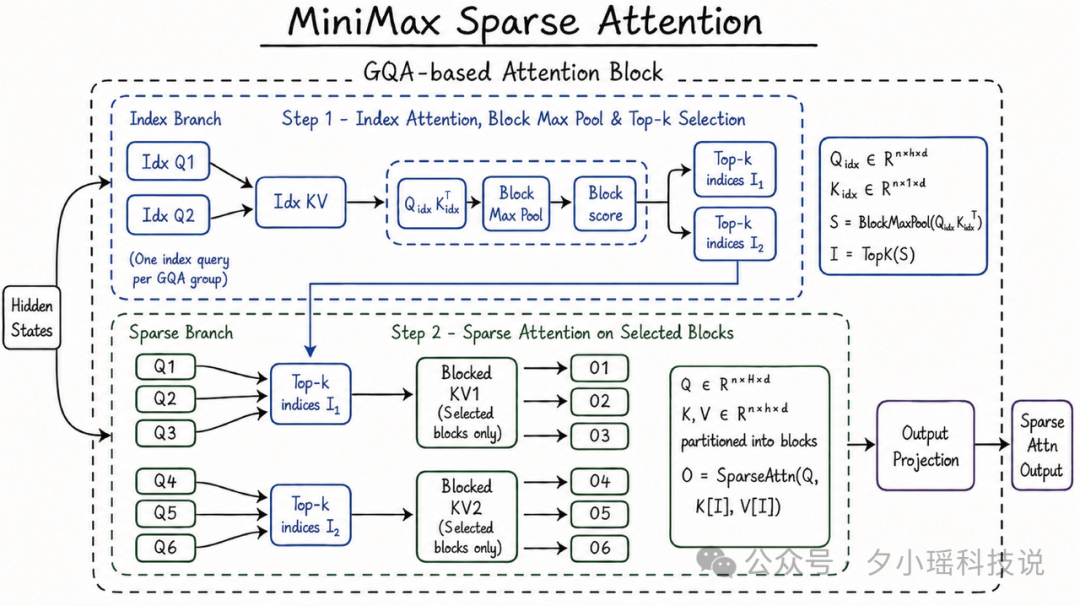
The key to M3's 1M context is a new attention mechanism — MiniMax Sparse Attention (MSA).
Under traditional attention, every character read gets compared against all characters before it. By the millionth character you're doing a million comparisons; double the text and compute quadruples.
MSA's approach uses KV blocks as the outer loop, so each block is read only once and memory access stays contiguous. Measured results:
- At 1M context, per-token compute is squeezed down to 1/20 of the previous generation
- Prefilling speeds up by more than 9x
- Decoding speeds up by more than 15x
Tested Scenarios
From Raw Video Assets Straight to a Website
Hand a bundle of assets containing videos, images, and documents to Claude Code hooked up to M3 and say only "use these materials as reference to build a company showcase page." M3 read the assets, wrote the code, tested locally, and deployed on its own. When a dirty server environment caused a 404, it tracked down the path problem and fixed that too. Delivered the finished product in 16 minutes.
Video Understanding to Slide Generation
Send a slide-tutorial video straight to MiniMax Code and say only "watch this video and teach me." M3 transcribed the actions in the video into a written SOP, extracting even fine details like "to merge shapes you have to select the rectangle first, then hold Shift and select the text — get the order wrong and the result is broken." It then went further and built the deck itself, delivered in half an hour.
Independently Reproducing an ICLR Paper in 12 Hours
Hand M3 a paper that won the ICLR 2025 Outstanding Paper Award and ask it to reproduce from scratch. M3 ran autonomously for nearly 12 hours, produced 18 commits and 23 experiment charts, got the core experiments running, observed the squeeze effect discussed in the paper, and validated the mitigation method.
Application Scenarios
- Long-document processing: swallow an entire paper or a complete codebase in one pass, no chunking
- Multimodal creation: video understanding, image analysis, and website generation done in one stop
- Code development: paired with MiniMax Code for long-horizon coding tasks, from requirements to delivery
How to Use It
MiniMax M3 is live and available through:
- MiniMax Code: M3's dedicated agent client, built to rival Claude Code
- API: OpenAI-compatible interface supported
- Token Plan: the mid-tier MAX plan comes in under 120 yuan, with usage worth roughly twice the $100 Claude MAX plan
Competitor Comparison
| Dimension | MiniMax M3 | Claude Opus | GPT-5.5 |
|---|---|---|---|
| 1M context | Yes | Yes | Yes |
| Native multimodality | Yes | Yes | Yes |
| Coding Agent | 59% (SWE-Bench Pro) | near Opus 4.7 | below M3 |
| Open source | Yes | No | No |
As an open-source model, M3 holds its own on overall capability and cost-effectiveness. For developers who need long context + multimodality + coding in one package, M3 is currently the only choice in the open-source ecosystem.