
Office Raccoon Desktop 2.0: Decoding Any Blogger's Methodology in 10 Minutes
Office Raccoon 2.0 supports custom Skills and Quick Bar quick actions; it can scrape and analyze WeChat official-account articles and output reusable writing frameworks
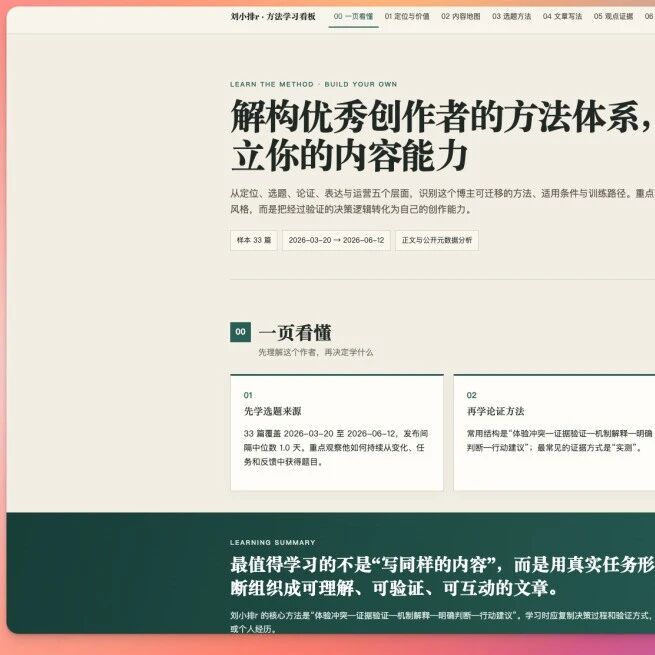
Office Raccoon Desktop 2.0: Decoding Any Blogger's Methodology in 10 Minutes
Office Raccoon 2.0 supports custom Skills and Quick Bar quick actions; it can scrape and analyze WeChat official-account articles and output reusable writing frameworks
Office Raccoon Desktop 2.0 is an AI office assistant from SenseTime that supports custom Skills, Quick Bar quick actions, and one-click generation of PPTs and web pages. This article shows how to build two practical Skills with it for batch-scraping official-account articles and breaking down viral-content methodologies.
Core Features
Custom Skill System
You can wrap your own workflows into Skills and add them to Office Raccoon. Just enter the Skill link under "Add Skill" to enable it.
Quick Bar (Cmd+K)
On desktop, press Cmd+K anytime to summon the Raccoon and process whatever you have selected, no window switching required. Select text and have the AI summarize, rewrite, or translate it — point and shoot.
Multi-Format Output
One-click generation of Feishu docs, PPTs, and web pages, covering the full pipeline from content production to sharing.
Hands-On Guide: Building Two Content-Analysis Skills
Step 1: Install the wechat-article-archive Skill
This Skill's job: drop in a WeChat official-account article link, and it automatically identifies the blogger, scrapes recent articles, and saves them as a Markdown archive.
Steps:
- Open Office Raccoon Desktop 2.0
- Go to "Add Skill" and enter the Skill link
- In the input box, enter this prompt:
Use wechat-article-archive to scrape the most recent 20 articles from '<article link>', then analyze them with author-methodology-analysis - Wait a few minutes and the system returns:
- Markdown archives of the articles (one folder per article, with body text and images)
- Image assets
- An article list
- A content methodology report
- A reusable copywriting-framework Skill
- A Feishu doc link
- A ZIP delivery package
- An HTML methodology dashboard
It scrapes 20 articles by default; adjust the count as needed.
Step 2: Understanding the Output Report
The report breaks the blogger's methodology down along these dimensions:
- Topic system: what topics the blogger picks and how they judge a topic's value
- Analysis framework: the logical structure and analysis path of the articles
- Judgment criteria: what content is worth writing and which angles are worth taking
- Expression templates: fixed phrasings for openings, transitions, and closings
- Case library: classic cases and supporting evidence cited again and again
- Quotable-line style: the sentence patterns behind highly shareable quotes
Step 3: Batch Analysis with author-methodology-analysis
If you already have local Markdown articles or Feishu docs, you can use this Skill directly for lightweight data analysis:
- Topic distribution, keywords, title patterns
- Article structure breakdown
- Quotable-sentence pattern extraction
- HTML report output
It also extracts a reusable skeleton from the author's content: topic scaffolding, title formulas, opening templates, paragraph phrasing, transition sentences, a quote generator — even a pre-publish checklist laid out for you.
💡 Tip: Learn the method, don't copy the answers. Learn how they pick topics, validate, structure, and review — but the experiences, resources, values, and voice have to be your own.
Quick Bar Tips
Select text in any app, then press Cmd+K:
| Scenario | Action |
|---|---|
| Summarize key points | Select paragraph -> Cmd+K -> "Summarize the key points" |
| Rewrite and polish | Select text -> Cmd+K -> "Make it more professional" |
| Generate a PPT | Select outline -> Cmd+K -> "Generate PPT" |
| Export to Feishu | Select content -> Cmd+K -> "Export as Feishu doc" |
| Generate a web page | Select content -> Cmd+K -> "Generate web page" |
Who It's For
- Content creators who want to decode and learn from viral bloggers' methodologies
- Operations teams that need to batch-analyze competitors' content strategies
- Social-media teams that need to generate and optimize content fast
- Anyone who wants to turn tacit know-how into reusable tools
Source: hands-on notes shared by Canghe
Toolin Editorial Team
Categories
Related articles

Kimi Work Adds Goal Mode and a Plugin Center, with 50% Off Quota in June
Kimi Work launches Goal Mode with 24-hour continuous autonomous operation and a new Plugin Center supporting Baidu Netdisk, DingTalk, Feishu, and other apps, with all task quota consumption halved in June.

Alibaba's HappyOyster 1.0: Create a World You Can Walk Into with a Single Sentence
Alibaba has released the world model product HappyOyster 1.0, which generates open worlds with real-time exploration and physics interaction from a single sentence, offering World Exploration and Real-Time Directing modes; the API is expected to open in early July.
GLM-5.2 Released as Open Source: 1M Context, No.1 Worldwide for AI Coding
Zhipu has released GLM-5.2 with a million-token context window, ranked first among globally available models on Code Arena, open-sourced under the MIT license so developers can deploy and use it commercially at will.

Kickart 3.0: Volcano Engine's Conversational Ad Video Creation Platform
Volcano Engine's Kickart 3.0 is live, supporting conversational video generation, viral-hit replication, Douyin e-commerce compliance pre-review, and Seedance 2.0 mini integration, helping merchants complete the entire marketing video creation workflow in one place.
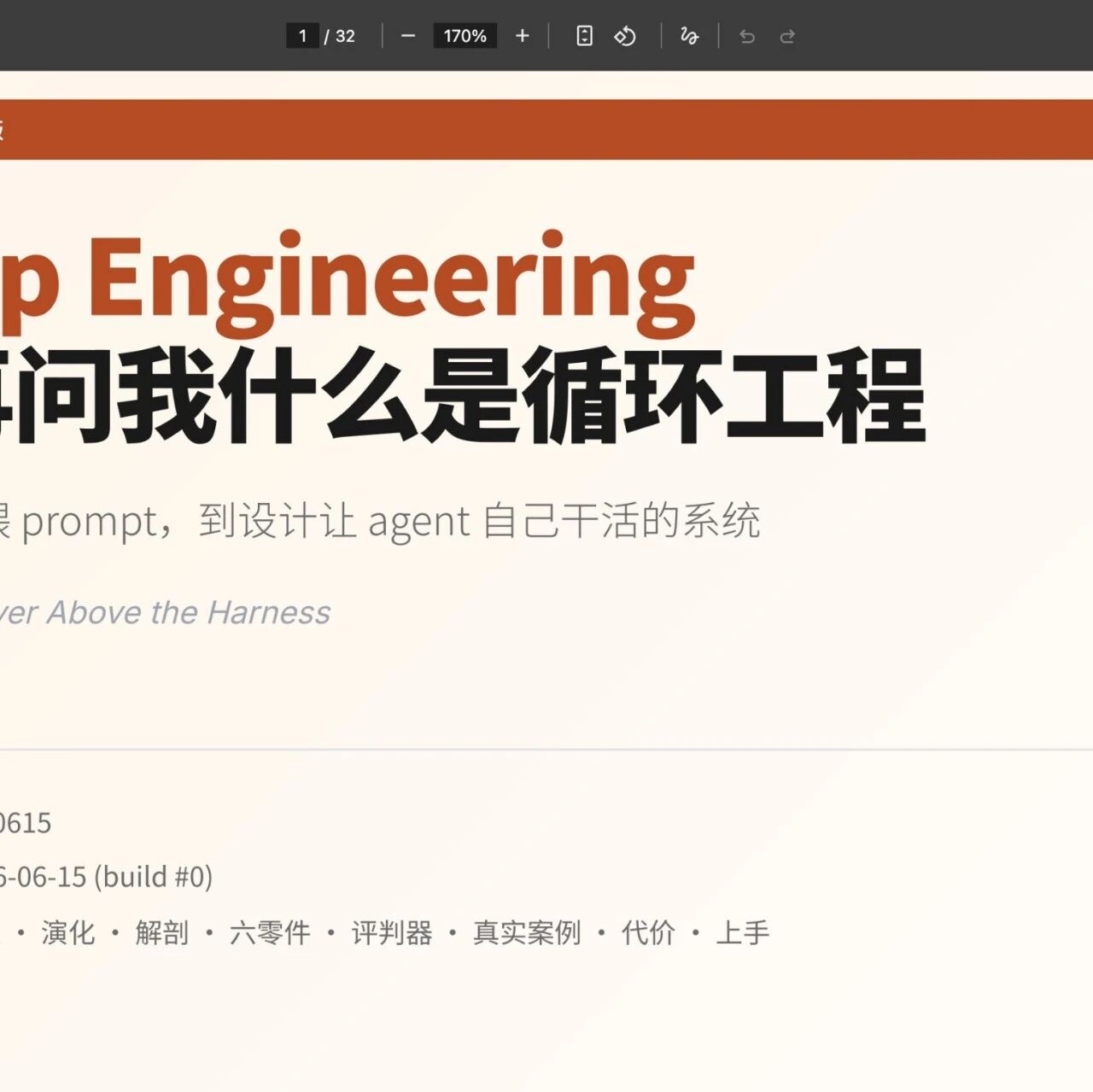
Loop Engineering in Practice: the 32-Page Orange Book, Free and Open Source
The Loop Engineering Orange Book systematically unpacks the concept of loop engineering, its five-step workflow and six core components, with hands-on Claude Code commands; free to read on GitHub and WeChat Reading.

UniRL: Tencent Hunyuan Open-Sources Its Multimodal RL Training Framework
Tencent Hunyuan's Pang Tianyu team has open-sourced UniRL, a single framework covering reinforcement learning training for image, video, and LLM multimodal generative models, supporting mainstream models like SD3, HunyuanVideo, and Qwen.