Volcano Engine's Full Agent Infra Upgrade: The 1+N+X System, AgentKit, and ArkClaw Enterprise
From the Seedance 2.0 moment to enterprise-grade Agent infrastructure, Volcano Engine uses the 1+N+X system, AgentKit, and ArkClaw Enterprise to move Agents from personal tools into organizational workflows for real.

Volcano Engine's Full Agent Infra Upgrade: The 1+N+X System, AgentKit, and ArkClaw Enterprise
From the Seedance 2.0 moment to enterprise-grade Agent infrastructure, Volcano Engine uses the 1+N+X system, AgentKit, and ArkClaw Enterprise to move Agents from personal tools into organizational workflows for real.
Once enterprises push Agents from "piloting one or two" to "systematic deployment," the question shifts from "is the model strong enough" to "is the infrastructure stable enough." At Volcano Engine's FORCE conference on June 23, 2026, a string of announcements all pointed at the same thing: building Agent-Ready infrastructure for the enterprise. This piece won't dwell on how striking Seedance 2.0's video generation is; instead it breaks down three things from an engineering angle — how the 1+N+X system manages digital employees, how AgentKit makes Agents reliable, controllable, and measurable, and how ArkClaw Enterprise wires Agents into real business processes.

A Strong Model Is Just the Entrance; Production Is the Dividing Line
Volcano Engine president Tan Dai was blunt at the conference: "For AI cloud providers, people buy from you because of the models." A strong-enough model (like Seedance 2.0, the first genuinely SOTA Chinese model to burst onto the scene) becomes the cloud's entrance on its own — customers calling APIs or plugging it into video/advertising/film/industrial simulation pipelines all flow toward Volcano through the model.
But once the model enters production, the deciding factor moves: can it enter real workflows, can real demand feed back into iteration, can it become a service the enterprise can call directly. This conference gave its largest share of airtime to the cloud products, Agent tooling, and safety systems built around the model.
1+N+X: Bringing Enterprise Agents Under One Architecture
Volcano Engine VP Zhang Xin's core argument: what enterprises need is not a few isolated Agents but a full product matrix serving different roles and departments, all working in concert.
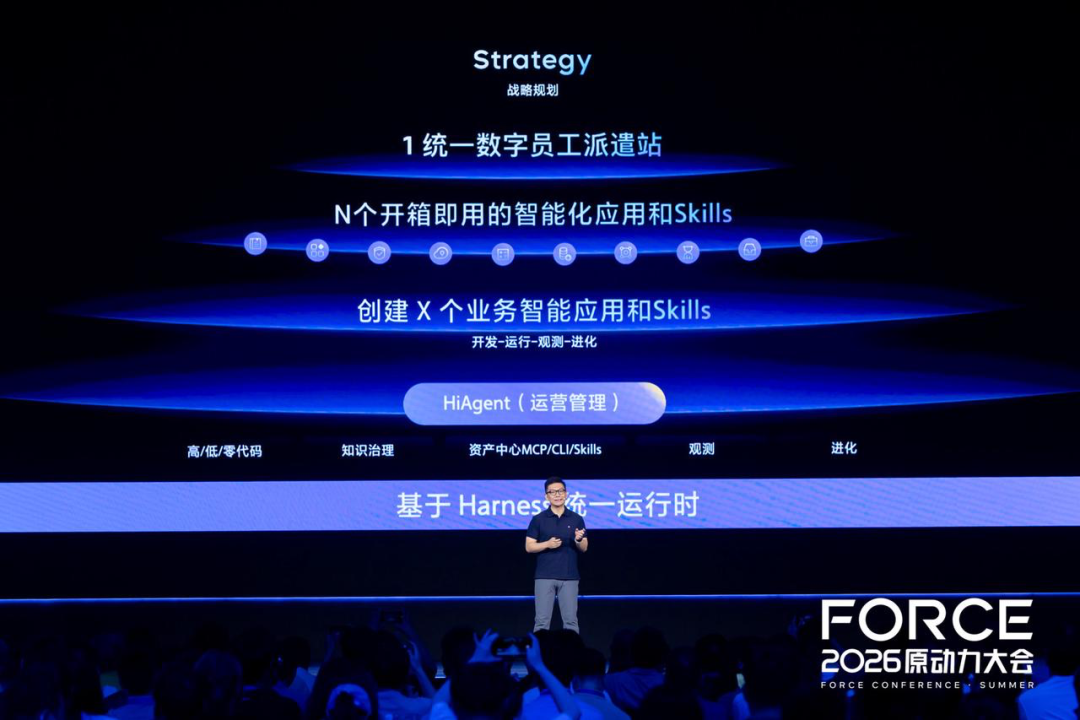
- "1": the AgentSphere digital-employee dispatch station, bringing all digital employees into one system for management and measurement
- "N": a set of out-of-the-box intelligent applications covering common enterprise needs
- "X": unlimited, continuously evolving business-specific intelligent applications — enterprises keep creating, running, observing, and optimizing their own digital employees on TRAE, Coze, and HiAgent
This system has landed in finance, manufacturing, energy, telecom, education, research, automotive, internet, and other industries. Three Agent development-and-operations products were upgraded alongside it:
TRAE Enterprise: From Writing Code to "Agentic Engineering"
On TRAE's own development, 94% of the code is now contributed by AI. The new TRAE Enterprise ships TRAE Work, and the core changes are two "ones": one account that moves naturally between TRAE IDE (professional developers) and TRAE Work (office collaboration), and one console that centrally manages knowledge bases, MCP, and security policies. Security and compliance defenses are built at three layers — transport, storage, and compute.
Case - AsiaInfo × TRAE: with a private knowledge base, multi-Agent orchestration, and a productivity-measurement flywheel, AsiaInfo scaled from a seed team to thousands of developers within months — about 1.8 hours saved per person per day (over 400 hours per person annualized), a 42% rise in code contribution rate, a 35% drop in defects per thousand lines of code, and an end-to-end development lifecycle shortened by about 15%.
Coze 3.0: Multi-Client Sync and Knowledge Reuse
Coze 3.0 connects mobile, web, and desktop clients with real-time sync, and distills industry knowledge into expert skills that can be invoked directly.
Case - GF Securities × Coze: high-frequency financial capabilities — financial comparisons, ETF screening, dragon-tiger lists, fund auto-invest, F10 company snapshots — were distilled into standardized professional Skills, turning AI from scattered point tools into capability packages that multiple roles can call on demand.
HiAgent 3.0: Full-Lifecycle Management for Digital Employees
Per an IDC report, HiAgent already holds first place in both private-deployment market share and product capability in the enterprise agent platform space. HiAgent 3.0 builds a three-layer "develop-run-manage" loop: the development domain supports high/low/zero-code collaboration; the runtime domain introduces a dual-mode "autonomous + orchestration" engine with a Learning Loop evolution mechanism that auto-corrects execution drift; the management domain upgrades from "managing Agents" to full-lifecycle operations for digital employees — "recruit, onboard, evolve, offboard."
Case - A major automaker × HiAgent 3.0: bringing scattered marketing Agents under unified management through AgentSphere with coordinated linkage, deployment compressed campaign preparation from 4 weeks to 5 business days, lifted overall efficiency about 3.5x, and made digital-employee performance and ROI visible.
AgentKit: Making Enterprise Agents "Reliable, Controllable, Measurable"
Tian Taotao, head of Volcano Engine's cloud infrastructure products, put it this way: what enterprises really need to build is Agent-Ready infrastructure — providing runtime environments, system connectivity, identity and permissions, observability and evaluation, and security governance. AgentKit is that unified production base.
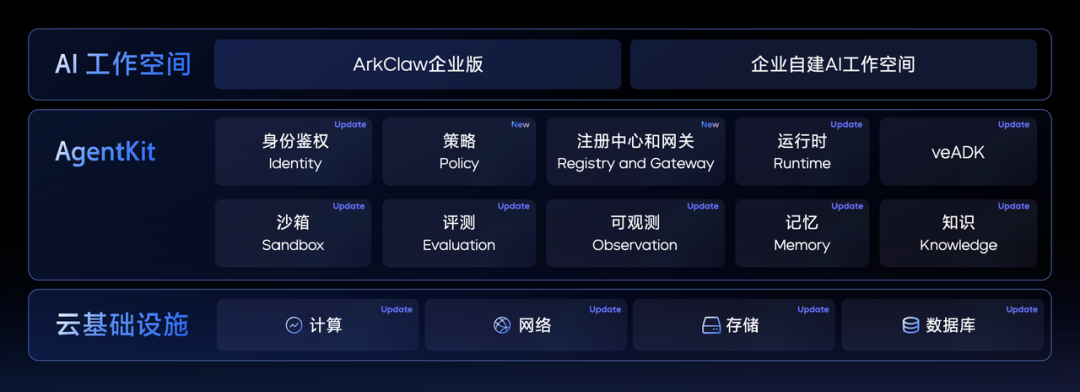
AgentKit is organized around three questions:
- Reliable: through Runtime, Gateway, Memory, and Knowledge, Agents run stably, keep understanding context, and connect to enterprise tool systems
- Controllable: through Identity, Policy, Guardrails, and Sandbox, Agents execute tasks within explicit identity/permission/policy/isolation boundaries
- Measurable: through Evaluation and Observability, an Agent's grounds, process, and results can be verified, observed, audited, and continuously improved
A few engineering capabilities worth calling out on their own:
Identity becomes the foundation of trust. AgentKit Identity is already connected to thousands of enterprise identity systems, supporting Lark, DingTalk, WeCom, custom SSO, and OAuth/OIDC/SAML. The key is chained identity propagation — an Agent no longer simply inherits all of the user's permissions, but completes tasks within an explicitly authorized least-privilege boundary: trusted identity, clear permissions, controllable behavior, secure keys, and a fully auditable chain.
The cloud sandbox supports 120,000 concurrent sandboxes within minutes, letting enterprise Agents "run concurrently by the tens of thousands" for large-scale evaluation, inference tasks, office automation, and long-horizon execution.
One command to onboard mainstream runtimes. Unified collection plugs into Claude Code, OpenClaw, Hermes, and more with one click, uniformly capturing Agent decisions, tool calls, and MCP call data; when tasks slow down, calls fail, or costs spike, you can quickly locate the failing layer and get root-cause hypotheses; online traces, sessions, failure cases, and user feedback automatically accumulate into new evaluation samples, so the Agent gets better the more it's used.
ArkClaw Enterprise: Wiring Agents into Real Business
On top of AgentKit's production base, ArkClaw Enterprise is the best practice built on it — an integrated, out-of-the-box Agent platform that brings Agents from personal tools into organizational workflows. Three capabilities:
- Out of the box: employees reach the Agent plaza, skill center, AI Search, shared Claw, and enterprise knowledge base through an IM or web Agent workbench
- Deep integration: AgentKit's Registry brings the enterprise's scattered Agents, Skills, MCP servers, and apps onto one platform — "register once, discover everywhere"; the enterprise knowledge center uniformly connects documents, databases, code repos, CRM, and tickets, distilling them into Agent Context that is cited and traceable
- Unified governance: IDP/SSO/OAuth plus Lark, DingTalk, and WeCom IM entry points; personal Agents respect authorization boundaries, team Agents respect Workspace isolation, and enterprise Agents support approval-gated access with full-chain auditing
In the Field: Agents Entering Workflows and Smart Devices for Real
- Seres: embedding ArkClaw into employees' daily workflows, building role-specific AI Agent capabilities across R&D, production, supply, sales, and service
- Haidilao: building store-operations Agents on ArkClaw covering regional coordination, task follow-up, and inspection archiving — hour-level work compressed to minutes, manual follow-up time cut 70%, store inspection satisfaction up 50%
- Skyworth Coocaa: building the AIOS home smart operating system on ArkClaw Device Edition, cutting token consumption 50% while supporting intelligent upgrades for millions of devices
The One-Sentence Summary
What Volcano Engine delivered this time isn't a point tool but an infrastructure answer for enterprise Agents: the 1+N+X system manages digital employees, AgentKit lays the base that makes Agents reliable, controllable, and measurable, and ArkClaw Enterprise wires Agents into the real business processes of sales, legal, R&D, and operations.