
AI Video Commerce in Practice: 3 Yuan of Compute Turning into $50,000 GMV
The complete zero-to-seven-figure AI TikTok commerce playbook, including a Sora 2 model comparison, the viral-hit reverse-engineering method, a parameterized batch production workflow, and three hard lessons that cost over 100,000 yuan.

AI Video Commerce in Practice: 3 Yuan of Compute Turning into $50,000 GMV
The complete zero-to-seven-figure AI TikTok commerce playbook, including a Sora 2 model comparison, the viral-hit reverse-engineering method, a parameterized batch production workflow, and three hard lessons that cost over 100,000 yuan.
An 8-second AI-generated product recommendation video, with compute costs under 3 yuan, drove over $50,000 in GMV after being linked to a product. This isn't a made-up story — it's real data a team produced over more than half a year. This tutorial lays out their complete playbook, including the lessons from losing over 100,000 yuan along the way.
What You Need Before Starting
- Tools needed: Sora 2 (or Grok / Veo 3 and other video generation models), image reference sites, Excel
- Platform needed: a TikTok cross-border e-commerce account
- Estimated cost: 0.5-15 yuan per video (depending on the model)
- Who it's for: cross-border e-commerce practitioners and short-video sellers
The Three-Step Process That's Easiest to Get Working
This is the simplest approach the team used to land their first sales, and it still works today.
Step 1: Find Real Material for Reference
Search for material on overseas image sites. Search trick: add iPhone after any keyword, and everything that comes back is real, shot-on-a-phone lifestyle imagery. For example, searching skincare iPhone returns selfies Americans took in front of their bathroom mirrors, not polished ad shots.
Use images like these as AI reference images, and the generated content won't read as AI at a glance.
Step 2: Reverse-Engineer the Prompt Parameters
Feed the real UGC images you found to a large model and have it break them down into structured prompts:
- Character features
- Scene description
- Lighting
- Composition
- Camera angle
No need to write prompts from scratch — extract them in reverse from proven viral material.
Step 3: Swap the Product, Generate the Video, Attach the Listing
Swap in your own product in the prompt, turn the image into a video, attach the product link, and publish.
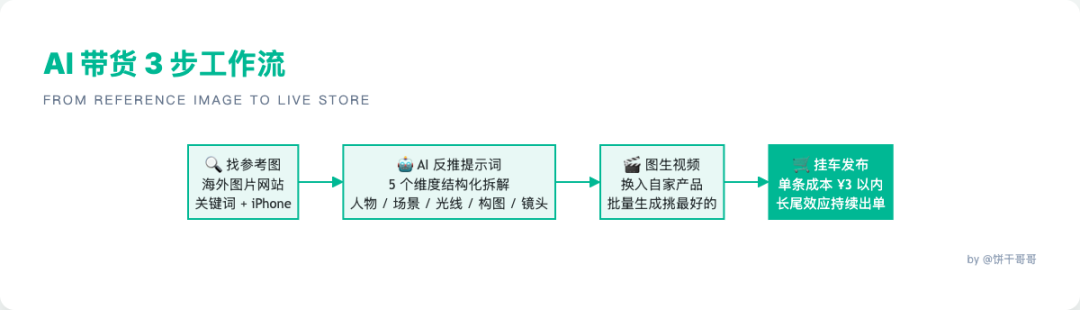
Just these three simple steps, and sales came in the first week. Each video costs less than 3 yuan in compute, and one person can produce dozens a day.
Three Lessons That Cost Over 100,000 Yuan
Lesson 1: 60/100 Product Consistency Is Good Enough
The team spent two months training LoRAs just to make the AI-generated product pixel-perfectly match the real item. They invested enormous time and compute, and not a single video took off.
Then it clicked: TikTok users scroll onto your video with zero expectations and decide whether to buy within 20 seconds — they aren't scrutinizing how closely the product matches. Product consistency at 60 out of 100 is enough; pour all the remaining energy into emotional hooks.
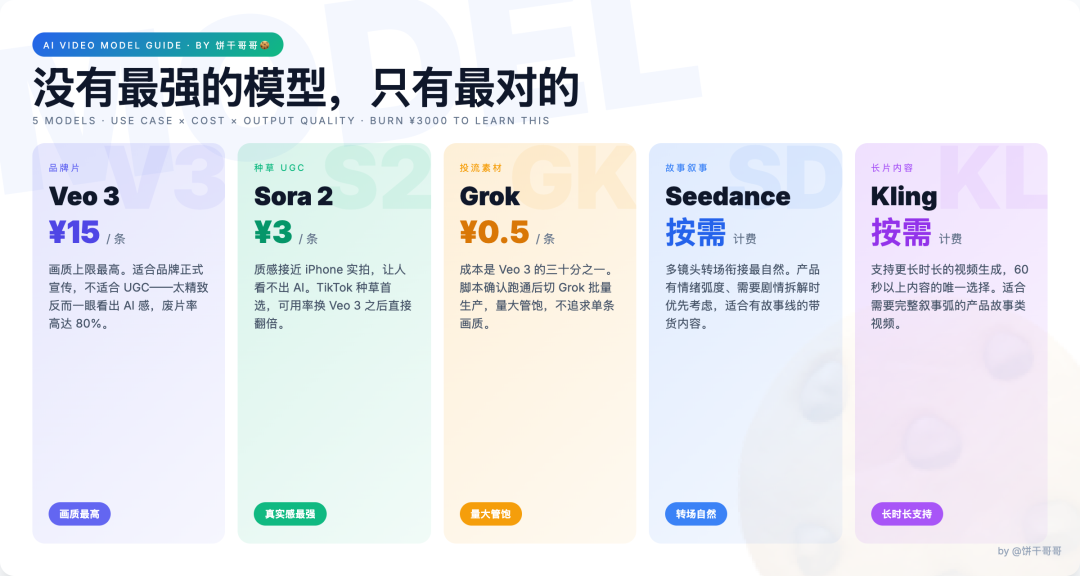
Lesson 2: Picking the Wrong Model Burns Money 30x Faster
| Use case | Recommended model | Cost per video | Why |
|---|---|---|---|
| Brand films | Veo 3 | ~15 yuan | Highest visual quality, fits formal promotion |
| Product UGC | Sora 2 | ~3 yuan | Most realistic, high usable rate |
| Ad traffic material | Grok | ~0.5 yuan | Cheapest, high volume |
| Storytelling | Seedance | Moderate | Natural transitions, fits narrative content |
| Longer videos | Kling | Moderate | Supports longer durations |
There's no single strongest model, only the most fitting one. Veo 3 has great visual quality but an 80% reject rate, because the footage doesn't look like it was shot by a real person. Sora 2's usable rate doubles outright, because the imagery is closer to the texture of real iPhone footage.
Lesson 3: Two Months of Persona Accounts, Zero Sales
The team started with AI persona accounts, convinced that building followers was the right path. Two months later, they had gained over three thousand followers and made zero sales. After switching to product recommendation videos, they made sales in the first week.
TikTok works on completely different logic from Douyin -- users don't chase IPs, they chase products.
The Core Methodology, Learned the Hard Way
The methodology distilled after the losses: find benchmarks -> break them down -> multiply.
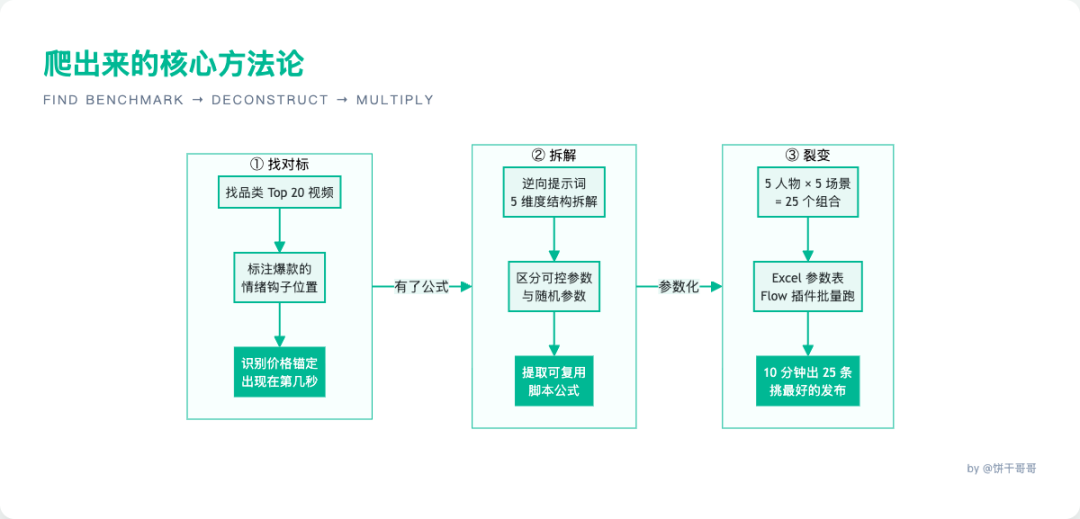
Step 1: Reverse-Engineer Viral Hits
Take a viral video and use the following prompt to break it down into 5 dimensions:
You are a short-video structure analysis expert. Break the video down into its smallest units:

1. Camera language: shot size, angle, camera movement, time allocation
2. Scene design: environment, lighting, prop placement, everyday-life elements
3. Subject actions: character behavior, product interaction, pacing of movements
4. Emotional rhythm: the emotional design of each second (which second the hook lands, which second the payoff hits)
5. Sound design: voiceover/spoken lines, background music, ambient effects

For each dimension, mark the "controlled parameters" and the "random parameters".
Controlled parameters must be specified precisely (e.g., shot size, actions),
random parameters are left for the model to improvise (e.g., background details, lighting tweaks).
Step 2: Parameterized Batch Production
Split the breakdown results into variables and constants. Constants stay fixed (the product's white-background image, shot size, composition); variables change (character, scene, action).
5 characters x 5 scenes = 25 combinations, written into an Excel parameter sheet and run in batch. Each row is one task, with only three inputs:
Column 1: task type (text-to-image / image-to-image / image-to-video)
Column 2: prompt
Column 3: reference image number
25 outputs in 10 minutes; pick the best from them.
Step 3: For Video Generation, Control Only Three Things
Camera description, scene changes, subject changes. Everything else goes to the model. Prompt scaffold:
[Sound]: voiceover + American English + female
[Camera]: close-up/close shot/medium shot + overhead/eye-level
[Scene]: kitchen counter / bathroom mirror / living room sofa
[Subject]: the specific action of the person holding the product
Core mindset: don't try to control the AI — amplify its predictions. Generating 20 images and picking 5 is 10x more efficient than grinding on 1 image through 20 rounds of tweaking.
FAQ
- Will TikTok ban AI videos: The platform currently doesn't explicitly prohibit commerce videos with AI-generated content; content quality is what matters
- How long is the payout cycle: TikTok's payout cycle is usually several dozen days, so you need sufficient cash flow
- How much of the $50,000 do you actually keep: After platform cuts, logistics, returns, and commissions, you keep roughly one fifth
- How long should you test a product: Test at most 3 scripts per product, with 10 videos per script. If none of the 3 scripts converts, switch products
The Endgame of Competition
When the cost of AI video production approaches zero and everyone can do it, competition is no longer about "who produces more." The answer is "whose scripts are better than everyone else's." Behind every script are the creator's life experience, aesthetic instincts, and judgment of user emotion. With the same tools and SOPs, different creators' viral rates differ by 3-5x.
In the AI era, the most valuable assets aren't tools or traffic — they're the prompt asset library, the viral script library, and the product-category selection data you accumulate through real practice.
Toolin Editorial Team
Categories
Related articles
Major Claude Design Update: One-Click Design System Import and Two-Way Code Sync
Anthropic has shipped a major Claude Design update with design system import, two-way /design-sync and /design code sync, and one-click export to 9 platforms.

GLM-5.2 Open Source, Put to the Test: On the Same Level as Opus 4.8 and GPT 5.5
GLM-5.2 is the first Chinese open-source model to enter the new "Big Three", with 1M long context and coding ability close to closed-source flagship level, MIT-licensed and ready to use.

Kimi Work Adds Goal Mode and a Plugin Center, with 50% Off Quota in June
Kimi Work launches Goal Mode with 24-hour continuous autonomous operation and a new Plugin Center supporting Baidu Netdisk, DingTalk, Feishu, and other apps, with all task quota consumption halved in June.

Alibaba's HappyOyster 1.0: Create a World You Can Walk Into with a Single Sentence
Alibaba has released the world model product HappyOyster 1.0, which generates open worlds with real-time exploration and physics interaction from a single sentence, offering World Exploration and Real-Time Directing modes; the API is expected to open in early July.

GLM-5.2 Released as Open Source: 1M Context, No.1 Worldwide for AI Coding
Zhipu has released GLM-5.2 with a million-token context window, ranked first among globally available models on Code Arena, open-sourced under the MIT license so developers can deploy and use it commercially at will.

Kickart 3.0: Volcano Engine's Conversational Ad Video Creation Platform
Volcano Engine's Kickart 3.0 is live, supporting conversational video generation, viral-hit replication, Douyin e-commerce compliance pre-review, and Seedance 2.0 mini integration, helping merchants complete the entire marketing video creation workflow in one place.