Binah.ai
A health data SDK that measures vital signs with a smartphone camera
Tool details
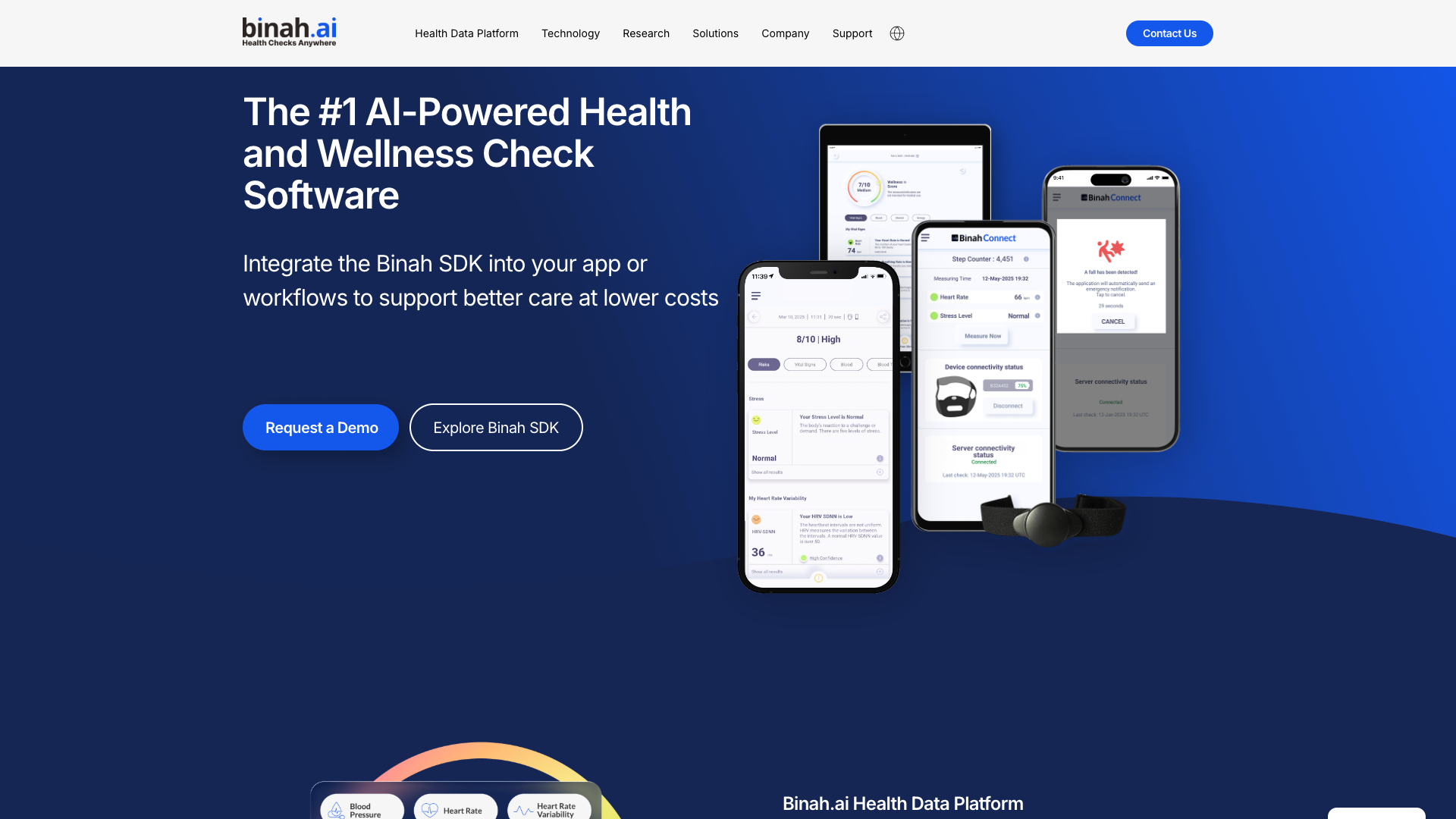
Binah.ai turns the front-facing camera of a phone, tablet, or laptop into a vital-signs sensor: a 35-to-60-second face video yields heart rate, blood pressure, blood oxygen, respiratory rate, HRV, and more than 14 metrics in total, sold as an SDK to insurers, corporate wellness programs, and remote monitoring platforms.
Core capabilities
- On-device rPPG measurement: vital signs, chronic-disease risk, and stress index in a single pass
- Layered algorithms: neural networks handle face and skin region detection, posture and lighting feedback, and frame-level signal quality checks, while waveform reconstruction and metric derivation run through deterministic signal processing
- Multi-platform SDK: 5 platforms, namely iOS, Android, Web, Flutter, and React Native; the Web build is multi-threaded WASM and can measure offline
- On-device privacy: no video stored, no facial features stored, no PII collected, and Binah.ai cannot access measurement results
- Continuous monitoring: Binah Connect with a Polar Verity Sense armband supports 3 to 120 minutes of continuous capture
- Metered licensing: per-session or per-active-device quotas, enforced by a license server built into the SDK
Use cases Built for B2B buyers that already have an app or web presence: insurance underwriting and dynamic underwriting, corporate wellness benefits, remote patient monitoring, virtual clinical trials, elder care, and hardware such as smart mirrors and vehicles. Individuals who just want to check their own blood pressure, and indie developers looking for a quick trial, are outside its scope.
Unique strengths The breadth of metrics is rare in this category: most competitors cover 5 to 8, while Binah.ai covers vital signs, chronic-disease risk, and stress in one pass. Processing is truly on-device rather than cloud inference, which saves compute and suits GDPR and HIPAA settings. The weaknesses are just as clear: accuracy figures are self-reported, and the pass thresholds are looser than ISO 81060-2.
Editor's take Worth recommending to enterprises that need low-cost, bulk, non-diagnostic vital-sign capture; the architecture and documentation quality are top-tier for this niche, and ISO 13485 signals a solid quality system. The trade-offs are real: harsh lighting requirements (≥400 lux cool light, a stand at 30 cm, and a 3-minute wait after measuring), an age prior baked into blood-pressure calculation, no FDA 510(k), and contract terms that bar public disclosure of benchmark results. The upgrade path is to book a Demo and run Binah Check, then negotiate licensing by active users or call volume.
Pricing
Custom pricingCustom (quote on request)Binah Check can be tried through a booked Demo, with no public free tierTiered by active users and call volume; a quote follows a booked Demo
Additional notes
In 2022, media cited the CEO's older framing: about $30 per user per year at 10K users, about $12 at 100K users, and about $1 at 50M users. These are the old framing, not current list prices. Current metering is per session (Sessions License) or per active device per month (Active Users License), and pricing requires a quote.
FAQ
User reviews
User Reviews
No reviews yet
No one has reviewed this tool yet